A paralleling controller for governor-based load sharing
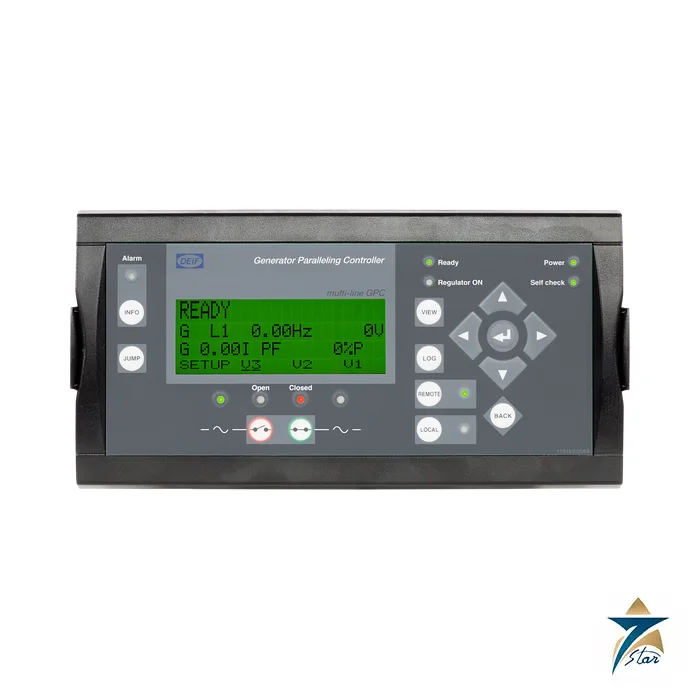
The DEIF GPC-3 is a Generator Paralleling Controller from the Multi-line 2 family for synchronising and load sharing diesel generator sets. Four regulation modes are selected through digital inputs on the standard unit and the governor is controlled accordingly: fixed frequency, fixed power (base load), frequency droop and load sharing. When the controller also drives the automatic voltage regulator, it adds fixed voltage, fixed var, fixed power factor, reactive load sharing and voltage droop; AVR control requires option D1.
Technical specifications
| Parameter |
Specification |
| Manufacturer / series |
DEIF A/S, Multi-line 2, GPC-3 Diesel |
| Variants |
06 GPC-3 Flex with display plus A1, D1, J1 (2912010030-06); 07 without display plus A1, D1 (2912010030-07); 08 without display (2912010030-08); 09 GPC-3 Flex with display plus J1 (2912010030-09) |
| Measuring voltage |
100 to 690 V AC (+/-20 percent); 600 V AC for the UL/cUL listing |
| Measuring current |
-/1 A or -/5 A input; 4 x In continuous, 20 x In for 10 s |
| Frequency |
30 to 70 Hz |
| Auxiliary supply |
Two 12/24 V DC inputs, 8 to 36 V; 11 W max on terminals 1-2 and 5 W max on 98-99 |
| Analogue load sharing lines |
-5 to 0 to +5 V DC, impedance 23.5 kohm |
| Analogue outputs |
0(4) to 20 mA and +/-25 mA, galvanically separated |
| Relay outputs |
250 V AC / 30 V DC, 5 A |
| Mounting and protection |
Rail or base mounting; IP20 unit; display IP40, or IP54 when fitted with the option L gasket |
| Operating temperature |
-25 to 70 °C, reduced to 60 °C when option N is fitted; up to 4000 m altitude |
| Weight |
1.6 kg unit; 0.4 kg display |
| Approvals |
UL/cUL Listed (UL508); UL/cUL Recognized (UL2200); VDE-AR-N-4105 compliant |
| Document |
Data sheet 4921240351N (EN), 16 pages |
Load sharing and engine control
Standard load sharing uses analogue lines without supervision, so DEIF recommends the optional CANshare feature (option G9) where wire break and short circuit on the load sharing lines must be supervised. With the engine control and protection option the controller can start and stop the engine and act as full backup of engine shutdown channels if the main processor fails. The controller is designed to work with the Uni-line components such as the FAS Full Automatic Synchroniser where that is preferred.
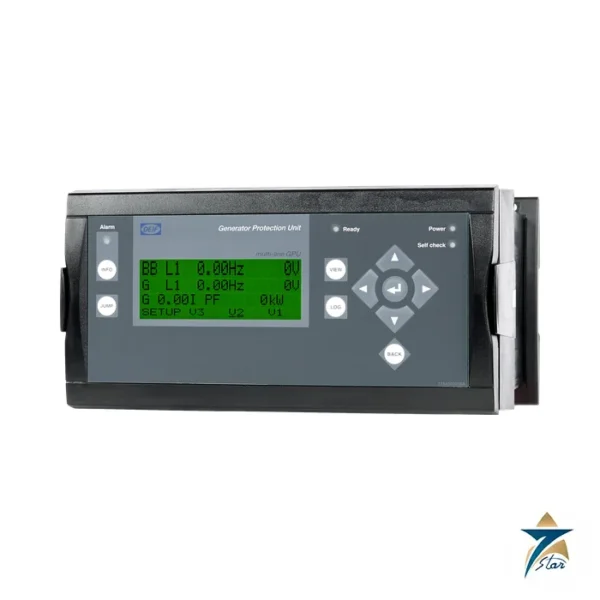
The display is a separate unit that can sit on the main unit or on the switchboard door, with up to two more displays. Display layouts include the standard delivery, engine and breaker control (Y1) and a display without local control buttons (Y11). Setup is through the display or the free Multi-line 2 PC utility over USB, and M-Logic provides the micro-PLC logic.
Options and ordering
Options include A mains protection (vector jump, df/dt), C generator add-on protection, D1 voltage control (constant voltage, constant reactive power, constant power factor, reactive load sharing, voltage droop), E and F analogue controller outputs, G9 CANshare, serial communication, M engine control and I/O, N Ethernet and Q measurement accuracy. Confirm the variant, the governor type for the analogue or relay interface and whether AVR control (D1) is required.
The data sheet shows three application examples: a stand-alone set, load sharing between sets over analogue load sharing lines, and a PLC-controlled system in which a PLC talks Modbus to up to three controllers, each with its own display. Response times with the delay set to minimum are under 50 ms for busbar over and under voltage and frequency, under 200 ms for generator reverse power and over-current, under 40 ms for fast over-current, under 130 ms for df/dt (ROCOF, four periods) and under 40 ms for vector jump. The unit interfaces to governors from GAC, Barber-Colman, Woodward and Cummins through the Multi-line 2 governor interfacing guide on the DEIF website.
How the DEIF GPC-3 works
The controller measures voltage, current and frequency on the generator and the busbar. It matches the generator speed and phase to the busbar, then closes the breaker. Once the generator is on the bus, it shares the load with the other sets by controlling the governor through the selected regulation mode.
Where the GPC-3 is used
- Diesel generator sets in parallel
- Base load operation
- Load sharing plants
- Power stations with several sets
- Systems that need governor and AVR control
Selection checklist for the GPC-3
- Variant with or without display
- Regulation modes needed
- AVR control option
- Load sharing line supervision
- Engine control option
- Measuring voltage
- Current transformer ratio
- Auxiliary supply
Installation, commissioning and maintenance notes for the GPC-3
Mount the unit on a rail or on its base inside the panel. Wire the measuring voltage, the current inputs and the supply as shown in the data sheet. Set the regulation mode and test synchronising on the bench or with the set at no load. Check terminals and wiring at regular intervals.
Requesting a quotation for the DEIF GPC-3
Please send the variant, the options needed, the generator voltage and the number of sets. Seven Star LLC serves industrial customers in Oman and the GCC and replies with a quotation based on the information provided.
GPC-3 controller type
It is a generator paralleling controller from the Multi-line 2 family.
GPC-3 duty
It synchronises and shares load between diesel generator sets.
GPC-3 regulation modes
Four modes are selected through digital inputs on the standard unit.
GPC-3 governor modes
The governor modes are fixed frequency, fixed power, frequency droop and load sharing.
GPC-3 AVR modes
With AVR control the modes add fixed voltage, fixed var, fixed power factor, reactive load sharing and voltage droop.
GPC-3 AVR option
AVR control requires option D1.
GPC-3 variants
Variants are offered with a display or without a display.
GPC-3 measuring voltage
The measuring voltage is 100 to 690 V AC.
GPC-3 current input
The current input is 1 A or 5 A.
GPC-3 frequency range
The frequency range is 30 to 70 Hz.
GPC-3 auxiliary supply
There are two 12/24 V DC supply inputs, accepting 8 to 36 V.
GPC-3 load sharing lines
The analogue load sharing lines run from minus 5 to plus 5 V DC.
GPC-3 analogue outputs
The analogue outputs are 0 or 4 to 20 mA and plus or minus 25 mA, galvanically separated.
GPC-3 relay outputs
The relay outputs are rated 5 A at 250 V AC.
GPC-3 mounting
It mounts on a rail or on a base.
GPC-3 operating temperature
The operating temperature runs from minus 25 to 70 degrees C.
GPC-3 altitude
It can be used at altitudes up to 4000 m.
GPC-3 weight
The unit weighs 1.6 kg and the display weighs 0.4 kg.
GPC-3 load sharing supervision
For wire break and short circuit supervision of the load sharing lines, DEIF recommends the optional CANshare feature.
GPC-3 engine control
With the engine control and protection option the controller can start and stop the engine.
GPC-3 backup role
It can act as backup of the engine shutdown channels if the main processor fails.
Controller records for the GPC-3
Record the variant, the options fitted and the parameter settings after commissioning.
Choosing the right GPC-3 options
Choose the options from the need for AVR control, supervised load sharing and engine control.
Documents and quotation
Download the DEIF GPC-3 data sheet 4921240351N (EN) from this page. A quotation request needs the exact variant, any option letters, quantities and the engine or alternator details. See Diesel Generator Spare Parts for related DEIF controllers and generator control products.



Reviews
There are no reviews yet.