Four current inputs in a single 12 mm POINT I/O slot
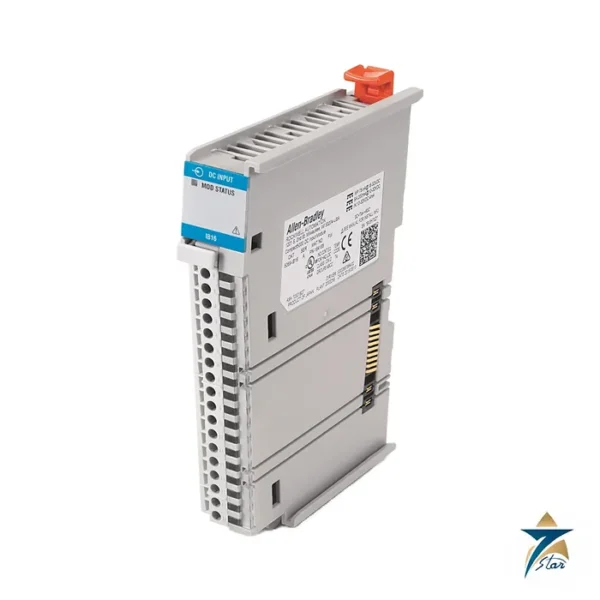
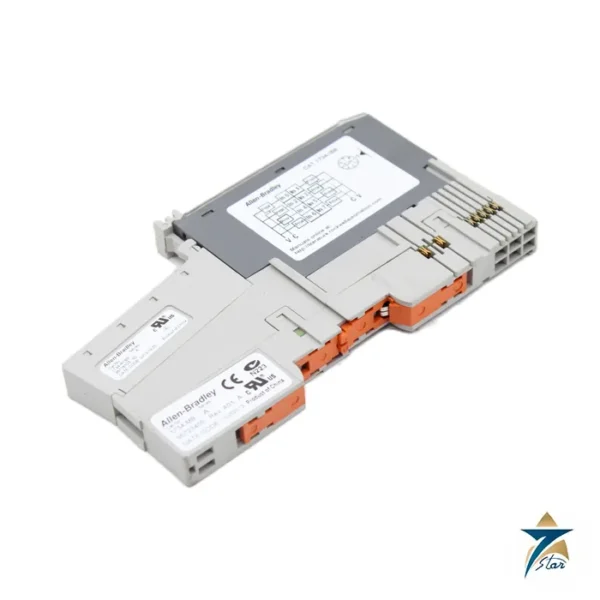
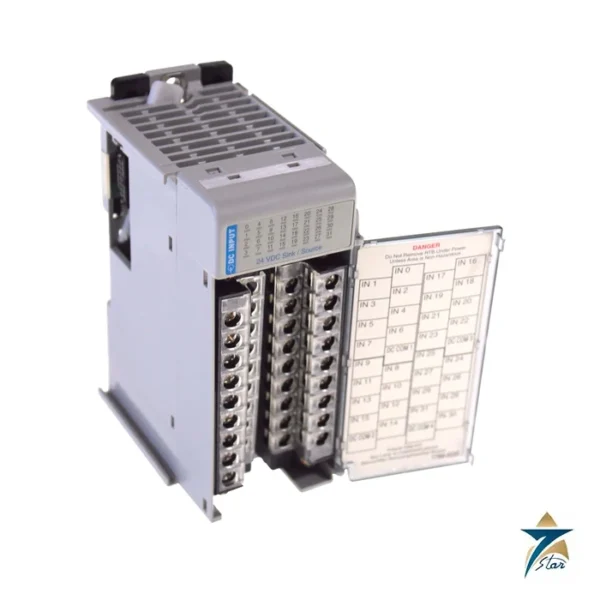
The Allen-Bradley 1734-IE4C is a high-density current input module that packs four analog channels into one POINT I/O slot. It reads 4 to 20 mA or 0 to 20 mA signals, converts them with a delta-sigma converter and reports them to the network adapter with 16-bit resolution.
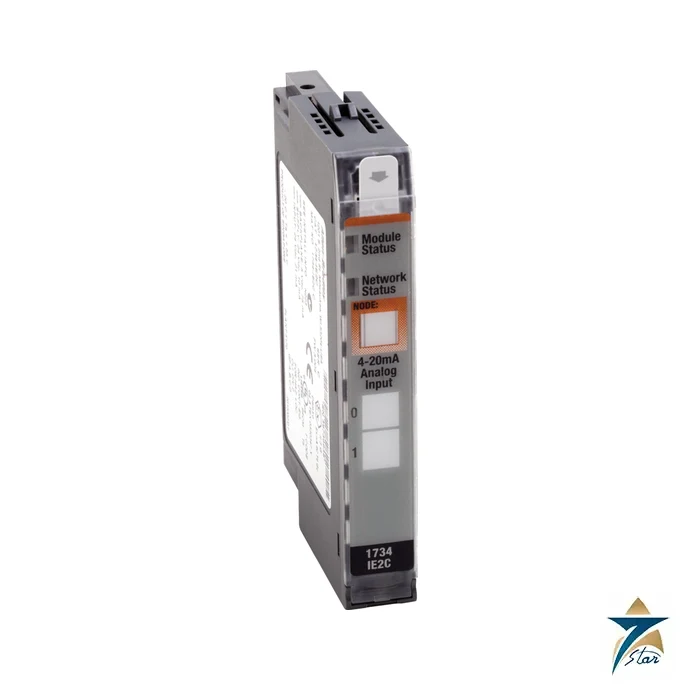
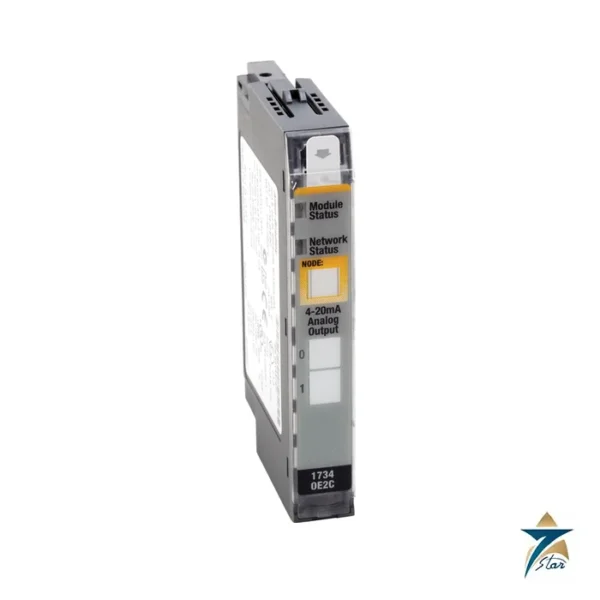
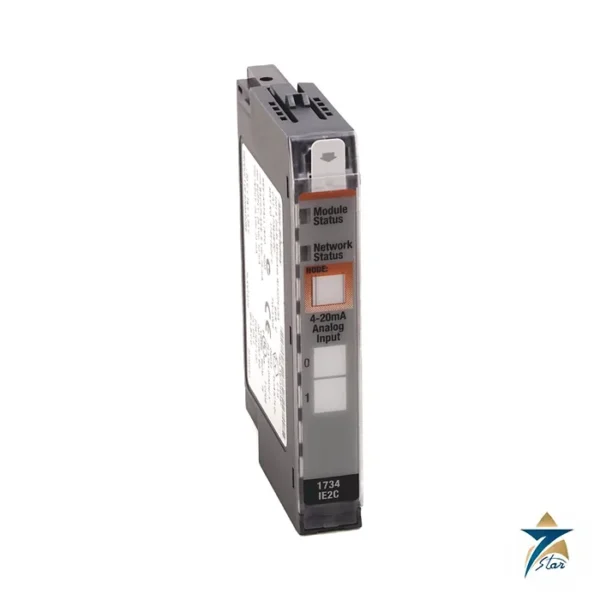
Compared with the two-channel 1734-IE2C the module halves the cost per channel and the space used on the DIN rail, which is useful for instrumentation nodes with many transmitters. Compared with the 1734-IE8C it has fewer channels but a faster per-module update rate.
Technical specifications
| Parameter |
Specification |
| Manufacturer / family |
Allen-Bradley (Rockwell Automation) / POINT I/O |
| Catalog number |
1734-IE4C (1734-IE4CK is the coated version) |
| Inputs |
4 single-ended, non-isolated, current |
| Input current range |
4 to 20 mA or 0 to 20 mA |
| Resolution |
16 bits over 0 to 21 mA, 0.32 uA per count |
| Absolute accuracy / drift |
0.1% of full scale at 25 °C / 30 ppm per C |
| Conversion type |
Delta sigma |
| Input update rate, per module |
200 ms at 60 Hz notch (default); 240 ms at 50 Hz; 25 ms at 480 Hz |
| Step response, per channel |
50 ms at 60 Hz notch (default) |
| Input impedance |
60 ohm |
| Field power input |
10 to 28.8V DC, 20 mA, Class 2 |
| POINTBus current, max / power dissipation |
75 mA / 0.55 W at 28.8V DC |
| Isolation |
50V, tested at 1500V AC for 60 s; none between inputs |
| Dimensions (H x W x D) / weight |
56.6 x 12.1 x 77.5 mm / 35 g |
| Keyswitch position |
3 |
Update rate and noise filtering
The notch filter is configurable. At the default 60 Hz setting the module update rate is 200 ms and the per-channel step response is 50 ms. Selecting 480 Hz brings the update rate down to 25 ms and the step response to 6.25 ms. The 50 Hz selection is 240 ms and 60 ms respectively.
Resolution is 0.32 microamps per count over a 0 to 21 mA range and accuracy is 0.1% of full scale at 25 °C with a drift of 30 ppm per C. The input impedance is 60 ohm. Overrange, underrange and alarm bits are reported in the module input data as described in the sheet.
Power and installation notes
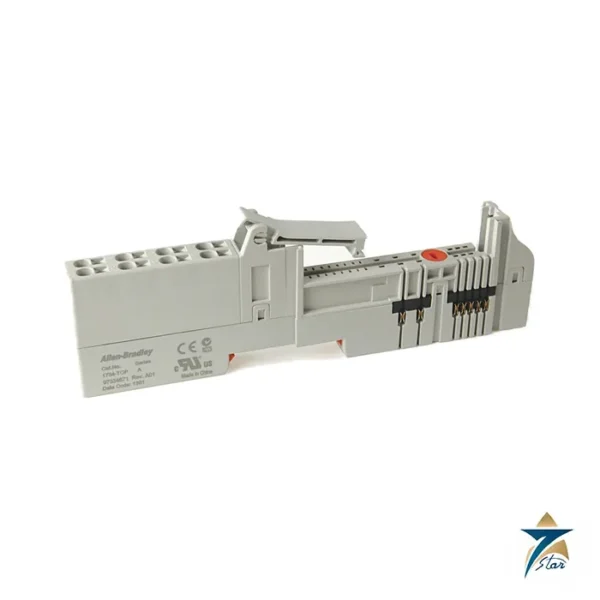
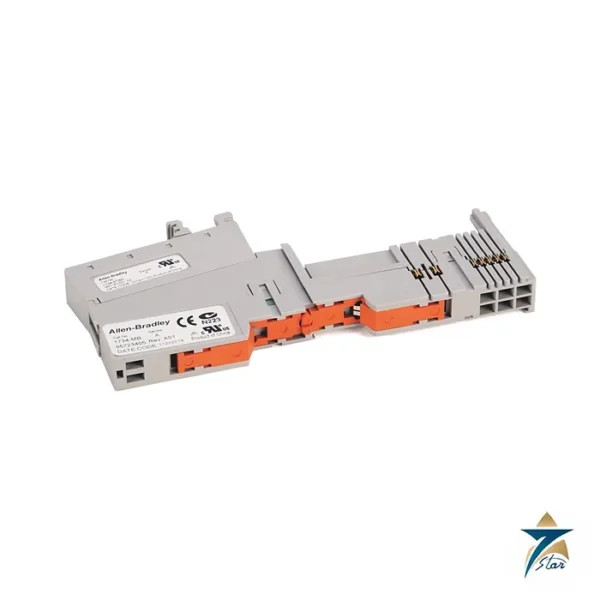
A separate 10 to 28.8V DC Class 2 field supply powers the module (20 mA), and POINTBus supplies up to 75 mA. Power dissipation is 0.55 W at 28.8V DC. The module sits on a 1734-TB, 1734-TBS, 1734-TOP or 1734-TOPS wiring base set to keyswitch position 3.
Wiring is shielded 22 to 14 AWG copper rated 100 °C or higher, with wire category 2 on the signal ports and 1 on the power ports. Isolation is 50V with a 1500V AC type test between the field side and the system, and there is no isolation between inputs, so loop isolators are needed where channels must be separated. The flashing red module indicator shows an open wire or missing field power. For troubleshooting, check the loop supply and the shield termination first, because a floating shield is a common source of unstable readings on 4 to 20 mA inputs.
Documents and quotation
The sheet 1734-IN032 contains the input tables, notch-filter data and certification list. Send the 1734-IE4C reference, quantity, the adapter or controller and the transmitter details for a quotation; this is a current-only module, so voltage signals need another type. See PLC & I/O Cards.
How the 1734-IE4C Works
Each of the four channels of the 1734-IE4C measures loop current across a low input impedance (60 ohm) and digitises the result with a delta-sigma converter. A delta-sigma converter oversamples the signal and passes it through a digital filter; the notch setting chosen in the module configuration places the strongest rejection at the mains frequency (50 Hz in Oman and most of the GCC) or trades noise rejection for speed at the 480 Hz setting. The value, together with the underrange, overrange and alarm status bits, travels over the POINTBus backplane to the communication adapter and from there to the controller.
The 4–20 mA “live zero” is the reason current loops remain the standard for field transmitters. A healthy transmitter never sends less than 4 mA, so a reading that falls towards 0 mA points to a broken wire, a failed transmitter or a missing loop supply rather than a real process value. Current signals are also much less sensitive to cable length and induced noise than voltage signals, which suits long cable runs across a plant.
Selection & Ordering Guide
- 1734-IE4C – four current inputs, standard version.
- 1734-IE4CK – conformal-coated version for humid, dusty or corrosive atmospheres.
- 1734-IE2C – two current inputs where only a few loops are needed.
- 1734-IE8C – eight current inputs where rail space matters more than update time.
- Voltage signals – choose a POINT I/O voltage input module such as the 1734-IE2V; the 1734-IE4C accepts current only.
The module also needs a terminal base (1734-TB, 1734-TBS, 1734-TOP or 1734-TOPS) and a communication adapter at the head of the node, for example an EtherNet/IP or DeviceNet adapter. List these items together when you request a quote, and our team can help confirm the correct ordering code for every part of the node.
Installation & Maintenance of the 1734-IE4C
- Turn the keyswitch on the terminal base to position 3 before fitting the module. The mechanical key stops a module of a different type from being plugged into a base that is wired for analog current.
- Select the 50 Hz notch on 50 Hz supply networks unless a faster update is needed for the process.
- Route analog cables away from motor and power cables, and terminate the shields as described in Rockwell’s wiring and grounding guidelines, publication 1770-4.1.
- The inputs share a common, so transmitters powered from different supplies may need loop isolators.
- POINT I/O supports removal and insertion under power; in hazardous locations do this only when the area is known to be non-hazardous, as the installation instructions require.
- During maintenance, inject a known current with a calibrated loop calibrator at the terminals and compare it with the value in the controller. This separates field faults from module faults quickly.
Typical Applications in Oman & the GCC
A four-channel current input such as the 1734-IE4C suits remote I/O nodes that collect a handful of transmitter signals: pressure, level and flow transmitters on oil and gas wellhead and gathering skids, pump stations and reservoirs in water networks, chemical dosing skids in desalination plants, and temperature or humidity transmitters in district cooling plants and building management panels. Installing POINT I/O close to the instruments in a field junction box replaces several long multicore cables with a single network cable. On coastal and desert sites, use an enclosure that keeps the node within its rated operating temperature, and consider the conformal-coated K version where humid or salt-laden air is a concern.
Why Source from Seven Star LLC
Seven Star LLC is an independent supplier based in Muscat. Seven Star LLC supplies Allen-Bradley POINT I/O modules and other industrial automation parts across Oman and the GCC to contractors, panel builders and plant operators. Send us the catalog number, the quantity and the details of your node and request a quote; our team can help confirm the correct ordering code, including the matching terminal base and adapter.


Reviews
There are no reviews yet.