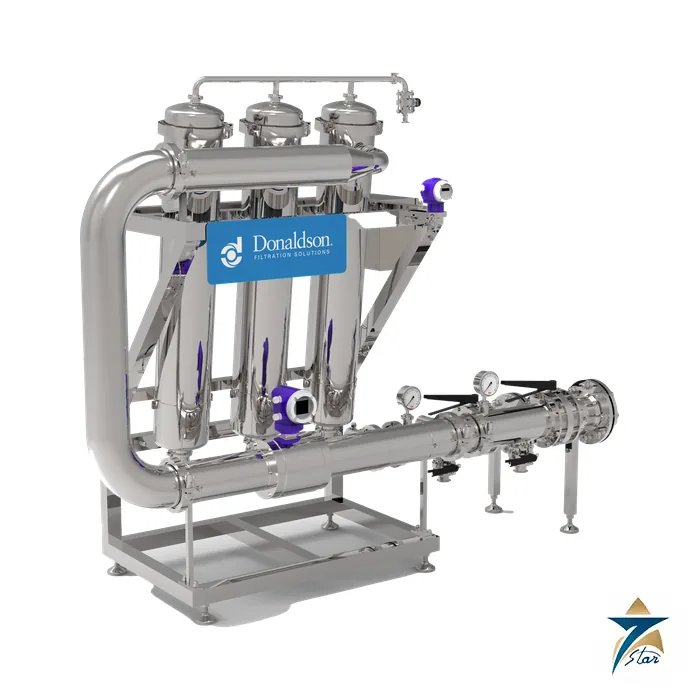
A hygienic stainless steel filtration skid for flows up to 200 m3/h
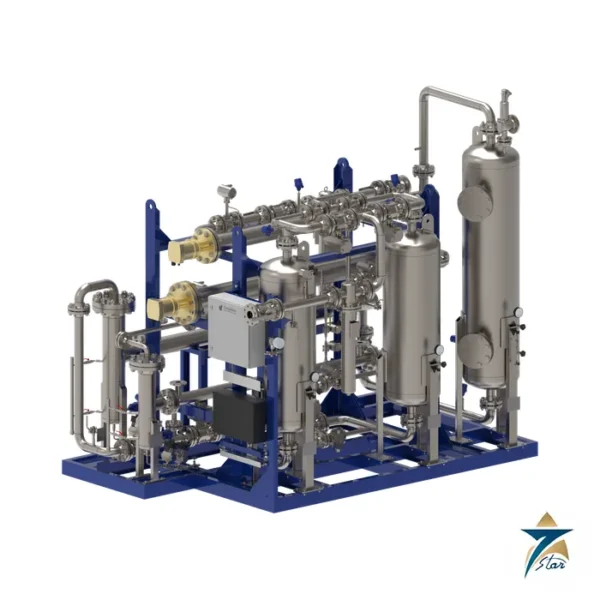
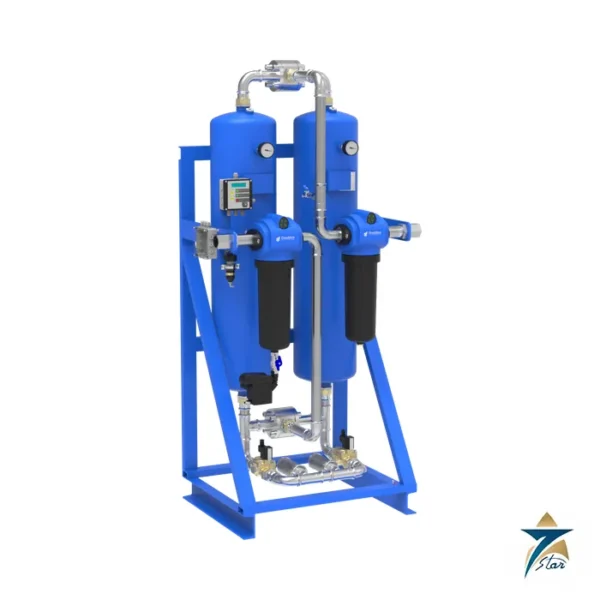
The Donaldson High Flow Skid AG1398001 is the largest of six standard skid sizes: four 60 inch housings on one frame, with a recommended flow of 200 m3/h. It is designed for water treatment such as pre-RO filtration and process water, and the data sheet names bottled water, dairy, breweries, soft drinks, wastewater and chemical removal as applications.
Housings and piping are made of EN 1.4404 (AISI 316) with electropolished surfaces of Ra 0.8 um, hygienic feet and reversible inlet and outlet connections. The skid can be mounted horizontally or vertically, and a choice of filtration options covers pre-filtration and removal of chlorine and heavy metals.
Technical specifications
| Parameter |
Specification |
| Part number |
AG1398001 (4 housings, 60 inch elements) |
| Recommended flow rate |
200 m3/h (varies with elements, viscosity and so on) |
| Inlet and outlet |
DN150 clamp to DIN 32676 |
| Housing volume |
62 L each |
| Maximum pressure |
Water 10 bar g; steam 1 bar g at +121 C |
| Temperature range |
Process -10 C to +95 C; ambient -10 C to +60 C; short term +121 C for up to 30 minutes |
| Material |
Housing and piping EN 1.4404 (AISI 316); EPDM and silicone seals |
| Surface finish |
Electropolished, Ra 0.8 um |
| Cleaning |
CIP; SIP on request |
| Food compliance |
EC 1935/2004 for components; FDA 21 CFR 177.2600 for sealing polymers |
Sizes in the range
- 2×40 inch: Part number AG1397501; Connection DN100; Recommended flow not printed
- 2×60 inch: Part number AG1397601; Connection DN100; Recommended flow 100 m3/h
- 3×40 inch: Part number AG1397701; Connection DN150; Recommended flow 120 m3/h
- 3×60 inch: Part number AG1397801; Connection DN150; Recommended flow 150 m3/h
- 4×40 inch: Part number AG1397901; Connection DN150; Recommended flow 160 m3/h
- 4×60 inch: Part number AG1398001; Connection DN150; Recommended flow 200 m3/h
The sheet text does not print a flow rate for the 2×40 inch skid. This page covers the 4×60 inch skid, AG1398001.
Weights, accessories and options
The 4×60 inch skid with frame and housing weighs 450 kg net and 770 kg water filled, with a footprint of 2,270 x 880 mm and a height of 2,600 mm. With basic equipment (drain system, pressure gauge and butterfly valve) the dimensions grow to 2,750 x 1,000 mm and the net weight is 512 kg, or 892 kg filled with water.
An advanced monitoring option adds a flow transmitter, a differential pressure transmitter and a junction box for process control. The sheet lists a DN150 drain (AG1405601) and a DN150 flow and differential pressure transmitter (AG1381401) for the three and four housing skids. The elements are not included in the part number, so state the filter media you need. Because the skid is modular, the sheet notes that capacity, extra filtration stages and control elements can be tailored, which should be agreed before the part number is fixed.
Selecting the skid for a water treatment line
Sizing a multi-housing skid starts with the real process flow rather than the catalogue figure. The recommended flow on the data sheet depends on the elements fitted and on fluid viscosity, so the design flow, the expected solids load and the required filtration rating should be fixed first. From there, the choice between a smaller skid running near its limit and the largest size running with margin becomes a question of element life, pressure drop and how often the plant can accept a change-out. Where pre-RO duty is the goal, the filter media should be chosen to protect the membranes downstream, and chlorine or heavy-metal removal options should be matched to the feed water analysis.
Hygienic plants such as dairies, breweries and bottled water lines will also look at the surface finish, the seal materials and the food-contact compliance listed in the table, and should confirm that EPDM or silicone suits their cleaning chemicals and product. Whether the skid will see CIP only, or whether SIP is needed as well, should be decided at this stage because SIP is offered on request rather than as standard.
Footprint, mounting and access
A four-housing frame is a large and heavy assembly, and the filled weight on the sheet should be used when checking floor loading and plinth design. Because the skid can be mounted horizontally or vertically, the layout can be adapted to the room, but clear space is still needed to open housings, lift elements out and reach the drains and valves. The reversible inlet and outlet connections help align the skid with existing pipework, and the clamp connections should be supported so that piping loads are not carried by the housings.
Installation and commissioning practice
Before first use, the pipework upstream should be flushed so that weld debris and construction dirt do not load new elements on day one. Clamp joints and seals should be checked for correct seating, and the system should be pressure tested within the limits given for water service. Elements are not part of the skid part number, so they must be ordered and installed separately, with care taken to seat each one correctly so that no bypass path exists around the media.
During commissioning it is good practice to record the clean differential pressure at the design flow. This baseline is the reference against which element loading is judged later. If the advanced monitoring option is used, the flow and differential pressure transmitters can pass these values to the plant control system through the junction box, so trends are logged automatically rather than read by hand.
Operation, cleaning and maintenance
In service, rising differential pressure is the main signal that elements are loading. Change-out intervals are best set from this trend and from water quality results, not from a fixed calendar alone. Cleaning cycles should follow the CIP programme agreed for the plant, staying within the process and short-term temperature limits listed on the sheet. After cleaning or element change, housings should be vented and drained correctly before returning to service.
Operating in GCC conditions
Plants in Oman and the wider Gulf often face high ambient temperatures, airborne dust and coastal humidity. The ambient range on the data sheet should be compared with the actual plant room conditions, especially for skids placed in unshaded or poorly ventilated areas. Instruments and the junction box, where fitted, benefit from protection against direct sun and dust. Feed water from desalination or groundwater sources can vary in quality through the year, so element choice and monitoring become more important in these regions.
What to include in your RFQ
To prepare an accurate offer, please send the design flow rate, the fluid and its temperature, the required filtration rating or filter media, the cleaning method (CIP or SIP), the preferred mounting orientation, and whether basic equipment or the advanced monitoring option is needed. Notes on available floor space and on any tailored stages or control elements help us confirm the configuration with the data sheet before the part number is fixed.
Documents and quotation
Contact us for AG1398001 through the page form. Our offer follows Donaldson High Flow Skid data sheet (AG1397501 to AG1398001), so check the filter media, flow rate and connection size there. Similar categories: Filtration Systems.


Reviews
There are no reviews yet.