Refrigeration dryers with thermal mass control, 0.65 to 3.90 m³/min
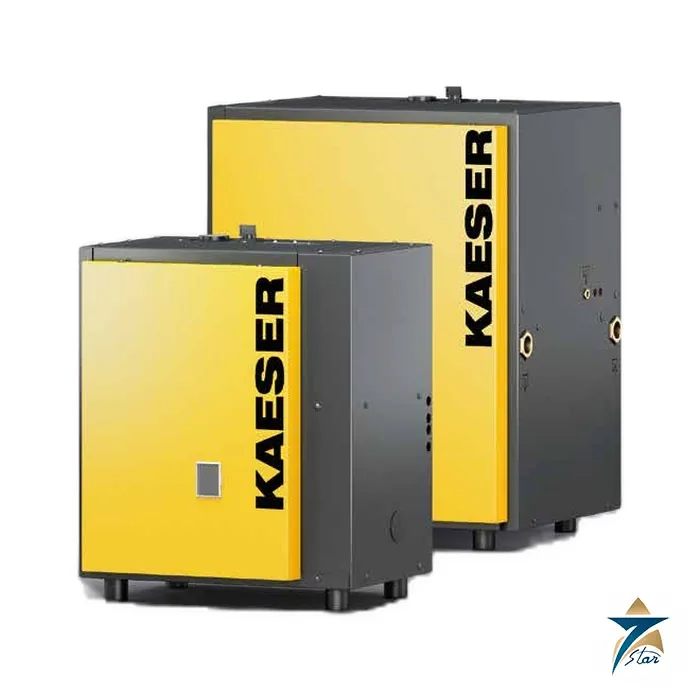
The Kaeser SECOTEC TA, TB and TC refrigeration dryers dry compressed air to a pressure dew point of +3 °C for flow rates of 0.65 to 3.90 m³/min at 3 to 16 bar. The air/refrigerant heat exchanger is embedded in a solid thermal mass that stores surplus cooling capacity and releases it later, so the refrigeration circuit runs only when cooling is needed. The brochure presents this as a saving at part load and outside working hours compared with hot-gas-bypass control, and quotes up to 26 percent lower life-cycle cost for the TC 36 in its example case. The dryers use R-513A refrigerant and are built at Kaeser’s plant in Gera, Germany.
Technical specifications
| Parameter |
TA 5 |
TA 8 |
TA 11 |
TB 19 |
TB 26 |
TC 31 |
TC 36 |
| Flow rate m3/min |
0.65 |
0.85 |
1.25 |
2.10 |
2.55 |
3.20 |
3.90 |
| Pressure loss bar |
0.07 |
0.14 |
0.17 |
0.19 |
0.20 |
0.17 |
0.17 |
| Power at 100% flow kW |
0.30 |
0.29 |
0.39 |
0.44 |
0.62 |
0.74 |
0.89 |
| Power at 50% flow kW |
0.16 |
0.16 |
0.20 |
0.24 |
0.34 |
0.34 |
0.41 |
| Weight kg |
70 |
80 |
85 |
108 |
116 |
155 |
170 |
| R-513A charge kg |
0.28 |
0.22 |
0.37 |
0.56 |
0.53 |
0.80 |
1.00 |
| Parameter |
Specification |
| Dimensions W x D x H |
TA: 630 x 484 x 779 mm; TB: 620 x 540 x 963 mm; TC: 764 x 660 x 1009 mm |
| Compressed air connection |
TA: G 3/4; TB: G 1; TC: G 1 1/4 |
| Condensate drain connection |
G 1/4 |
| Power supply |
230 V / 1 Ph / 50 Hz |
| Operating limits |
Ambient +3 to +43 °C; maximum air inlet +55 °C; working pressure 3 to 16 bar |
| Reference conditions |
ISO 7183 Option A1: 1 bar(a), +20 °C, 0% RH; pressure dew point +3 °C, 7 bar(g), inlet +35 °C, ambient +25 °C |
| Refrigerant |
R-513A, GWP 629, hermetically sealed circuit |
| Equipment |
ECO-DRAIN 30 electronic condensate drain, stainless steel separator, SECOTEC CONTROL with dew point trend indicator, IP 54 control cabinet, EN 60204-1 |
Derating for real operating conditions
The flow rates apply at the reference point, so correct them before selecting. The brochure gives factors for working pressure, from 0.75 at 3 bar to 1.23 at 16 bar and 1.00 at 7 bar, for inlet temperature, from 1.20 at 30 °C to 0.49 at 60 °C, and for ambient temperature, from 1.00 at 25 °C to 0.92 at 43 °C. Multiply the reference flow by the three factors; the brochure example takes a 4.7 m³/min unit at 10 bar, 40 °C inlet and 30 °C ambient down to 4.25 m³/min. In hot plant rooms the ambient and inlet factors can dominate the selection.
Options and installation
Options listed include floating contacts, an ECO-DRAIN with alarm contact, bolt-down feet, an autotransformer for deviating mains voltage, special RAL colours and a silicone-free version to VW factory standard 3.10.7. The dryers are normally installed downstream of the compressor aftercooler and ahead of fine filtration; for air that must meet a dew point below +3 °C a desiccant dryer is needed instead. Seven Star LLC, an independent supplier in Muscat, quotes the exact model after you confirm flow, working pressure, inlet and ambient temperature and supply voltage. The brochure is attached and related items are in Filtration Systems.
How the Kaeser SECOTEC TA-TC refrigeration dryers work
Compressed air leaves a compressor warm and full of water vapour. A refrigeration dryer cools the air, so most of the vapour condenses into water that is drained away, and the air is then warmed a little so that it does not sweat in the pipes. In the SECOTEC TA, TB and TC dryers the air passes through an air/refrigerant heat exchanger that sits inside a solid thermal mass. The mass stores spare cooling capacity and gives it back later, so the refrigeration circuit does not need to run all the time. The dryer reaches a pressure dew point of +3 degrees C.
Where the SECOTEC TA-TC dryers are used
- Compressed air supply for workshops and factories.
- Pneumatic tools and machines that need dry air.
- Plants with a varying air demand, where part load operation is common.
- Sites with a limited number of operating hours, such as one-shift plants.
- Systems that need dry air before filters and process equipment.
Selection checklist for the SECOTEC TA-TC dryers
- Flow rate from 0.65 to 3.90 m3/min at the reference conditions, corrected for the real ones.
- Working pressure of 3 to 16 bar and the correction factor that goes with it.
- Air inlet temperature up to 55 degrees C, and its correction factor.
- Ambient temperature from 3 to 43 degrees C, and its correction factor.
- Pressure loss at the working flow.
- Connection size: G 3/4, G 1 or G 1 1/4 depending on the series.
- Power supply of 230 V, one phase, 50 Hz.
- Refrigerant R-513A and the amount in the circuit.
- Condensate drain: the ECO-DRAIN 30 electronic drain is part of the equipment.
Installation, commissioning and maintenance notes
Fit the dryer in a clean room that stays within the ambient limits, with free space for the cooling air. Connect the air line and the condensate drain, and send the condensate to a treatment point that meets local rules. Switch on the power and wait for the dryer to reach its operating state before the air is sent through it. The dew point trend indicator on the control shows whether the dryer works correctly. Clean the condenser from time to time, and follow the service schedule from the maker.
Requesting a quotation for the Kaeser SECOTEC TA-TC
Send the air flow, the working pressure, the inlet temperature and the ambient temperature. Seven Star LLC serves industrial customers in Oman and the GCC and replies with a quotation based on the information provided.
Correcting the flow for real conditions
The flow rates apply at the reference point. Multiply them by the factors for working pressure, inlet temperature and ambient temperature, and then pick the model that still covers the demand.
Why thermal mass control saves energy
When the air demand is low, the refrigeration circuit switches off and the thermal mass holds the cooling, so the power use falls at part load and outside working hours.
Records and service
Keep the model, the serial number and the service dates with the plant records.



Reviews
There are no reviews yet.