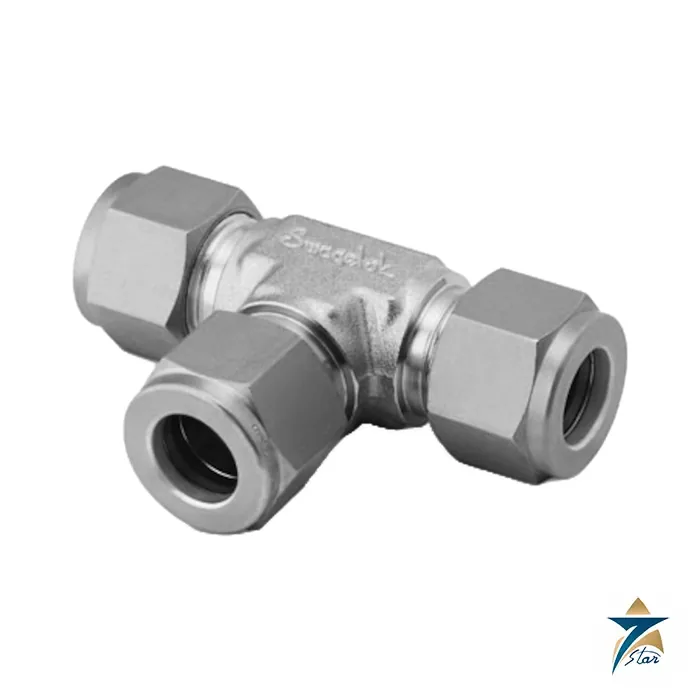
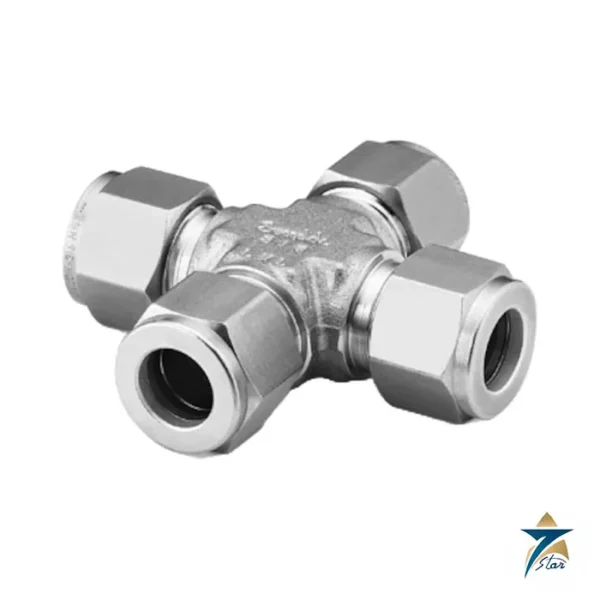
The Swagelok SS-810-3 is a union tee: three 1/2 in. tube-fitting ends on one forged 316 stainless body. It lets an instrument or sample line branch without welding, joins a header to two drops, or splits a supply to a pair of consumers, and every port uses the same live-loaded two-ferrule seal as the straight fittings.
Technical specifications
| Parameter |
Specification |
| Part number |
SS-810-3 |
| Description |
Union tee, three 1/2 in. Swagelok tube-fitting ends |
| Body material |
316 stainless steel (forged shape) |
| Tube OD (all ports) |
1/2 in. |
| Dimension A (run length) |
2.84 in. |
| Dimension Ax (centre to run end) |
1.42 in. |
| Dimension D (nut size) |
0.90 in. |
| Dimension E (nominal opening) |
0.41 in. |
| Hex flat F |
13/16 in. |
| Pressure basis |
Rated to the working pressure of the tubing used (Tubing Data MS-01-107) |
| Cleaning |
Standard cleaning and packaging SC-10 |
Where a tee earns its place
In sample conditioning, a tee is the point where a bypass loop, a pressure gauge branch or a relief branch leaves the main line. Because all three ports are identical 1/2 in. Swagelok ends, you can orient the branch freely and use the same tubing at every leg. The catalog gives the run length A as 2.84 in. and the half-run Ax as 1.42 in., which tells you the branch sits on the centre line of the body; plan clearance for wrenches on all three nuts before you cut tube lengths.
The tee is a forged shape (ASTM A182 for 316 stainless) with a nominal opening E of 0.41 in. Bored-through variants for thermocouple or dip-tube use appear in the catalog under a separate section and carry different numbers; SS-810-3 is the standard closed-body tee.
Ordering variants and decoding
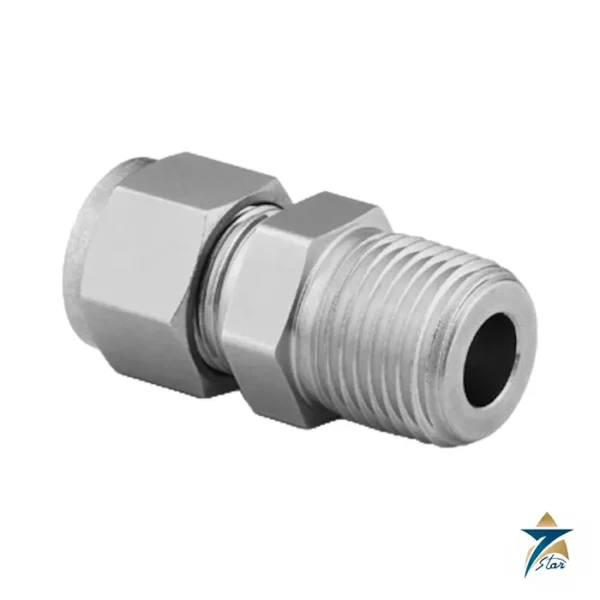
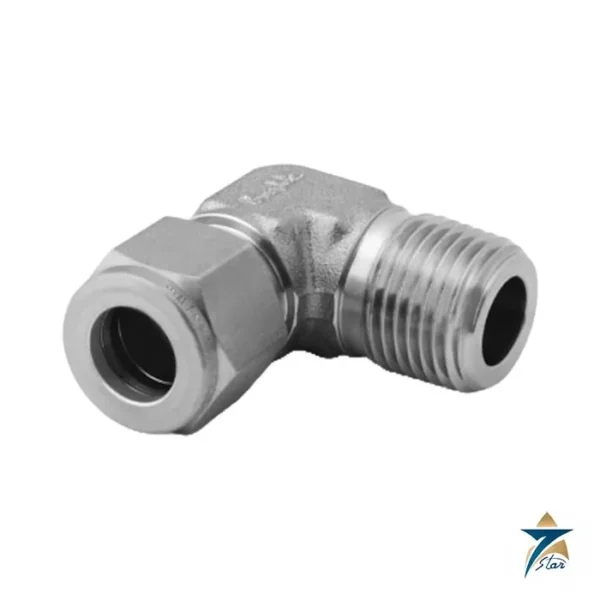
In SS-810-3 the SS prefix is 316 stainless, 810 means 1/2 in. tube and 3 is the union tee. When a branch or run must end in a pipe thread the catalog uses different codes: 3TTM is a tee with a male NPT branch, TMT has the male thread on the run, and TTF and TFT put a female NPT on the branch or run. Metric 12 mm equivalents carry 12M0 instead of 810. Always quote the full code, including any trailing designator, so the right thread or cleaning option is supplied.
Add CP for individually bagged fittings or BQ for the special cleaning with silver-plated front ferrules described in the catalog.
Pressure and installation
A tube-fitting end is rated to the tubing. Fit annealed 316 stainless or other tubing from the Swagelok Tubing Data catalog and read the working pressure for your wall thickness; the tee does not add a lower limit on its own. For ECE R110 applications, the catalog states that Swagelok stainless tube fittings with 316 stainless tubing in listed wall ranges were tested to those requirements.
Assemble on clean, unmarked tubing seated hard against the shoulder. A finger-tight nut plus one and one-quarter turns completes the first pull-up for this tube size, and the gap inspection gauge proves it. Always vent the line first and hold the body with a second wrench. Make up one port at a time and keep the body from rotating; a tee under strain from two pipework runs is a classic source of fatigue, so support the tubing near the body.
Key features of the SS-810-3 union tee
- Three identical tube ends: all ports accept 1/2 in. OD tubing, so any leg can serve as inlet, outlet or branch and no adapters are needed.
- Two-ferrule gripping action: the back ferrule drives the front ferrule into the tube to form the seal while the back ferrule grips the tube, giving resistance to vibration and to the pull-out forces that occur in long instrument runs.
- Gaugeable make-up: correct first pull-up can be checked with the inspection gauge, which is useful for quality records on skids and analyser shelters.
- Forged 316 stainless body: suitable for most process and instrument media and for corrosive outdoor environments where carbon steel or brass would degrade.
- No welding or threading: branches can be made, modified or removed with hand tools, which saves hot-work permits in operating plants.
Choosing between a tee and other branch options
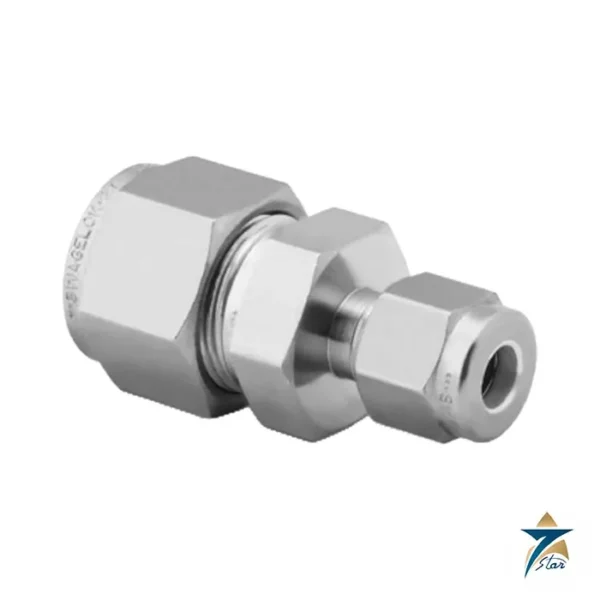
A union tee is the simplest way to divide one 1/2 in. line into two or to join two lines into one when all three legs use the same tube size. Where the branch must be a smaller size, a reducing tee or a reducer in one port is the usual choice; where the branch goes directly into an instrument with a threaded port, a male or female branch tee from the same catalog avoids an extra joint. If the branch carries a gauge that must be isolated for calibration, consider placing a small valve directly downstream of the tee rather than relying on the fitting alone. Using fewer joints reduces the number of potential leak points, so review the whole run before settling on a configuration.
Tubing compatibility
Swagelok tube fittings are designed to be used with tubing of the same material and with hardness and wall thickness within the ranges listed in the tubing data catalog. Mixing materials, for example using copper tube in a stainless fitting, is not recommended because galling and differences in hardness can affect the seal. Tubing must be round, free of scratches along the sealing area and cut square with the burr removed.
Maintenance and reassembly
After the first make-up, a fitting can be disconnected and retightened many times. On reassembly, the nut is brought back to the original position and then snugged with a slight additional rotation; a fresh gap gauge check is not used for remakes, because the ferrules are already set. Inspect the tube end for damage before each remake, and replace the tube section and ferrules if the sealing area is scored. Keep a record of which joints were opened during shutdowns so that they receive a leak test on start-up.
Use in Oman and GCC installations
Instrument tubing on GCC plants is often exposed to sun, sand, salt-laden coastal air and large daily temperature swings. 316 stainless steel bodies resist general corrosion well in these conditions, but chloride deposits can still promote pitting or crevice attack over time, so periodic washing and inspection of exposed tubing systems on coastal sites is good practice. Support clamps close to each tee reduce thermal expansion and vibration stresses, and protective trays or shields help where tubing passes through walkways or is exposed to impact.
What to include in your RFQ
- Full part number SS-810-3 plus any suffix for cleaning or packaging
- Quantity, and whether matching nuts and ferrule sets or inspection gauges are also needed
- Tubing material and wall thickness, so the pressure rating of the system can be confirmed
- Process medium, pressure and temperature if you want the selection reviewed
- Any certificates or traceability documents required by your project
Documents and quotation
Everything summarised here comes from the Swagelok catalog MS-01-140 (Gaugeable Tube Fittings and Adapter Fittings), which you can download from this page. To receive a quotation, reply with SS-810-3, how many you need and whether special cleaning is required.
Check the code, size and end connection against the catalog table before purchase, since variants with similar numbers exist. Related items: product category.





Reviews
There are no reviews yet.