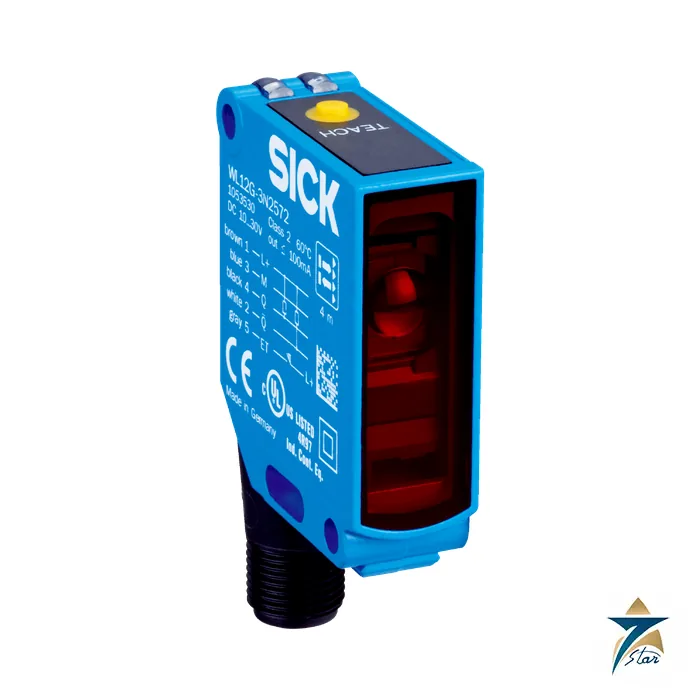
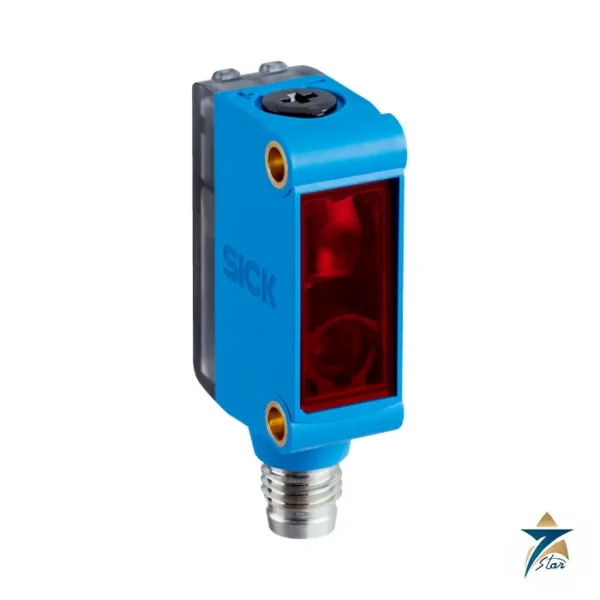
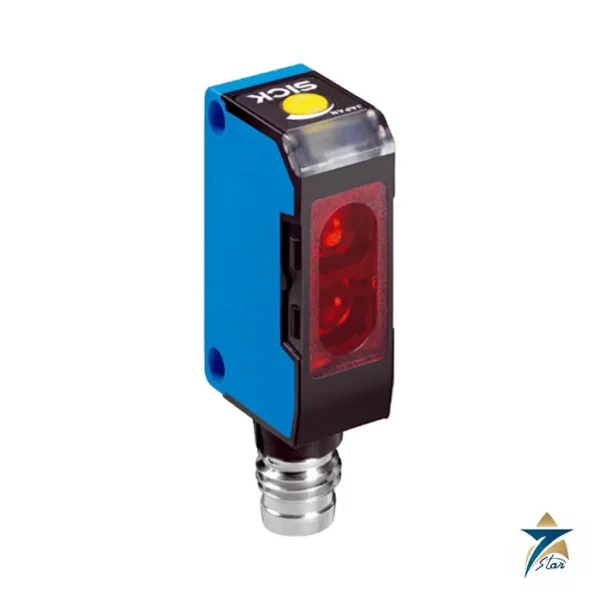
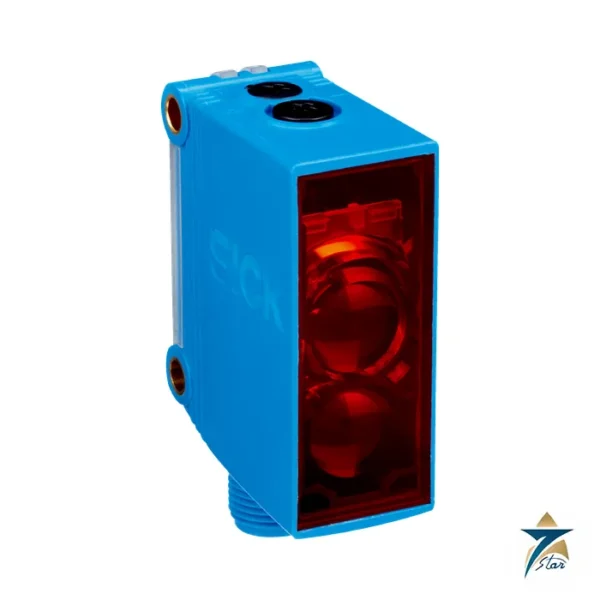
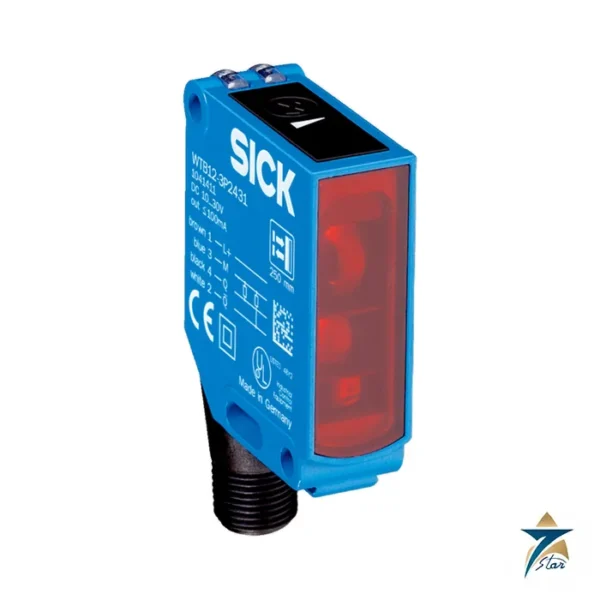
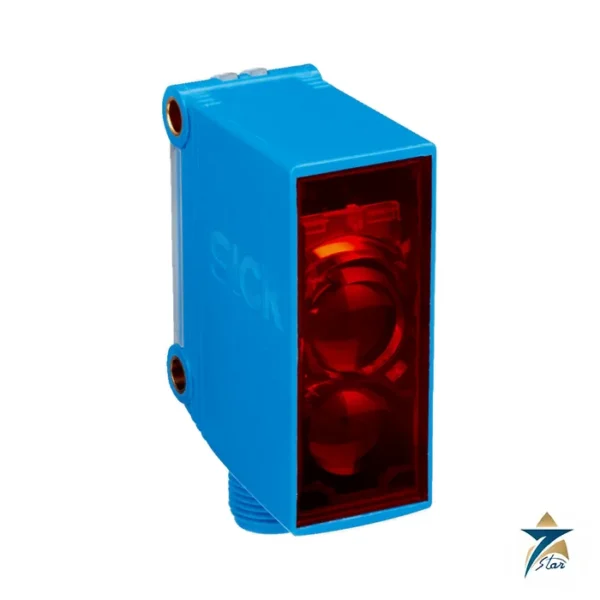
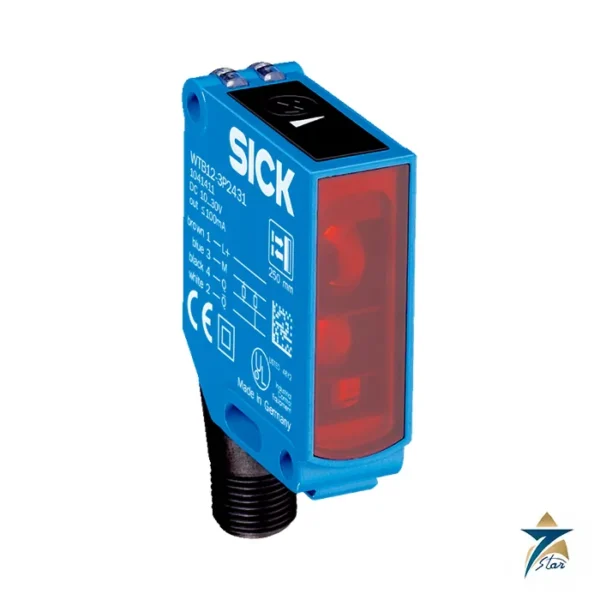
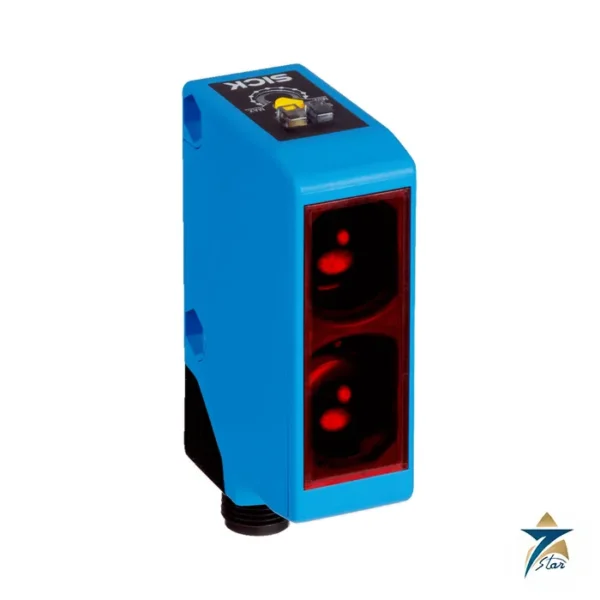
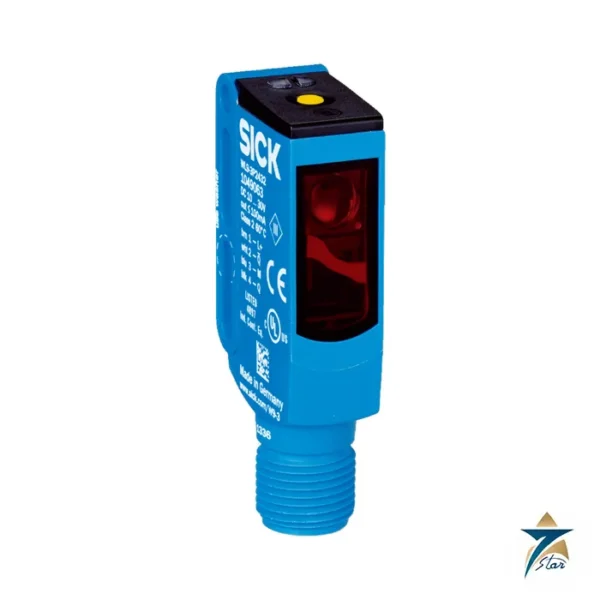
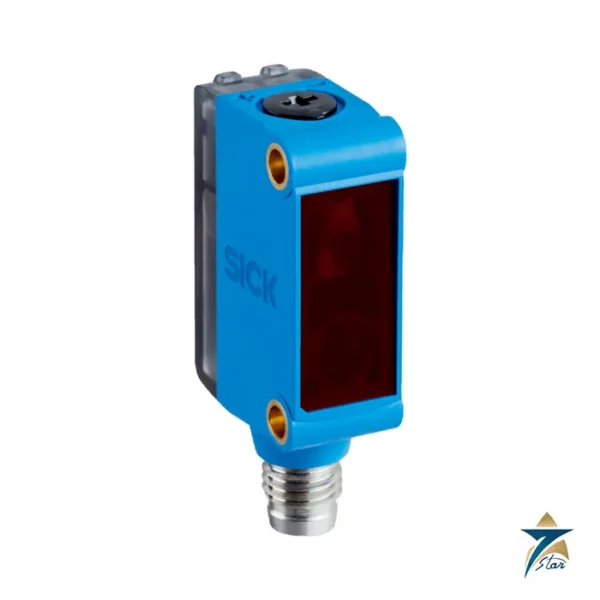
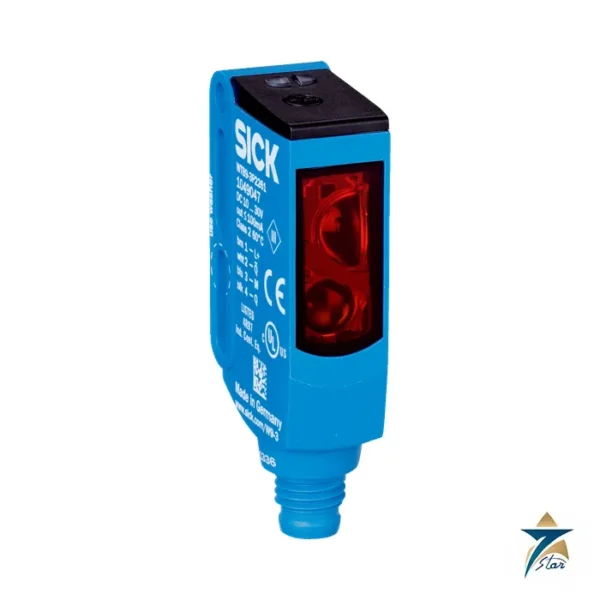
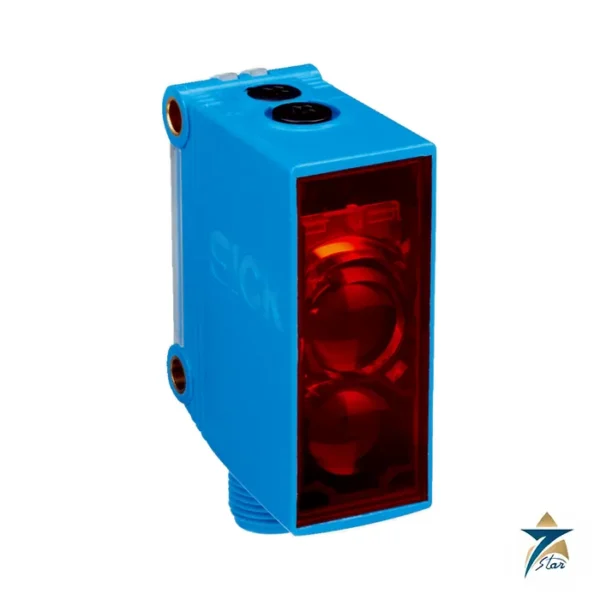
SICK’s WL12G-3V2572 (W12 family, part no. 1053537) is a reflector-based photoelectric sensor. The light goes out, returns from the reflector and is evaluated; an interrupted beam means an object is present. The sensing range maximum is 0 m … 4 m. Output: PNP, light/dark switching; connection: Plug, M12, 5-pin.
Retro-reflective sensing with the WL12G-3V2572
The data sheet describes the optics as autocollimation (coaxial), without a reflector minimum distance. In practice that means the sensor can work close to the reflector, which helps in tight machine envelopes, and the receiver looks along the same axis as the sender. A polarisation filter is fitted: it passes only light that the reflector has rotated, so shiny objects are less likely to be mistaken for the reflector. A retro-reflective sensor sends its beam to a reflector and expects it back; an object in the path interrupts the beam and the output changes. A light-switching output turns on while the beam reaches the receiver, a dark-switching output turns on when the beam is blocked. Choose according to how the controller treats a broken wire.
Light source: PinPoint LED, visible red light, light spot Ø 25 mm (1.5 m). Adjustment: single teach-in button. The data sheet lists this special application: detecting transparent objects. Response time ≤ 333 µs.
Technical specifications
| Parameter |
Specification |
| Type code |
WL12G-3V2572 |
| Part number |
1053537 |
| EAN |
4047084219092 |
| Product family |
W12 |
| Functional principle |
Photoelectric retro-reflective sensor |
| Functional principle detail |
Without reflector minimum distance (autocollimation/coaxial optics) |
| Sensing range max. |
0 m … 4 m |
| Polarisation filter |
Yes |
| Emitted beam: Light source |
PinPoint LED |
| Emitted beam: Type of light |
Visible red light |
| Emitted beam: Light spot size (distance) |
Ø 25 mm (1.5 m) |
| Key LED figures: Wave length |
660 nm |
| Adjustment |
Single teach-in button |
| Special applications |
Detecting transparent objects |
| AutoAdapt |
Yes |
| MTTFD |
1,099 years |
| DCavg |
0 % |
| Supply voltage UB |
10 V DC … 30 V DC |
| Ripple |
< 5 Vpp |
| Current consumption |
40 mA |
| Protection class |
III |
| Digital output: Type |
PNP |
| Digital output: Switching mode |
Light/dark switching |
| Digital output: Signal voltage PNP HIGH/LOW |
Approx. VS – 2.5 V / 0 V |
| Digital output: Output current Imax. |
≤ 100 mA |
| Digital output: Response time |
≤ 333 µs |
| Digital output: Switching frequency |
1,500 Hz |
| Circuit protection |
A ; B ; C ; D |
| Special feature |
Detecting transparent objects |
| Plausibility output, stable detection |
Approx. 0 V |
| Plausibility output, unstable detection |
VS – 2.5 V |
| Housing |
Rectangular |
| Dimensions (W x H x D) |
15.5 mm x 48.5 mm x 42 mm |
| Connection |
Plug, M12, 5-pin |
| Material: Housing |
Metal, zinc diecast |
| Material: Front screen |
Plastic, PMMA |
| Weight |
120 g |
| Enclosure rating |
IP66; IP67 |
| Ambient operating temperature |
–40 °C … +60 °C |
| Ambient temperature, storage |
–40 °C … +75 °C |
| Declarations and certificates in the data sheet |
EU declaration of conformity; UK declaration of conformity; ACMA declaration of conformity; Moroccan declaration of conformity; China RoHS; China Compulsory Product Certification (CCC) exempt; ECOLAB certificate; cULus certificate; Photobiological safety (DIN EN 62471) certificate |
Type code WL12G-3V2572 and part number 1053537
1053537 is the order number for WL12G-3V2572. The type code gives you the family (WL12G) at a glance, but connector, range and output polarity are only certain from the part number and the data sheet.
Related catalogue entries in the same family, each ordered under a different number:
- WL12G-3V2572S01 (part no. 1053540)
- WL12G-3V2572S07 (part no. 1069341)
- WL12G-3V2572S02 (part no. 1053541)
- WL12G-3V2572S05 (part no. 1069340)
- WL12G-3P2572 (part no. 1053535)
Mounting, wiring and alignment notes
The unit runs from 10 V DC … 30 V DC and carries IP66; IP67 protection; ambient temperature in operation is –40 °C … +60 °C. The body measures 15.5 mm x 48.5 mm x 42 mm and weighs 120 g. No reflector is listed as supplied, so add a suitable reflector to the order and check the operating reserve against the distance you need. After alignment, test with the thinnest or most transparent product on the line, and re-test after the first cleaning cycle.
Where the WL12G-3V2572 fits best
This sensor is aimed at lines where transparent objects such as bottles, trays, films or clear packaging have to be detected reliably. A standard retro-reflective sensor can struggle here, because a clear object weakens the returning beam only slightly. The data sheet lists detecting transparent objects as the special application, together with AutoAdapt, so the WL12G-3V2572 is a candidate for conveyors, filling and packaging machines, and handling stations where such products pass between the sensor and the reflector.
The coaxial optics without a reflector minimum distance help on compact machines where the sensor and reflector must sit close together, and the visible red light spot makes alignment easier during setup. The zinc diecast housing with IP66 and IP67 ratings suits machine frames in environments where regular cleaning takes place.
Choosing between this type and related entries
Several related type codes exist in the same family, each with its own part number. They may differ in connection, output or other details, so do not treat them as interchangeable without checking the respective data sheet. If you are replacing an existing sensor, compare the part number printed on the old device with the list above and confirm output polarity, switching mode and connection before ordering.
Teach-in and controller integration
Use the single teach-in button with the reflector in place and the beam unobstructed, then check the result with the actual product on the line. Decide whether light switching or dark switching suits your safety philosophy, since this determines how the controller interprets a broken wire or a missing signal. Where the plausibility output is wired, the controller can use it to distinguish stable from unstable detection and flag the need for cleaning or realignment before failures occur.
Information to include in your RFQ
Quote the type code WL12G-3V2572 and part number 1053537, the quantity, and whether a reflector is needed for your setup. Describing the objects to be detected, the distance between sensor and reflector, and the controller input type helps us confirm that this version is the right match.
Documents and quotation
Attached: the unaltered SICK data sheet for WL12G-3V2572, part number 1053537. It is the reference if anything on this page needs checking. Tell us the quantity and the delivery location in the RFQ form, quoting the part number above, and we will come back with a quotation. Related items are listed under Sensors & Transmitters. Before ordering, confirm that output polarity, connection and range match your controller and the device being replaced. If this page and the data sheet ever differ, the data sheet applies.


Reviews
There are no reviews yet.