Compact series-progressive distribution for small points
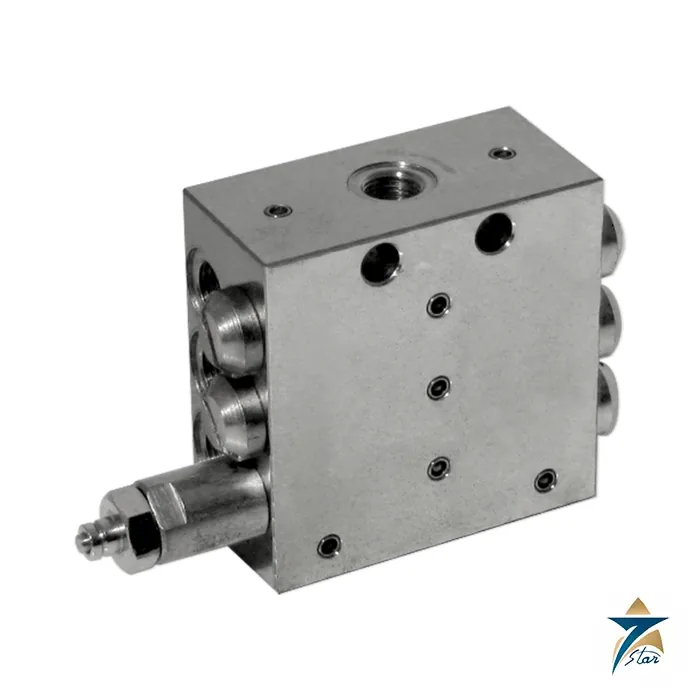
The PVB Divider Valve is designed for small-size series progressive lubrication systems. It is a cost-efficient way to supply many lubrication points with relatively small volumes of oil or grease, and is used on machine tools, processing machinery, mobile equipment, presses, textile, printing and packaging machinery.
In a series progressive block only one piston moves at a time, and each piston movement frees the next, so lubricant is metered out of the outlets in a fixed order. If any outlet blocks, the block stops, which is the basis for cycle monitoring. Manifolds come with 6 to 20 outlets and a metered volume of 0.20 cc per outlet per cycle.
Technical specifications
| Parameter |
Specification |
| Outlets |
6, 8, 10, 12, 14, 16, 18 or 20 |
| Metered volume |
0.20 cc (0.012 cu in.) per outlet per cycle |
| Material and finish |
Carbon steel with zinc-nickel plating |
| Pressure range |
Minimum 145 psi (10 bar); maximum 5075 psi (350 bar) |
| Maximum differential pressure between two outlets |
1015 psi (70 bar) |
| Inlet |
1/8 BSPP |
| Temperature range |
-5 °F to 176 °F (-20 °C to 80 °C) |
| Lubricant |
Grease up to NLGI 2; oil ISO VG 68 to 1,500 at working temperature; synthetics: check with the manufacturer |
| Monitoring |
No cycle pin, with cycle pin, or cycle pin and cycle switch (PNP or NPN proximity switch with LED) |
| Outlet configuration |
Codes a (open), b (closed, ported to opposite outlet) and c (closed, ported to adjacent segment) |
Selecting outlets and combining volumes
Order by outlet count with pin: PVB06-PIN, PVB08-PIN, PVB10-PIN, PVB12-PIN, PVB14-PIN, PVB16-PIN, PVB18-PIN and PVB20-PIN. Connectors and closure plugs are chosen separately, which lets you combine two outlets for 0.40 cc or three for 0.60 cc, or close an outlet by the b or c porting; code c is not possible on the end segment. Standard tubing or push-to-connect fittings with check valves are available in 3/16 in., 1/4 in., 4 mm and 6 mm sizes.
Related Bijur Delimon products in the same range are compared below.
| Product |
Type |
Key range |
| SureFire II |
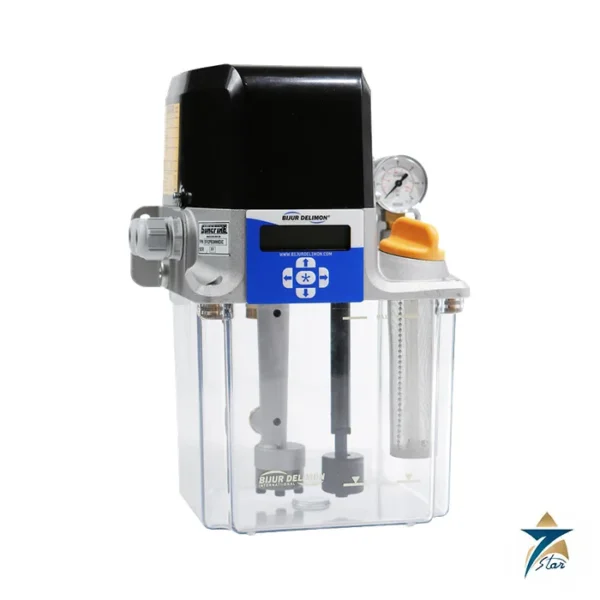
Electric gear pump, 2 to 30 litre |
PDI 450 psi / SLR 75 psi |
| MultiPort II |
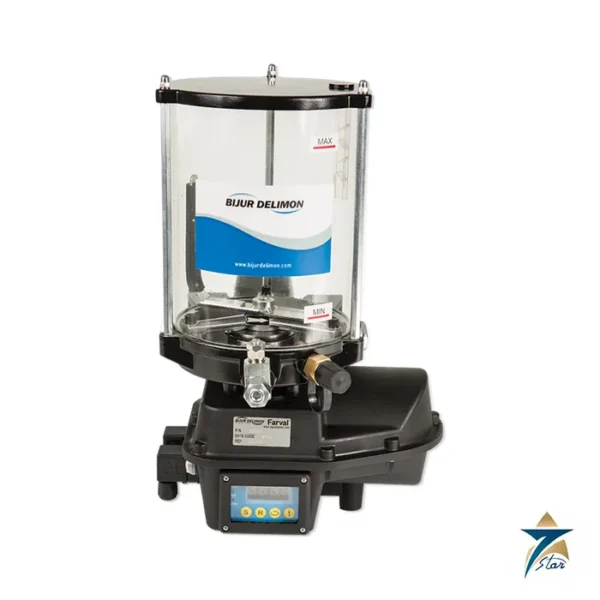
Electric multi-element pump, 3 or 7 litre grease |
Up to 250 bar |
| Dynamis Maxx |
Mobile electric piston pump, 4 or 8 litre |
160 or 300 bar relief |
| Airmatic |
Pneumatic oil pump, 1, 4 or 12 litre |
2 to 10 cc per stroke |
| SureMatic |
Pneumatic grease or oil pump, 1 to 5 litre |
Up to 100 bar (grease) |
| PVB |
Progressive divider valve |
0.20 cc per outlet |
| ZEM |
Positive displacement injector |
0.01 to 1.5 cc |
| SMAC-MAX |
Multi-mode controller |
110 or 220 VAC |
Installation and monitoring
Fit the block with the PVB bracket (35417), connect the inlet tubing connector for 1/4 in., 6 mm or 10 mm tube, and monitor the cycle with the cycle pin or a proximity switch (66925-1311 PNP or 66925S003 NPN) with cable 76928-2863 or 76928-2833. For oil or grease supply, feed it from a progressive-service pump such as the Bijur Delimon MultiPort II, Dynamis Maxx or SureMatic; see pumps and lubrication equipment. A mobile version, PVBM, has its own datasheet.
Planning a progressive circuit around the PVB
Start by listing every point the block must serve and the relative amount of lubricant each one needs. Because every outlet of the PVB discharges the same metered volume per cycle, points that need more lubricant are handled by combining outlets rather than by changing the block. Group the points by location on the machine so tube runs stay short and similar in length, and decide early whether the circuit will carry oil or grease, since that choice drives the pump, the tube size and the cycle time.
- Count the lubrication points and round up to the nearest available outlet count, keeping spare capacity in mind only where the porting codes allow an outlet to be closed cleanly.
- Check that the lubricant falls inside the grease or oil limits listed in the specification table, at the real working temperature rather than at room temperature.
- Confirm the supply pump is suited to progressive service and that its pressure stays inside the block’s pressure range.
- Keep the pressure difference between outlets within the stated differential limit by avoiding very long or very restrictive individual lines.
Commissioning and first fill
Before connecting the bearings, flush the supply line and fill the block and the outlet tubes completely so no air pockets remain. Air in a progressive system delays delivery and can make the cycle monitoring report a fault that is really a filling problem. Run the pump until lubricant appears at every outlet, then connect the lines to the points and watch at least several full cycles. With the cycle pin or cycle switch fitted, confirm that the controller sees the movement each time the block completes its sequence. A block that stops part way usually points to a blocked line or point, which is exactly the condition the series progressive design is meant to reveal.
Operation in GCC plants
Machinery in Oman and the wider Gulf often runs in hot workshops, dusty yards and humid coastal sites. Heat thins oil and softens grease, so choose the lubricant grade for the temperature the block actually sees in summer and stay inside the listed temperature range. Dust is the main enemy of small metering pistons; keep the supply reservoir closed, fill it through clean equipment and route tubes away from areas where they can be crushed or cut. In humid or coastal locations the zinc-nickel plated carbon steel body helps, but tube ends and connections should still be inspected during routine rounds.
Routine checks
- Review the cycle monitoring signal and investigate any missed cycles promptly rather than increasing pump pressure.
- Look for dry bearings or excess lubricant at points, which can indicate a wrong outlet combination.
- Record lubricant type and grade on the machine so refills do not mix incompatible products.
Documents and quotation
The manufacturer datasheet (PVB Divider Valve Datasheet 35217 R8 10/24) is attached to this page as a download. For a quotation, send the lubricant and viscosity or NLGI grade, the number and type of lubrication points, the system type (progressive, injector or single-line), the supply voltage or air pressure, the ambient temperature range and any option letters from the ordering chart. Please confirm the full part number and options against the current manufacturer datasheet before ordering; the data on this page is taken from the datasheet revision named above.



Reviews
There are no reviews yet.