- AC Drives
- Industrial Communications
- PLC & I/O Cards
- Vibration Monitoring
- Automation Accessories
- Controllers & Data Acquisition
- Safety Switches & Guard Locking
- CCTV & Security
- Encoders
- Industrial Computers
- HMI Displays
- Motor Soft Starters
- Isolator & Barrier
- Pneumatic Cylinders
- Servo Drives
- Automation Software
- Robotics
- Machine Vision
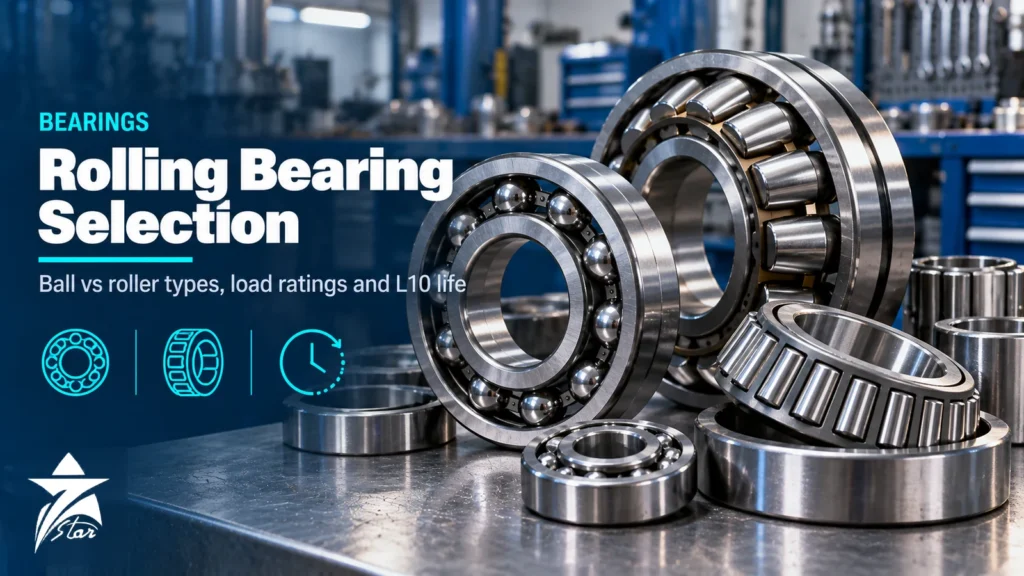
Most bearing problems on a plant are not exotic. A pump motor runs hot after an overhaul, a fan bearing fails every few months, or a store cannot find the exact part number printed on a worn-out ring. Good rolling bearing selection prevents most of these issues before they start. This guide explains how ball and roller bearings differ, how to read the dynamic and static load ratings, how the L10 life formula works and where it misleads, and which data you need to collect so a replacement bearing matches the original or improves on it.
How Rolling Bearings Carry Load
A rolling bearing transfers load from a rotating shaft to a housing through rolling elements running between an inner and an outer ring. The shape of the contact decides almost everything else. A ball touches the raceway at a small elliptical point, which gives low friction and high speed capability but limited load capacity. A roller touches along a line, which spreads the load and gives much higher capacity and stiffness, at the cost of higher friction and lower permissible speed.
The second deciding factor is the contact angle, the angle between the line of action of the load and a plane perpendicular to the shaft. A deep groove ball bearing has a nominal contact angle close to zero, so it is mainly a radial bearing that also carries moderate axial load in both directions. An angular contact ball bearing or a tapered roller bearing has a deliberate contact angle, so it carries heavy combined loads but only in one axial direction, which is why these bearings are normally mounted in pairs.
Ball vs Roller Bearing Types Compared
The table below summarises the bearing families you will meet most often in pumps, motors, fans, gearboxes and conveyors. Ratings are relative, for the same bore size.
| Bearing type | Radial load | Axial load | Misalignment tolerance | Speed capability | Typical applications |
|---|---|---|---|---|---|
| Deep groove ball | Moderate | Moderate, both directions | Very low | High | Electric motors, small pumps, fans |
| Angular contact ball | Moderate | High, one direction (pairs for both) | Very low | High | Pump thrust ends, compressors, spindles |
| Self-aligning ball | Light to moderate | Light | High | Moderate to high | Long shafts, agricultural and textile machines |
| Cylindrical roller (NU, N, NJ, NUP) | High | None to light, depending on flange design | Very low | High for a roller bearing | Motor drive ends, gearboxes, large pumps |
| Tapered roller | High | High, one direction | Low | Moderate | Gearboxes, wheel hubs, rolling mill rolls |
| Spherical roller | Very high | Moderate, both directions | High | Moderate | Vibrating screens, crushers, fans, plummer blocks |
| Needle roller | High for its size | None | Very low | Moderate | Compact gearboxes, rocker arms |
| Thrust ball or thrust roller | None or light | High | Low (spherical roller thrust: high) | Low to moderate | Vertical pumps, extruders, crane hooks |
Two practical points follow from this table. First, a self-aligning design (self-aligning ball or spherical roller) is the right answer when the shaft can deflect or the housings cannot be machined in one setup, for example on long fan shafts or structural steel frames. Second, a cylindrical roller bearing of type NU or N lets the shaft move axially inside the bearing, which makes it an ideal non-locating bearing but means it must always be paired with a bearing that locates the shaft axially. Browse typical families in our ball bearings and roller bearings categories.
Reading a Bearing Designation
Most metric bearings follow the ISO dimension series system. In a designation such as 6310, the first digit gives the bearing type (6 = deep groove ball), the second digit gives the dimension series, and the last two digits give the bore code. For bore codes 04 and above, multiply by 5 to get the bore in millimetres, so 6310 has a 50 mm bore. Codes 00, 01, 02 and 03 mean 10, 12, 15 and 17 mm respectively.
Suffixes describe the details that matter for interchangeability, and each manufacturer uses its own letters. Common examples are:
- Shields and seals: Z or ZZ for metal shields, RS, RSH or DDU style suffixes for contact rubber seals.
- Internal clearance: C2 (less than normal), CN or no suffix (normal), C3 and C4 (greater than normal).
- Bore shape: K for a 1:12 tapered bore used with adapter or withdrawal sleeves.
- Cage: suffixes for pressed steel, machined brass or glass-fibre reinforced polyamide cages.
- Internal design and precision: letters for improved internal designs, contact angle (for angular contact bearings) and tolerance class.
Because suffixes are not harmonised, never assume that the same letters mean the same thing across brands. Cross-reference by dimensions, internal design, clearance, cage, seal type and precision class, not by letters alone.
Dynamic and Static Load Ratings
Every catalogue bearing has two load ratings. The basic dynamic load rating C, defined in ISO 281, is the constant load under which a large population of identical bearings reaches a basic rating life of one million revolutions. It is used for rotating bearings and fatigue life. The basic static load rating C0, defined in ISO 76, corresponds to a contact stress that produces a small but acceptable permanent deformation of the rolling element and raceway. It is used for stationary, very slow or oscillating bearings and for shock loads.
Real bearings rarely see a pure radial or pure axial load, so the combined load is converted into an equivalent dynamic load P using the factors published for each bearing type: P = X × Fr + Y × Fa, where Fr is the radial load, Fa the axial load and X and Y the catalogue factors. For static checks, the equivalent static load P0 is calculated in a similar way and compared with C0 through the static safety factor s0 = C0 / P0. A low s0 means risk of raceway indentation, which later shows up as noise and early fatigue.
Many manufacturers also publish a fatigue load limit Pu. Below this load, and with clean, well-lubricated conditions, fatigue damage is very unlikely.
L10 Life Basics and a Worked Example
The basic rating life from ISO 281 is:
- L10 = (C / P)^p, in millions of revolutions
- L10h = 10^6 / (60 × n) × L10, in operating hours, with n in rpm
- p = 3 for ball bearings and p = 10/3 for roller bearings
L10 is a statistical value: 90% of a large group of identical bearings reaches or exceeds it before the first sign of rolling contact fatigue. It is not a prediction for a single bearing, and it says nothing about failures caused by contamination, lubrication or mounting.
A simple example with round numbers shows how sensitive life is to load. Take a ball bearing with C = 60 kN carrying P = 6 kN at 1,500 rpm. C/P = 10, so L10 = 10³ = 1,000 million revolutions and L10h = 10^9 / (60 × 1,500) ≈ 11,100 hours. If the load doubles to 12 kN, C/P falls to 5 and L10h drops to about 1,390 hours, one eighth of the original. For a roller bearing with the same C/P of 10, L10 = 10^(10/3) ≈ 2,154 million revolutions, or about 23,900 hours at 1,500 rpm. Belt over-tensioning, an unbalanced impeller or a misaligned coupling can raise P enough to cut real life dramatically.
Modified Rating Life: Reliability, Lubrication and Contamination
ISO 281 extends the basic formula to the modified rating life Lnm = a1 × aISO × L10. The factor a1 adjusts for a reliability other than 90%. Typical values from the standard are 1 for 90%, 0.64 for 95%, 0.55 for 96%, 0.47 for 97%, 0.37 for 98% and 0.25 for 99% reliability. Designing a critical single-train pump for 99% reliability therefore needs four times the basic L10 margin.
The life modification factor aISO combines three influences: the lubrication condition, expressed by the viscosity ratio κ (actual operating viscosity divided by the viscosity required for the bearing size and speed); the contamination factor ηc, which ranges from close to 1 for very clean lubricant to small values for heavily contaminated conditions; and the ratio of the fatigue load limit Pu to the equivalent load P. In clean, well-lubricated service aISO can exceed 1 by a large margin; with dirty grease and low viscosity it can fall well below 1. This is why improving sealing and lubricant cleanliness often extends life more than upsizing the bearing.
Selection Criteria Beyond Load
- Speed: compare operating speed with the reference speed (thermal) and limiting speed (mechanical) in the catalogue.
- Axial location: decide which bearing locates the shaft and which floats to accommodate thermal expansion of the shaft.
- Misalignment and shaft deflection: choose self-aligning types where deflection or housing misalignment cannot be avoided.
- Internal clearance: interference fits and a hot inner ring reduce operating clearance; select C3 or C4 where the original equipment manufacturer specifies it.
- Fits: rotating inner ring loads need an interference fit on the shaft; the stationary outer ring is normally a transition or loose fit in the housing.
- Stiffness and precision: machine tool spindles and pump thrust bearings may need preloaded angular contact pairs and a higher precision class.
- Lubrication and sealing: grease versus oil, sealed-for-life versus relubricated, and the seal type needed for the environment.
- Electrical current: inverter-fed motors may need current-insulated or hybrid bearings to prevent electrical erosion.
Locating and Non-Locating Arrangements
A shaft supported by two bearings must be fixed axially at one point only. The locating bearing carries axial loads in both directions; the non-locating bearing lets the shaft grow with temperature. Typical combinations are a deep groove ball bearing as locating bearing with a cylindrical roller bearing (type NU or N) as non-locating bearing on a motor, or two spherical roller bearings in plummer block housings where one housing is fitted with locating rings and the other is left free. Adjusted arrangements, such as a pair of tapered roller bearings, set the clearance or preload during assembly and are common in gearboxes. Fitting locating rings in both housings, or clamping both outer rings, is a frequent cause of overheating after a repair.
Data to Collect Before Specifying or Replacing a Bearing
- Full designation from the ring or box, including all prefixes and suffixes, and the manufacturer name.
- Boundary dimensions: bore, outside diameter and width, measured if markings are worn.
- Machine data: equipment type, power, speed, direction and type of loads, driven by belt or coupling.
- Position in the machine: drive end or non-drive end, locating or non-locating.
- Operating temperature of the bearing and the ambient, plus any heat source nearby.
- Lubrication method, lubricant name and relubrication interval.
- Environment: dust, water, chemicals, washdown, vibration from adjacent equipment.
- Failure history: how long the previous bearing lasted and what the damage looked like.
- Whether the motor is supplied by a variable speed drive.
GCC Operating Conditions
Ambient temperatures around 50 °C in summer, plus heat from the process and direct sun on outdoor skids, push bearing temperatures up and lower the lubricant’s operating viscosity. That reduces κ and, through aISO, the predicted life. When checking a design, use the real operating temperature rather than a catalogue default, and confirm that the lubricant still provides adequate viscosity. Fine wind-blown sand is a strong abrasive; contact seals, labyrinths and correct grease purging matter more than a larger bearing. Coastal plants and desalination sites add humid, salty air, so standby equipment can suffer moisture corrosion and false brinelling if it never turns. Motors on variable frequency drives, common in water and HVAC services, need attention to shaft voltages; our guide to VFD selection for hot climates covers the drive side of that problem.
Common Rolling Bearing Selection Mistakes
- Replacing a C3 bearing with a normal-clearance bearing because the dimensions match.
- Swapping sealed and open bearings without changing the lubrication method.
- Upsizing to a roller bearing when the real issue is contamination or misalignment.
- Ignoring axial load from a belt pulley, helical gear or impeller thrust in the life calculation.
- Using one locating bearing too many and leaving no room for shaft expansion.
- Relying on L10 alone without monitoring; trends from a vibration monitoring system show when real conditions differ from the design.
Rolling Bearing Selection Checklist
- Identify loads (radial, axial, shock) and speed at all operating points.
- Choose the bearing family that suits the load direction, misalignment and speed.
- Check L10h and, where data is available, the modified life Lnm with realistic κ and contamination.
- Check the static safety factor for shock and standstill loads.
- Confirm the locating and non-locating arrangement.
- Select fits, internal clearance, cage and precision class.
- Choose lubrication method and sealing for the actual environment.
- Verify the speed rating with the chosen seals and lubricant.
- Record the full designation and drawing references for future spares.
Bearings We Supply, by Load Type
The bearing type follows from the load direction, speed and misalignment worked out above. These examples from our catalogue cover the main types; the exact size, clearance and cage still come from your L10 calculation and the shaft and housing fits.
| Product | Type | Where it fits |
|---|---|---|
| SKF 6206-2RS1 Deep Groove Ball Bearing | Sealed deep groove ball bearing | Electric motors, fans and small pumps with mainly radial loads. |
| NSK 7208A Single-Row Angular Contact Ball Bearing | Single-row angular contact ball bearing | Combined radial and axial loads, usually mounted as a pair. |
| NSK 7304AWDT Matched Angular Contact Ball Bearings | Matched angular contact pair | Higher axial load in one direction than a single bearing can carry. |
| Timken 32206 Tapered Roller Bearing | Tapered roller bearing | Heavy combined loads in gearboxes and wheel hubs. |
| Timken Single-Row Cylindrical Roller Bearings NU N NJ NUP ETP EJ EMA | Cylindrical roller bearing | High radial loads, and axial float at the non-locating end of the shaft. |
| Timken 22216EJW33 Spherical Roller Bearing | Spherical roller bearing | Heavy loads where the shaft deflects or the housings are not perfectly aligned. |
| NSK 51208 Thrust Ball Bearing | Thrust ball bearing | Pure axial loads at low to moderate speed. |
For replacements, the full designation on the bearing ring, including suffixes for seals, clearance and cage, is what we need. Send it through our quote request form.
Sourcing Rolling Bearings Through Seven Star LLC
Seven Star LLC supplies ball, roller and specialty bearings from established manufacturers on request for plants in Oman and across the GCC. We help with selection and with cross-checking part numbers and suffixes between brands, and availability and lead time are confirmed at quotation. You can also see related items in our bearings and power transmission range.
Send us the bearing designation, a photo of the ring markings or the equipment nameplate and datasheet, and we will prepare an RFQ response with matching options.
Frequently asked questions
What is the difference between L10 and L10h?
L10 is the basic rating life in millions of revolutions that 90% of a large group of identical bearings will reach or exceed before fatigue appears. L10h is the same life expressed in operating hours at a constant speed, calculated as L10h = 10^6 / (60 × n) × L10. L10h is easier to compare against maintenance intervals and plant run lengths.
Why is the life exponent 3 for ball bearings and 10/3 for roller bearings?
The exponent reflects the different contact geometry: balls make point contact and rollers make line contact, so stress rises differently with load. ISO 281 uses p = 3 for ball bearings and p = 10/3 for roller bearings. The practical consequence is that life is very sensitive to load; doubling the load on a ball bearing reduces its L10 life to one eighth.
When should I choose a C3 clearance bearing instead of normal clearance?
C3 has more radial internal clearance than normal (CN) and is commonly chosen when the inner ring has a tight interference fit, when the inner ring runs much hotter than the outer ring, or when the shaft speed and temperature are high, as in many electric motors. Too much clearance in a lightly loaded bearing can cause skidding and noise, so follow the original equipment designation unless there is a documented reason to change.
Can I replace a deep groove ball bearing with a cylindrical roller bearing to get more life?
Not directly. A cylindrical roller bearing carries much more radial load but little or no axial load (NU and N types carry none), it tolerates very little misalignment and it changes the locating arrangement of the shaft. Any type change should be checked against axial loads, speed limits, housing dimensions and the shaft arrangement by the equipment designer or an experienced reliability engineer.
What does the static safety factor s0 tell me?
The static safety factor s0 = C0/P0 compares the basic static load rating with the equivalent static load, including shock peaks. It guards against permanent indentation of the raceways when the bearing is stationary, oscillating or slow-turning. Manufacturers publish minimum s0 values that are higher where quiet running is required or where shock loads are uncertain.
Why do bearings fail well before their calculated L10 life?
The basic L10 formula assumes clean, adequately lubricated bearings correctly mounted and aligned. In practice contamination, wrong lubricant viscosity, misalignment, poor fits and mounting damage shorten life far more than load does. That is why ISO 281 adds the modified rating life with the aISO factor, which accounts for lubrication condition and contamination level.
Was this guide helpful?One click helps us write better guides for engineers.
Thank you! Glad it helped. Need this equipment for your project? Request a quotation
Thank you. We will use this to improve the guide.