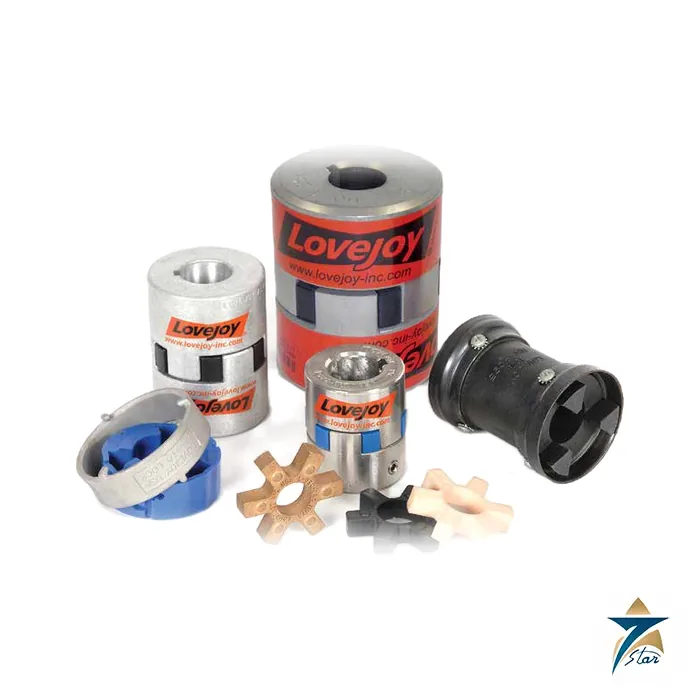
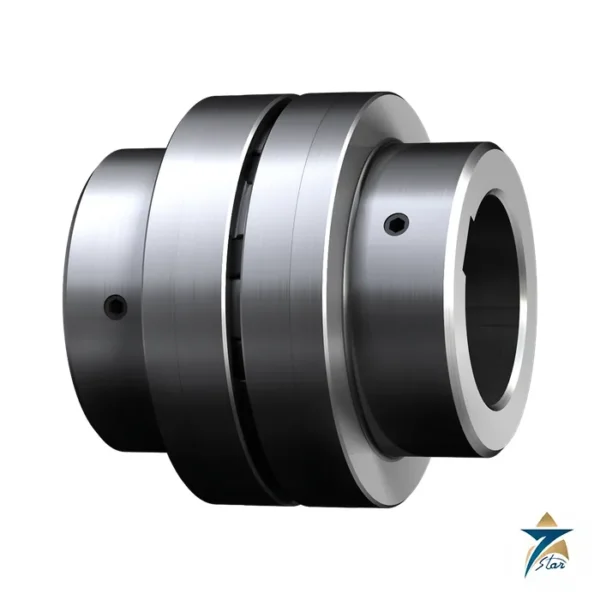
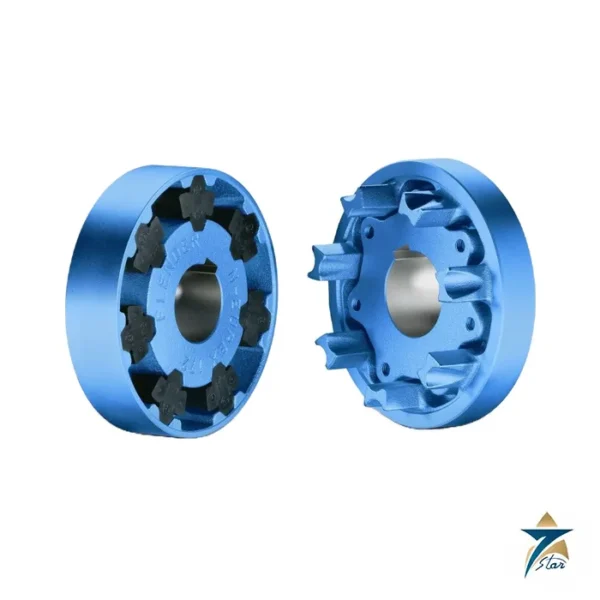
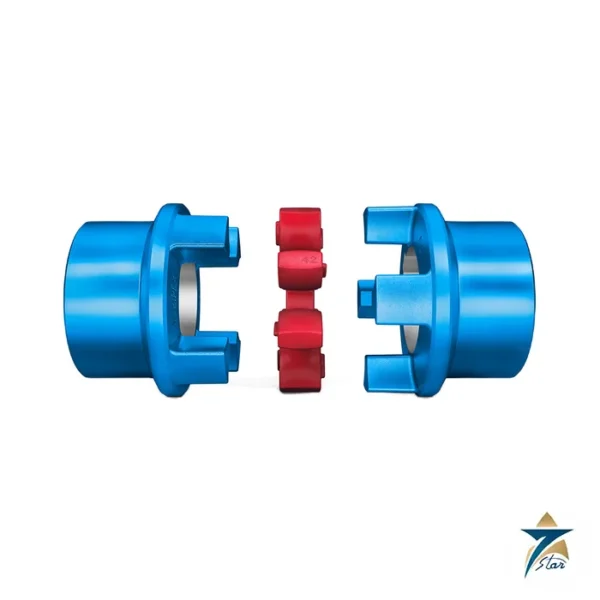
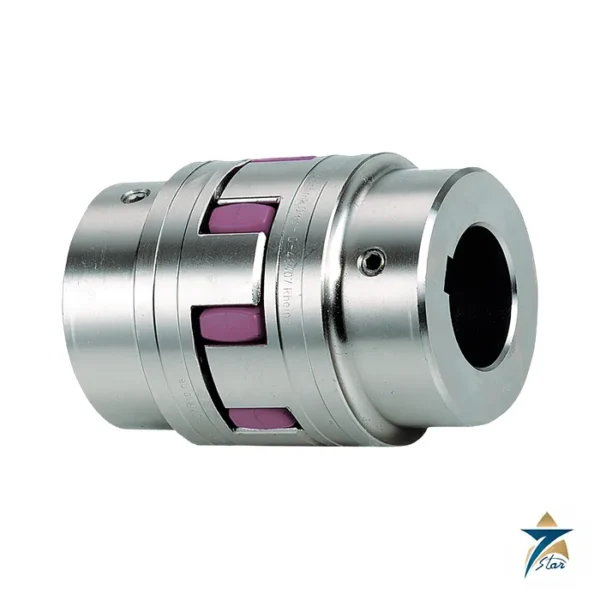
Lovejoy L100 is the 1.375 in (35 mm) maximum-bore size of the Lovejoy L Type jaw coupling: two sintered-iron hubs with three jaws each and an elastomer spider that transmits torque in compression between them. The jaw catalogue presents the L Type as the standard shaft-to-shaft connection for general industrial duty, with no lubrication and a fail-safe jaw engagement if the spider fails.
A three-jaw coupling for motor-to-machine shafts
Lovejoy states that its jaw couplings serve power transmission to industrial equipment such as pumps, gear boxes, compressors, blowers, mixers and conveyors, driven by electric motors and internal combustion engines. The L100 sits in the middle of the L035 to L276 range, which spans 3.5 in-lb to 4,716 in-lb with the standard spider, so it is a common choice for a motor of a few kilowatts at 1,450 or 1,750 RPM driving a centrifugal pump or a screw conveyor.
The catalogue lists these advantages: resistance to oil, dirt, sand, moisture and grease, no metal-to-metal contact, more than 850,000 bore combinations across the range, and most types available from stock in 24 hours (a manufacturer statement). Hubs for L035 to L190 are sintered iron; L225 and L276 are cast iron.
Technical specifications
| Parameter |
Specification |
| Coupling type |
L Type jaw coupling: 2 hubs + 1 spider |
| Size |
L100 |
| Hub material |
Sintered iron |
| Jaws per hub |
3 |
| Bore range |
0.438 in (12 mm) minimum to 1.375 in (35 mm) maximum |
| Overall length (OAL) |
3.48 in |
| Hub length through bore (LTB) |
1.38 in |
| Gap between hubs (G) |
0.71 in |
| Hub outside diameter (OD and HD) |
2.54 in |
| Set screw |
5/16-18 thread, one per hub as standard |
| Weight, solid hubs / maximum bore |
3.20 lb / 2.40 lb (as printed) |
| Moment of inertia WR2 |
2.783 lb-in2 |
| Maximum speed |
7,000 RPM NBR, 3,600 RPM Hytrel |
| Maximum angular misalignment |
1 deg NBR and urethane, 1/2 deg Hytrel and bronze |
| Maximum parallel misalignment |
0.015 in (bronze 0.010 in) |
Spider performance for the L100 size, from the jaw catalogue:
| Spider |
Hardness |
Temperature range |
Rated torque |
Power or speed note |
| SOX (NBR), black |
80A |
-40 to 212 F (-40 to 100 C) |
417 in-lb / 47.1 Nm |
11.9 HP at 1,800 RPM |
| Urethane, blue |
90-95A |
-30 to 160 F (-34 to 71 C) |
626 in-lb / 70.7 Nm |
not listed |
| Hytrel, tan |
55D |
-60 to 250 F (-51 to 121 C) |
1,134 in-lb / 128 Nm |
32.4 HP at 1,800 RPM |
| Bronze |
rigid |
-40 to 450 F (-40 to 232 C) |
1,134 in-lb / 128 Nm |
250 RPM maximum |
L Type sizes in the same family
Standard NBR torque and maximum bore for each size, so the L100 can be compared with its neighbours:
| Size |
Nominal torque, NBR |
Maximum bore |
| L035 |
3.5 in-lb |
0.375 in (9 mm) |
| L050 |
26.3 in-lb |
0.625 in (16 mm) |
| L070 |
43.2 in-lb |
0.750 in (19 mm) |
| L075 |
90 in-lb |
0.875 in (22 mm) |
| L090 |
144 in-lb |
1.000 in (25 mm) |
| L095 |
194 in-lb |
1.125 in (28 mm) |
| L099 |
318 in-lb |
1.188 in (30 mm) |
| L100 |
417 in-lb |
1.375 in (35 mm) |
| L110 |
792 in-lb |
1.625 in (42 mm) |
| L150 |
1,240 in-lb |
1.875 in (48 mm) |
| L190 |
1,728 in-lb |
2.125 in (55 mm) |
| L225 |
2,340 in-lb |
2.625 in (65 mm) |
| L276 |
4,716 in-lb |
2.875 in (73 mm) |
Selecting and ordering the L100
Find the nominal torque as HP x 63,025 / RPM in in-lb (or kW x 9,550 / RPM in Nm), multiply by the application service factor, and choose the first spider rating at or above that design torque. The catalogue worked example gives a service factor of 1.25 for a standard-torque electric motor driving a rotary pump. Then confirm both shaft diameters fit the maximum bore.
Order two hubs and one spider using the UPC tables, adding the printed 685144 prefix. For the L100 the catalogue lists, for example, NBR solid spider 11494, NBR open-centre spider 11492, Hytrel open-centre spider 11486, bronze open-centre spider 11497, and a 1-3/8 in hub with 5/16 x 5/32 keyway 11522 or a 35 mm unkeyed hub 41332. Hubs ship with one set screw; spline-bore hubs carry the L-LOC clamping feature.
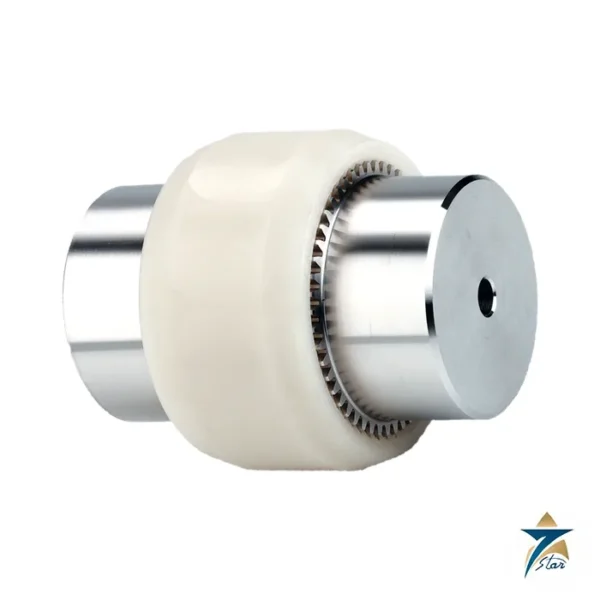
Related jaw couplings from other makers on this site include the KTR ROTEX torsionally flexible jaw coupling; sizes and spiders are not interchangeable without a manufacturer check.
Installation and operation notes
The catalogue warnings are specific: do not exceed catalogue ratings, avoid sudden shock loads at start-up, do not run with improper alignment or damaged elastomers, and inspect the assembly shortly after first operation and periodically afterwards. A healthy coupling runs quietly and smoothly; vibration or a beating sound means shut down and recheck alignment. The catalogue also notes that critical speeds matter for applications involving reciprocating drivers or driven devices.
Where the L100 is used
Typical duties are centrifugal pumps (service factor 1.25 with a standard-torque motor), blowers, light conveyors and mixers. In hot, dusty or oily plants the compression-loaded spider needs no grease and the catalogue lists resistance to oil, dirt and sand; choose Hytrel where ambient or process heat exceeds the NBR limit of 212 F. Lovejoy states that it does not supply these products for elevators, man lifts or other equipment that carries people.
Frequently asked questions
What does the L100 size cover?
The L100 accepts bores up to 1.375 in (35 mm), carries 417 in-lb (47.1 Nm) with the standard NBR spider and runs to 7,000 RPM with that spider, per the jaw catalogue ratings.
Does the L Type coupling need lubrication?
No. The catalogue describes jaw couplings as requiring no lubrication, with no metal-to-metal contact between hubs.
What happens if the spider wears out?
The jaw design is described as fail-safe: the hubs still engage if the elastomer fails, but the spider should be replaced as soon as wear or damage is found.
Which spider material suits higher temperature?
Hytrel is rated -60 to 250 F (-51 to 121 C) and 1,134 in-lb on L100, against -40 to 212 F for standard NBR; its speed limit on this size is 3,600 RPM.
How are Lovejoy L Type parts ordered?
Select two hubs and one spider by UPC number from the bore and keyway tables and add the 685144 prefix printed in the catalogue.
Documents and quotation
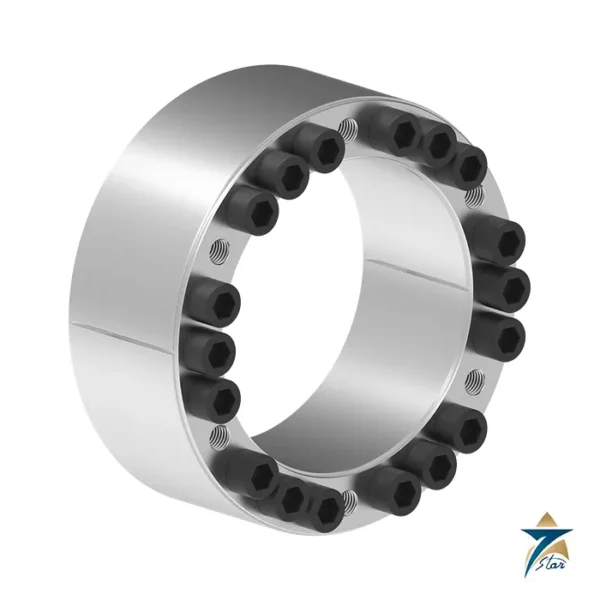
The Lovejoy jaw coupling catalogue section is hosted on this page. See more in Couplings and Shaft Locking Devices. Seven Star LLC is an independent supplier in Muscat; send the size, both bore and keyway sizes, spider material and quantity for a quotation.


Reviews
There are no reviews yet.