- AC Drives
- Industrial Communications
- PLC & I/O Cards
- Vibration Monitoring
- Automation Accessories
- Controllers & Data Acquisition
- CCTV & Security
- Encoders
- Industrial Computers
- Safety Switches & Guard Locking
- HMI Displays
- Motor Soft Starters
- Isolator & Barrier
- Pneumatic Cylinders
- Servo Drives
- Automation Software
- Robotics
- Machine Vision
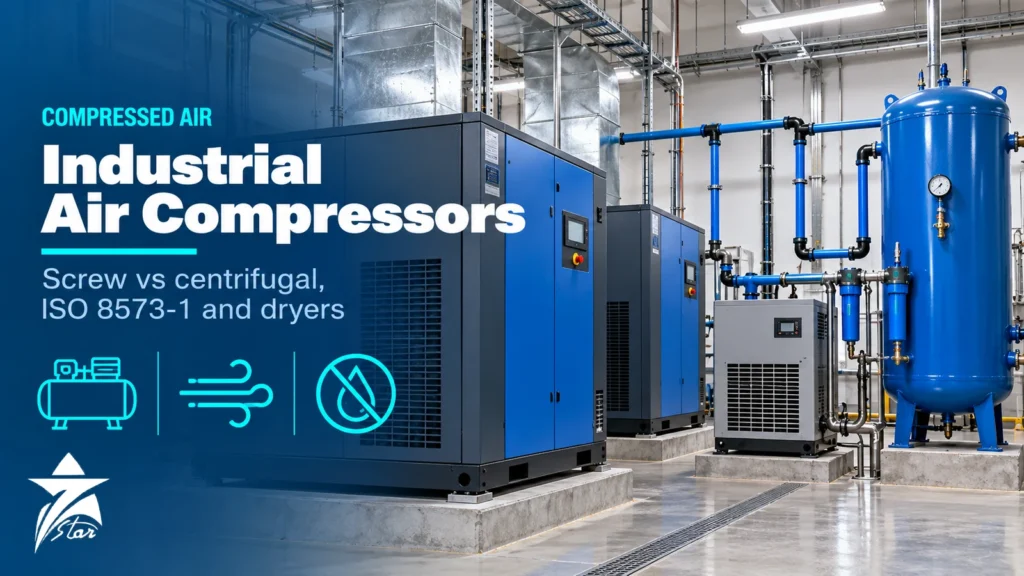
Compressed air is one of the most expensive utilities on an industrial site per unit of useful energy, and on oil and gas facilities it also feeds the instrument air that keeps control valves, actuators and shutdown valves working. Choosing between screw, centrifugal and reciprocating industrial air compressors is only half the decision; the other half is the air quality the users need and the dryers and filters that deliver it. This guide compares the three compressor technologies, explains ISO 8573-1 purity classes, matches dryer types to dew point targets and lists what to specify for a hot, dusty GCC site.
How the Three Types of Industrial Air Compressors Work
Rotary Screw Compressors
Two meshing helical rotors trap air and reduce its volume as it moves along the rotors. In oil-injected (oil-flooded) machines, oil seals the rotor clearances, removes the heat of compression and lubricates the rotors; it is then separated from the air in a separator vessel, leaving a small carryover that downstream filters must remove. Oil-free screw compressors use timing gears to keep the rotors apart, compress in two stages with intercooling and deliver air free of injected oil. Screw machines cover the widest part of the industrial range, deliver steady pulsation-free air and handle continuous duty well.
Centrifugal Compressors
A high-speed impeller accelerates the air and a diffuser converts velocity into pressure. Most industrial plant-air units have two or three stages with intercoolers. The compression path is oil-free by design, because the bearings and gearbox are separated from the air by shaft seals. Centrifugals are efficient at high, steady flows and are usually chosen for large central air plants. Their limitation is surge: below a minimum flow the machine becomes unstable, so turndown is limited and excess air is blown off unless the control system and system storage are designed for it. Delivered mass flow also falls as inlet air temperature rises, which matters in the Gulf summer.
Reciprocating (Piston) Compressors
A piston in a cylinder compresses air in each stroke. Single- and two-stage lubricated units are common for workshops and small intermittent demands; oil-free designs with non-lubricated rings exist for clean-air duties. Reciprocating compressors reach high pressures easily, which is why they are still used for breathing air cylinders, high-pressure start air and test benches. For continuous plant air they carry more maintenance (valves, rings, packing), higher noise and pulsating flow that needs a receiver.
Screw vs Centrifugal vs Reciprocating Compared
| Criterion | Rotary screw | Centrifugal | Reciprocating |
|---|---|---|---|
| Typical role | General plant and instrument air, small to large | Large central air plants with steady base load | Small or intermittent demand, high pressure |
| Oil in compression chamber | Oil-injected or oil-free versions | Oil-free by design | Lubricated or oil-free versions |
| Flow character | Smooth, continuous | Smooth, continuous | Pulsating; needs receiver |
| Part-load control | Load/unload, inlet modulation or variable speed | Inlet guide vanes or throttling within surge limit, then blow-off | Start/stop or load/unload |
| Main limitations | Oil carryover on injected units; airend overhaul interval | Surge; sensitive to inlet temperature and cooling water | Wear of valves and rings; noise and vibration |
| Typical maintenance items | Oil, oil filter, separator element, air filter, airend bearings | Air filter, oil system for bearings, intercooler cleaning, seals | Valves, rings, packing, crankcase oil |
A common arrangement on larger sites is one or more fixed-speed machines carrying base load and a variable speed screw compressor trimming demand. Variable speed drives save energy only when demand actually varies; on a steady full-load machine they add losses and cost. For drive selection in high ambient conditions, our article on variable frequency drive selection for hot climates covers derating and cabinet cooling.
ISO 8573-1 Air Quality Classes Explained
ISO 8573-1:2010 specifies compressed air purity with three numbers in the format particles : water : oil, written for example as ISO 8573-1:2010 [1:2:1]. A lower class number means cleaner air. Class 0 does not mean zero contamination; it means a limit stricter than Class 1 that is agreed between the user and the equipment supplier and stated explicitly.
| Class | Water: pressure dew point | Total oil (aerosol, liquid and vapour) |
|---|---|---|
| 1 | ≤ −70 °C | ≤ 0.01 mg/m³ |
| 2 | ≤ −40 °C | ≤ 0.1 mg/m³ |
| 3 | ≤ −20 °C | ≤ 1 mg/m³ |
| 4 | ≤ +3 °C | ≤ 5 mg/m³ |
| 5 | ≤ +7 °C | — |
| 6 | ≤ +10 °C | — |
Classes 7 to 9 for water describe liquid water content rather than dew point and are relevant only to non-critical air. Particle classes are defined by counts of particles in size bands for Classes 1 to 5, and by mass concentration for the higher classes. Testing and measurement methods are given in the other parts of the ISO 8573 series.
What Class Do Typical Users Need?
- Instrument air for positioners and actuators: dry air with a dew point well below the lowest temperature the piping sees. ANSI/ISA-7.0.01 asks for a dew point at line pressure at least 10 °C below the minimum ambient temperature, limits particle size to 40 µm and oil to as close to zero as possible. Many owners specify a −40 °C pressure dew point (water Class 2) regardless of climate.
- General plant air and tools: often Class 4 water (+3 °C dew point) from a refrigerant dryer with general purpose filtration.
- Food, pharmaceutical and electronics contact: oil Class 1 or Class 0 as specified, usually with oil-free compressors plus filtration.
- Breathing air: governed by separate breathing air standards and requires gas monitoring, not just ISO 8573-1 classes.
Modern valve positioners have small nozzles and spool valves that are sensitive to oil and moisture, so a poor instrument air system shows up as sticky control valves and positioner failures long before anyone measures dew point.
Dryer Types and the Dew Point They Achieve
| Dryer type | Typical pressure dew point | Notes |
|---|---|---|
| Refrigerated | About +3 °C to +7 °C (water Class 4–5) | Low energy; capacity falls with high ambient and inlet temperature; needs correction factors above rating conditions |
| Heatless desiccant (pressure swing) | −40 °C, or −70 °C with suitable design | Simple; uses a portion of dried air for regeneration purge, which is a continuous energy cost |
| Heated purge / blower purge desiccant | −40 °C typical | Lower purge losses than heatless; heaters and blowers to maintain |
| Heat-of-compression | Varies with compressor discharge temperature | Uses hot air from oil-free compressors to regenerate desiccant; very low running cost |
| Membrane | Depends on design and purge | Small point-of-use flows, no power needed |
Size dryers for the worst case: maximum flow, maximum inlet temperature, maximum ambient and minimum inlet pressure. Manufacturers rate refrigerated dryers at standard reference conditions; at higher ambient and inlet temperatures the correction factors can reduce capacity significantly, so a dryer selected on nameplate flow alone will often deliver wet air in August. Dew point sensors after the dryer, with alarm, are the only way to know what the dryer actually delivers.
Filtration Around the Dryer
Filtration is matched to the target class. A typical instrument air train is: compressor aftercooler and water separator, a general purpose coalescing filter, a high-efficiency coalescing filter for oil aerosol, the dryer, then a particulate after-filter to catch desiccant dust. Where oil vapour must be reduced to Class 1, an activated carbon stage follows the coalescers on oil-injected systems. Differential pressure indicators on each filter housing show when filter elements need replacement; elements should be changed on schedule even if pressure drop looks low, because coalescing efficiency can degrade before pressure drop rises.
Sizing and Specification Data to Collect
- Total air demand: sum of continuous users, intermittent users with their duty cycle, and leakage allowance. Measure the existing system if possible.
- Required pressure at the furthest user, plus pressure drop through dryers, filters and piping.
- Air quality class for each user group (ISO 8573-1 particles : water : oil).
- Site conditions: maximum and minimum ambient, relative humidity, altitude, dust load, indoor or outdoor installation.
- Cooling medium: air-cooled or water-cooled, and cooling water temperature and quality.
- Power supply, hazardous area classification of the compressor location and air intake.
- Redundancy philosophy (for example N+1 compressors and dryers) and receiver volume.
- Applicable specifications: in refinery and gas plant service, API 619 (rotary positive displacement compressors, including screw machines) and API 672 (packaged integrally geared centrifugal air compressors) are often referenced.
When comparing offers, ask for performance per ISO 1217 (displacement compressors) and the specific energy at your operating pressure. Free air delivery stated at different reference conditions or pressures cannot be compared directly.
Compressors in Hot, Dusty GCC Conditions
- Specify the package for the true maximum ambient, around 50 °C at many sites, including sun-exposed enclosures. Standard packages are often rated for lower ambient temperatures.
- Air-cooled oil coolers and aftercoolers lose capacity in heat; high discharge temperature trips in summer afternoons are a classic symptom of undersized coolers or blocked fins.
- Use heavy-duty or two-stage intake filtration where sand and dust are present, and duct the intake from a cool, shaded, clean location.
- Compressor rooms need forced ventilation sized to remove most of the input power as heat; recirculating hot exhaust air into the intake degrades capacity and reliability.
- Coastal humidity puts heavy water load on dryers and condensate drains; zero-loss level-sensing drains avoid the air waste of timed drains.
- In gas plants, keep the air intake outside hazardous areas and away from potential gas release points.
Maintenance and Troubleshooting Pointers
- High oil carryover on a screw compressor: separator element saturated or damaged, scavenge line blocked, or oil level too high.
- High discharge temperature: dirty coolers, wrong oil, thermostatic valve fault or high ambient.
- Centrifugal compressor blowing off continuously: demand below its turndown range; review sequencing or add a trim machine.
- Wet air downstream of a refrigerated dryer: overloaded or bypassed dryer, failed drain, or ambient beyond the dryer’s corrected capacity.
- Pressure falling at remote users: undersized piping, clogged filters or leaks; perform a leak survey before buying more compressor capacity.
Compressed Air System Checklist
- Demand profile measured or estimated, including leakage.
- Compressor type chosen for size and load profile; base load and trim strategy defined.
- ISO 8573-1 class defined for each user group, with instrument air dew point well below minimum ambient.
- Dryer and filters sized at worst-case temperature and flow, with correction factors applied.
- Dew point monitoring and filter differential pressure indication installed.
- Package rated for site maximum ambient, dust and humidity.
- Receiver volume and redundancy agreed; condensate handled to local discharge rules.
Compressed Air Equipment We Supply
These products cover each stage of the air system described above, from generation through drying and filtration to measurement. Choose the dryer and filter grades from the ISO 8573-1 class you need at the point of use, not from the compressor outlet.
| Product | Type | Where it fits |
|---|---|---|
| Atlas Copco GA VSD+ Series Oil-Injected Rotary Screw Compressor | Oil-injected rotary screw compressor, variable speed | Plants whose air demand changes through the day, where a VSD saves energy compared with load/unload control. |
| Ingersoll Rand Next Generation R-Series Oil-Flooded Rotary Screw Compressor | Oil-flooded rotary screw compressor | Continuous plant and instrument air supply. |
| Kaeser SECOTEC TA-TC Refrigeration Air Dryers, 0.65-3.9 m3/min | Refrigeration dryer | General plant air where a pressure dew point of about +3 °C is enough. |
| Kaeser DC 2.0-DC 11.3 Heatless Desiccant Air Dryers | Heatless desiccant dryer | Instrument air and outdoor lines that need a pressure dew point of -40 °C or lower. |
| Kaeser KF F6-F320 Compressed Air Filters, 0.6-32 m3/min | Compressed air filters | Particle and oil aerosol removal before and after the dryer, graded to the purity class required. |
| CS Instruments FA 510/515 – Dew Point Sensor for Compressed Air & Gases | Dew point sensor | Checking that the dryer really delivers the humidity class you specified. |
| CS Instruments VA 500 Thermal Mass Flow Meter for Compressed Air | Thermal mass flow meter for compressed air | Measuring consumption and finding leaks before you buy a bigger compressor. |
For spares such as separator elements, filter elements, dryer desiccant and service kits, send the compressor or dryer model and serial number through our quote request form.
Sourcing Industrial Air Compressors Through Seven Star LLC
Seven Star LLC supplies industrial compressors, dryers, filter housings and replacement elements, separators and compressor spare parts on request for customers in Oman and the GCC. We help with selection and with cross-checking part numbers against your existing packages; availability and lead time are confirmed at quotation.
Send your air demand, required ISO 8573-1 class, the nameplate of your current compressor or your RFQ, and we will prepare options for your review.
Frequently asked questions
What does ISO 8573-1:2010 [1:2:1] mean?
The three numbers are the purity classes for particles, water and oil in that order. [1:2:1] means particle Class 1, water Class 2 (pressure dew point of −40 °C or lower) and oil Class 1 (total oil no more than 0.01 mg/m³). Lower numbers mean cleaner air.
Is a centrifugal compressor better than a screw compressor?
Neither is better in general. Centrifugal compressors are efficient and oil-free at large, steady flows but have limited turndown because of surge. Screw compressors cover a wider range of sizes and handle variable demand well, especially with variable speed drives.
What dew point does instrument air need?
ANSI/ISA-7.0.01 asks for a pressure dew point at least 10 °C below the lowest temperature the instrument air system is exposed to. Many oil and gas owners simply specify −40 °C pressure dew point, which a desiccant dryer can deliver.
Does an oil-free compressor mean Class 0 air?
No. Class 0 is a limit stricter than Class 1 that must be stated explicitly, and it applies to the air at the point of use. Intake air can contain hydrocarbons and particles, so an oil-free compressor still needs appropriate filtration and verification to meet a specified class.
Why does my refrigerated dryer deliver wet air in summer?
Refrigerated dryers are rated at reference inlet and ambient temperatures. At high ambient and inlet temperatures their capacity falls, so a dryer sized on nameplate flow can be overloaded. Check the manufacturer's correction factors, the condensate drain and the cooler condition.
What data is needed to quote a replacement compressor?
Air demand and its variation, required pressure at the users, air quality class, site ambient range, cooling medium, power supply, hazardous area classification and redundancy requirements. For a direct replacement, the nameplate and model of the existing unit are the fastest starting point.
Was this guide helpful?One click helps us write better guides for engineers.
Thank you! Glad it helped. Need this equipment for your project? Request a quotation
Thank you. We will use this to improve the guide.