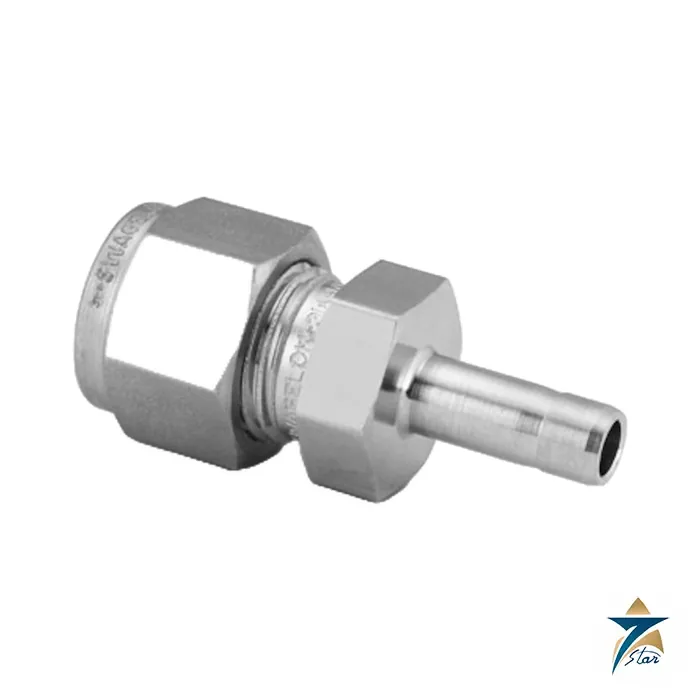
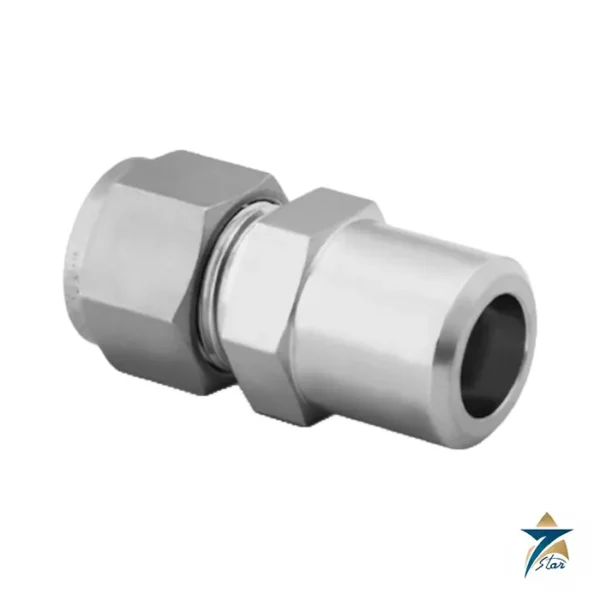
The Swagelok SS-600-R-4 is a reducer in the strict Swagelok sense: a 3/8 in. tube-fitting end on one side and a plain 1/4 in. tube stub on the other. The stub is not meant to take a nut. It is designed to be inserted into the 1/4 in. tube port of another Swagelok fitting body, so a 3/8 in. line can be reduced into an existing 1/4 in. port, such as the port of a valve, tee or union already in the system.
Technical specifications
| Parameter |
Specification |
| Part number |
SS-600-R-4 |
| Description |
Reducer, 3/8 in. tube-fitting end x 1/4 in. tube stub |
| Body material |
316 stainless steel (bar stock) |
| Large end (T) |
3/8 in. tube OD, Swagelok tube fitting |
| Stub end (Tx) |
1/4 in. tube OD, plain tube stub |
| Dimension A (overall length) |
1.63 in. |
| Dimension D (nut size) |
0.66 in. |
| Dimension E (nominal opening) |
0.17 in. |
| Hex flat F |
5/8 in. |
| Cleaning |
Standard cleaning and packaging SC-10 |
| Catalog guidance |
Use long reducers in female Swagelok end connections |
What a reducer actually does
A reducer saves a fitting. Instead of placing a union and a separate tube stub between a 3/8 in. line and a 1/4 in. port, the stub is built into the body and slides into the port of the next fitting where the nut of that fitting makes the seal. Swagelok lists reducers as straight fittings with a size pair, T for the nut end and Tx for the stub. The 0.17 in. nominal opening is the narrowest part of the passage and fixes the flow restriction of this reduction.
At 1.63 in. overall, it is compact, but the stub must be fully seated in the receiving fitting. The catalog advises using only long reducers in female Swagelok end connections, a point that matters when the stub will be inserted into a deep tube port.
Ordering and alternatives
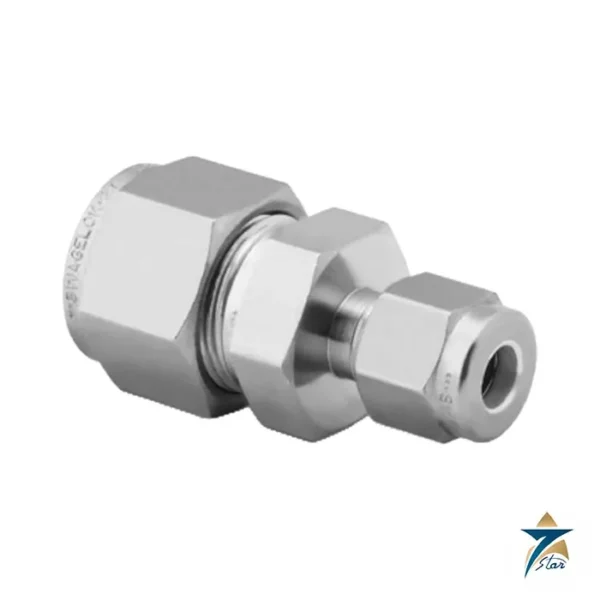
SS-600-R-4: 316 stainless, 3/8 in. tube (600), R for reducer, 4 for the 1/4 in. stub size. The catalog lists reducers from the 3/8 in. size down to 1/4 in. (R-4), 1/8 in. (R-2) and up to 1/2 in. (R-8 on larger bodies), plus metric versions. A reducing union such as SS-810-6-4 is the right alternative when both ends are tubing and each needs a nut.
There is also a bulkhead reducer and a long reducer in the catalog; confirm which is needed before quoting. Cleaning and packaging suffixes CP and BQ are available.
Installation
Make sure the stub is clean and square, push it to the bottom of the receiving port and tighten the nut of the receiving fitting as for ordinary tubing, one and one-quarter turns from finger-tight on 1/4 in. and larger sizes. At the 3/8 in. end of the reducer use the same procedure. The Swagelok gap inspection gauge applies to each nut made up.
The pressure limit follows the tubing on each side and the receiving fitting. Because a stub cannot be pulled up like a tube, reducers are not a substitute for proper tube connections where vibration is severe.
Selection checks for the SS-600-R-4
Before choosing this reducer, confirm the actual outside diameter of both lines with a tube gauge or calliper, because fractional and metric tubing of similar size can look alike in the field and do not mix. Check that the receiving fitting has a 1/4 in. Swagelok tube port and that its depth suits the stub, keeping in mind the catalog note about long reducers in female end connections. Review the pressure and temperature conditions of the line against the ratings in the catalog for the tubing and the receiving fitting, since the reducer does not raise the limit set by the weakest part of the connection. Finally, check that the narrower opening is acceptable for the flow, especially on sample lines, purge lines and instrument impulse lines where response time matters.
Making up the connection on site
Cut the 3/8 in. tube square, deburr it inside and outside, and remove chips and dust so that nothing enters the instrument or valve downstream. Mark the nut before tightening so the number of turns can be counted, and do not mix components from other manufacturers with the Swagelok fitting. Support the tubing close to the reducer so that the weight of the line, or of a valve hanging on it, does not load the joint, and leave a short straight length at each fitting so that the tube can enter squarely.
Leak testing and reassembly
Test the completed line with the medium and test method required by the site procedure before it is put into service. When a connection is taken apart for maintenance, mark the position of the nut and follow the Swagelok reassembly instructions in the catalog, inspecting the parts for damage before reusing them.
Instrument tubing in Oman and GCC conditions
Instrument and sample tubing on oil, gas, desalination and chemical sites in Oman and across the Gulf is exposed to strong sun, large daily temperature swings and, near the coast, salty and humid air. Thermal expansion of long tube runs can push on fittings, so allow for movement with bends and proper clamping instead of straight rigid runs between fixed points. Wash sand and salt deposits from exposed fittings during routine maintenance, and inspect stainless steel tubing and fittings near the sea for staining or pitting, which can point to crevice corrosion under clamps or deposits. Keep spare fittings in their packaging until use so that dust does not reach the sealing surfaces. On a new installation, a brief walk-down of all reducers and other tube fittings after the first heat cycle helps the team find any joint that needs attention before the line is handed over to operations.
Documents and quotation
The reference for this page is Swagelok catalog MS-01-140, Gaugeable Tube Fittings and Adapter Fittings. It holds the ordering numbers, dimension tables, pressure ratings and installation steps summarised above, and is attached for download. Send SS-600-R-4 with the quantity and any cleaning or packaging option and we will quote.
Related items: product category.





Reviews
There are no reviews yet.