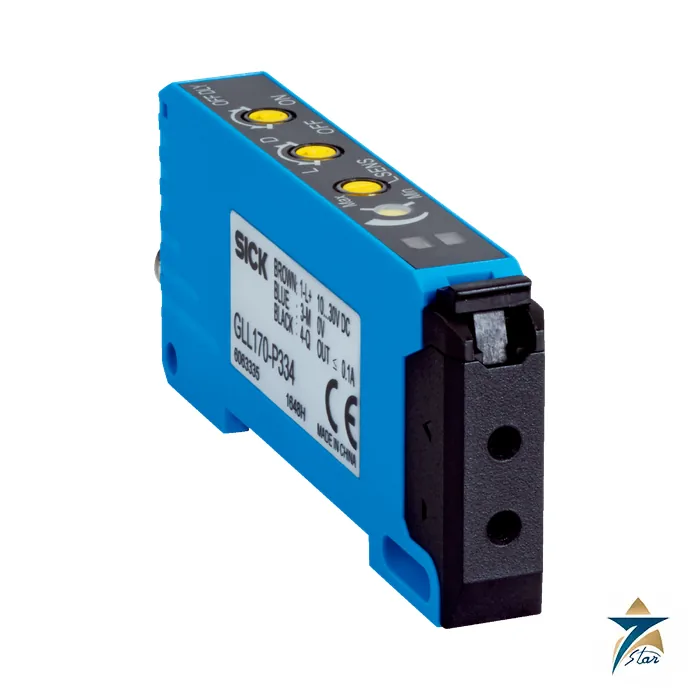
GLL170-P334 is a SICK GLL170 fiber-optic amplifier (part no. 6063335), a stand-alone unit with PNP switching output and light/dark switching. It does not sense by itself: the sensing range and the switching principle depend on the optical fiber cable connected to it, which is why the data sheet states “depending on the optical fiber cable used”.
Fiber-optic sensing with the GLL170-P334 amplifier
Fiber-optic sensors send light through a thin plastic fibre to a point where a normal photoelectric sensor will not fit: inside a machine, behind a guard, in a hot area or between two close components. The amplifier houses the visible red LED (red) and the receiver; the fibre cable brings the light to the sensing point and back. The response time is see table and the switching frequency is see table, which suits fast pick-and-place and counting work.
Settings are made on the unit: a potentiometer is described for sensitivity setting. A time function is available (off delay). Indicators are a green operating LED and a yellow output LED.
Technical specifications
| Parameter |
Specification |
| Type code |
GLL170-P334 |
| Part number |
6063335 |
| Product family |
GLL170 |
| Device type |
Fiber-optic amplifier |
| Device type detail |
Stand-alone |
| Functional principle detail |
Depending on the optical fiber cable used |
| Sensing range max. |
Depending on the optical fiber cable used |
| Emitted beam: Light source |
LED |
| Emitted beam: Type of light |
Visible red light |
| Key LED figures: Normative reference |
EN 62471:2008-09 | IEC 62471:2006, modified |
| Key LED figures: LED risk group marking |
Free group |
| Key LED figures: Wave length |
632 nm |
| Key LED figures: Average service life |
100,000 h at Ta = +25 °C |
| Adjustment: Potentiometer |
For setting the sensing range/for setting the switching mode/for adjusting the switch-off delay |
| Display: LED green |
Operating indicator; Static on: power on; Dimmed in the range +/- 10 % of the switching threshold |
| Display: LED yellow |
Status of digital output; Permanently on: Switching output active; Permanently off: Digital output not active |
| Supply voltage UB |
10 V DC … 30 V DC |
| Current consumption |
≤ 30 mA |
| Digital output: Number |
1 |
| Digital output: Type |
PNP |
| Digital output: Switching mode |
Light/dark switching |
| Digital output: Signal voltage PNP HIGH/LOW |
Approx. UB-1.5 V / 0 V |
| Digital output: Signal voltage NPN HIGH/LOW |
Approx. UB / < 1.5 V |
| Digital output: Output current Imax. |
≤ 100 mA |
| Digital output: Circuit protection outputs |
Reverse polarity protected |
| Digital output: Response time |
≤ 250 µs |
| Digital output: Switching frequency |
2 kHz |
| Digital output: Time functions |
Without time delay, off delay |
| Declarations and certificates in the data sheet |
EU declaration of conformity; UK declaration of conformity; ACMA declaration of conformity; Moroccan declaration of conformity; China RoHS; China Compulsory Product Certification (CCC) exempt; cRUus certificate |
Type code GLL170-P334 and part number 6063335
GLL is the fiber-optic amplifier line and 170 the design generation; the letters and digits after the hyphen describe output and connection. The compatibility lists of SICK also name a GLL170(T) variant, which has its own part number, so check the label of the unit you want to replace. Part number 6063335 identifies this exact amplifier. Fibre cables such as the LL3-DB01 proximity cable (part no. 5308074) are ordered separately.
Other active types in the same SICK family, each with its own part number:
- GLL170-P332 (part no. 6063334) – Connection type: Cable, Connection type Detail: Cable, 3-wire
- GLL170-P334S06 (part no. 6071258)
- GLL170-P334S08 (part no. 6073294)
- GLL170-P332S03 (part no. 6068136) – Connection type: Cable, Connection type Detail: Cable, 3-wire
- GLL170-P333 (part no. 6063336) – Connection type Detail: Connector M8, 3-pin
Choosing the fibre and wiring the amplifier
Supply 10 V DC … 30 V DC; connection male connector M8, 4-pin; enclosure rating IP66 (EN 60529); ambient operating range –25 °C … +55 °C; dimensions 10 mm x 31.7 mm x 72.5 mm; weight 19 g. Choose the fibre by principle (proximity or through-beam), head design and bending needs; the amplifier alone will not detect an object. Check the PNP output against your controller input and the sensing range listed in the fibre cable data sheet for the amplifier mode you intend to use.
Commissioning the amplifier with its fibre
- Mount the amplifier where the fibre cable can reach the sensing point without tight bends, and keep the amplifier body away from the hottest or wettest part of the machine; only the fibre needs to go there.
- Wire the 10 to 30 V DC supply and the PNP output through the M8 connector, and check that the controller input accepts a PNP (sourcing) signal.
- Choose light or dark switching to match the logic of the machine, so that the output state is correct when the object is present.
- Set the sensing threshold with a real target and a real background, then test at the line speed the machine will run.
- Set the off delay only where the controller needs a longer pulse than the object produces.
Typical applications on production lines
Because the sensing point is at the end of the fibre, the GLL170-P334 is often chosen for detecting small parts on feeders, checking presence in nests and fixtures, counting items on narrow conveyors, and monitoring edges or gaps in places too tight for a standard photoelectric sensor. The fast response suits counting and high-speed transfer work. For each application, the fibre type and head shape decide the result as much as the amplifier does, so test with the fibre that will be used in production.
Operation in hot, dusty and humid plants
Factories, packaging lines and process plants in Oman can see high ambient temperatures and airborne dust. The amplifier is rated for -25 to +55 C and IP66, so check the temperature inside the machine guard or cabinet where it will be mounted, which can be higher than the hall temperature. Dust on the fibre end can reduce the received light, so add cleaning of the fibre tips to planned maintenance and re-check the threshold after cleaning or after the fibre has been moved. Route the fibre and the connection cable away from moving parts and sharp edges, and secure them so vibration does not change the alignment.
Information to include in your RFQ
Give the type code GLL170-P334 and part number 6063335, the quantity, and the fibre cable you intend to use or the sensing task it must perform. If you are replacing a unit, include the type code and part number from its label, since related types such as GLL170-P332, GLL170-P333 and the S-variants have different part numbers.
Documents and quotation
Attached: the unaltered SICK data sheet for GLL170-P334, part number 6063335. It is the reference if anything on this page needs checking. Tell us the quantity and the delivery location in the RFQ form, quoting the part number above, and we will come back with a quotation. Related items are listed under Sensors & Transmitters. Before ordering, confirm that output polarity, connection and range match your controller and the device being replaced. If this page and the data sheet ever differ, the data sheet applies.


Reviews
There are no reviews yet.