All-metal servo laminae coupling with high torsional stiffness
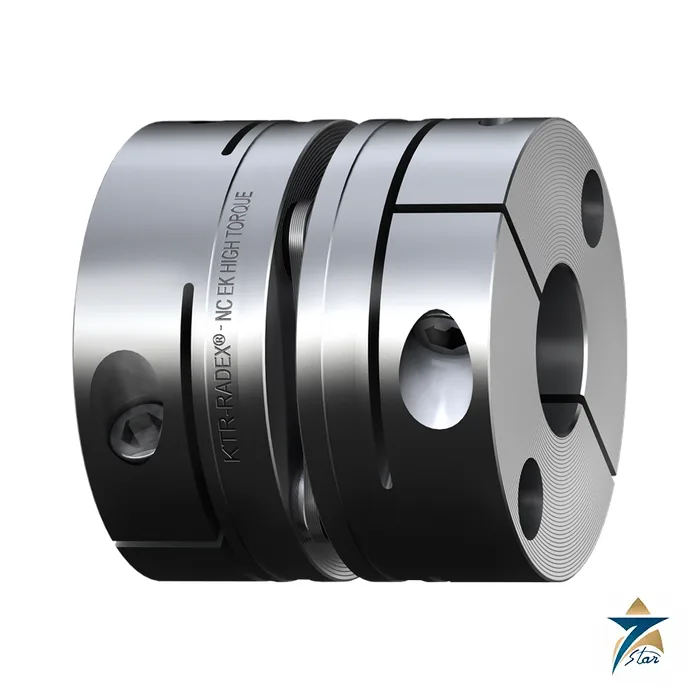
The KTR RADEX-NC is a backlash-free, torsionally stiff and maintenance-free servo laminae coupling. A set of stainless steel laminae, flexible in bending but stiff in torsion, takes up axial, angular and radial shaft displacement. Because it is all metal, KTR states it can be used at temperatures up to +200 °C and in aggressive ambient conditions. The RADEX-NC HT version extends the series to higher torque. KTR developed the series for servo technology, citing indexing tables, planetary and worm gears and ball screws as typical uses where high torsion spring stiffness is needed.
The data below is from KTR operating and assembly instructions KTR-N 47210 EN (edition 12) for RADEX-NC and RADEX-NC HT, types DK (double-cardanic) and EK (single-cardanic).
Technical specifications
| Parameter |
Specification |
| Manufacturer |
KTR Systems GmbH, Rheine, Germany |
| Coupling type |
Backlash-free, torsionally stiff steel laminae servo coupling |
| Types |
DK (double-cardanic, with two laminae sets) and EK (single-cardanic) |
| Sizes, RADEX-NC |
5, 10, 15, 20, 25, 35, 42 |
| Sizes, RADEX-NC HT |
43, 51, 61, 75 |
| Rated torque TKN, RADEX-NC |
2.5 Nm (size 5), 20 Nm (size 15), 60 Nm (size 25), 300 Nm (size 42) |
| Rated torque TKN, RADEX-NC HT |
600 Nm (size 43), 1,300 Nm (size 51), 2,000 Nm (size 61), 3,200 Nm (size 75) |
| Maximum torque TK max. |
5 Nm (size 5) to 600 Nm (size 42); 900 Nm (size 43) to 4,800 Nm (size 75) |
| Maximum speed |
18,300 rpm (size 5), 8,050 rpm (size 20), 4,550 rpm (size 42); 8,100 rpm (size 43), 5,100 rpm (size 75) |
| Torsion spring stiffness, type DK |
1,200 Nm/rad (size 5), 30,000 Nm/rad (size 20), 120,000 Nm/rad (size 42), 1,050,000 Nm/rad (HT size 75) |
| Hub versions |
2.5 / 2.6 double-slot clamping hub; 3.5 / 3.6 triple-slot clamping hub and 6.5 clamping ring hub (HT only) |
| Maximum finish bore, RADEX-NC |
12 mm (size 5), 25 mm (size 20), 55 mm (size 42) |
| Axial displacement Ka, type DK |
0.4 mm (size 5), 1.0 mm (size 15), 1.6 mm (size 25) |
| Radial displacement Kr, type DK |
0.13 mm (size 5), 0.17 mm (size 15), 0.33 mm (size 25); type EK has no radial displacement |
| Angular displacement Kw |
1 degree for types DK and EK |
DK or EK, standard or HT
Type DK has two laminae sets and a spacer, which gives the radial offset capability and a lower torsional stiffness: for size 5 the spring stiffness is 1,200 Nm/rad against 2,400 Nm/rad for the single-cardanic type EK. Type EK has one laminae set and takes up angular and axial displacement only, but it is the stiffest, which suits direct motor-to-spindle or encoder connections. The HT series (sizes 43 to 75) fills the gap above the 300 Nm limit of the standard series, with clamping hubs and a clamping ring hub.
KTR states that the torque data refer to the laminae set only. Attachments that can generate heat, sparks or static charge, such as brake drums and torque limiters, are not permitted in explosive atmospheres, and hubs without feather keyway may be used in category 3 only. Dimensions, clamping screw sizes and tightening torques are given per size in the instruction, from 0.8 Nm for the M2.5 screw of size 5 to 610 Nm for size 75.
Selection checks before ordering a RADEX-NC
Start the selection from the drive side: the servo motor peak torque during acceleration and emergency stops usually matters more than the continuous torque, so compare both against the rated and maximum torque values of the chosen size and the service factors given in the KTR instruction. Next check that both shaft diameters fall within the finish bore range of the hub version you intend to use, and that the installation space allows the full coupling length including the spacer on type DK. Finally decide which misalignment the machine really has. If the motor and the driven shaft can be aligned precisely on a common flange, the single-cardanic EK gives the stiffest connection; where radial offset cannot be avoided, the double-cardanic DK is the safer choice.
For positioning axes, also compare the torsional stiffness of the coupling with that of the ball screw or gearbox. A coupling that is much softer than the rest of the drive train can become the limiting element for servo tuning.
Assembly and alignment
Clean the shafts and hub bores of oil, paint and burrs before fitting, since clamping hubs rely on friction to transmit torque. Slide the hubs on without hammering, set the axial distance specified for the size in the instruction, and tighten the clamping screws evenly in several passes to the stated torque with a calibrated torque wrench. Then check radial, angular and axial alignment with a dial gauge or laser tool. The displacement figures in the table are limits, not targets; keeping actual misalignment well below them reduces alternating stress in the laminae and extends their life.
Laminae sets should not be bent, twisted or used as a handle while the coupling is being installed. If a set has been deformed during handling, replace it rather than straightening it.
Commissioning and inspection
Before the first run, turn the shafts by hand where possible to confirm that nothing rubs and that the laminae do not show visible bowing. Run the axis at low speed, then increase gradually while listening for unusual noise and watching the servo following error. Although the coupling is described as maintenance-free, a visual check at planned shutdowns is good practice: look for cracks in the laminae, fretting marks at the screw joints and any loosening of clamping screws, and recheck alignment if the motor or gearbox has been moved.
Use in Oman and GCC conditions
The all-metal design avoids elastomer elements that can harden or soften with heat, which is useful in plants where machine rooms run hot through the summer. Fine desert dust is still a concern, because abrasive particles can settle in screw joints and between laminae, so a simple guard that keeps dust and fingers away is advisable on exposed machines. In humid coastal areas around Muscat, Sohar and Duqm, protect bare steel surfaces on hubs and shafts with a light preservative during storage, and keep spare couplings in their packaging until fitting. If the coupling will run in a classified area, review the explosion-protection notes in the KTR instruction with the site safety engineer before ordering.
Documents and quotation
The attached PDF is the KTR operating and assembly instruction for RADEX-NC and RADEX-NC HT. For a quotation send the shaft diameters, peak and rated torque, speed, required torsional stiffness, whether radial offset has to be absorbed (DK) or not (EK), ambient temperature and hub type. See Servo Drives for matching drives.










Reviews
There are no reviews yet.