A flexible 16-point analog input card for process signals
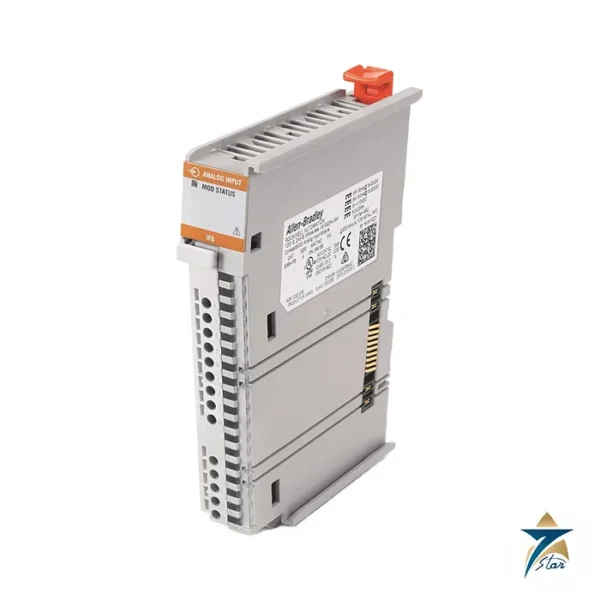
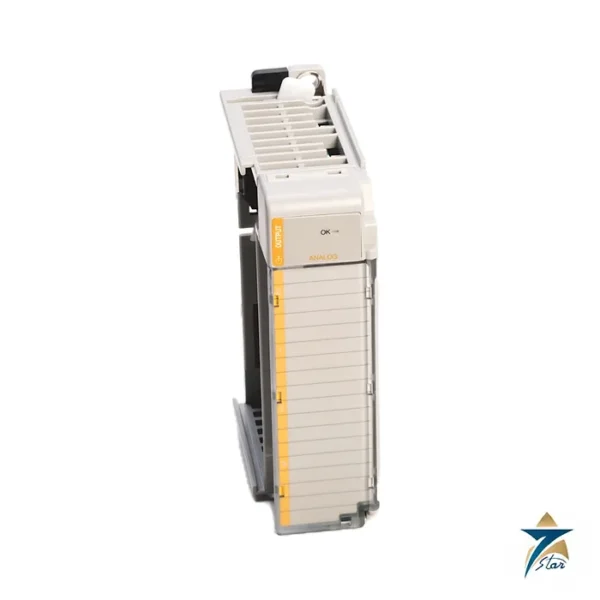
The Allen-Bradley 1756-IF16 is a ControlLogix analog input module that can be wired as 16 single-ended inputs, 8 differential inputs or 4 differential high-speed inputs. Each point accepts voltage (plus or minus 10 V, 0 to 10 V, 0 to 5 V) or 0 to 20 mA current, so one module can serve a mixed set of transmitters, positioners and instruments.
Because the choice of single-ended or differential wiring is a module configuration, the same catalog number covers a high-count node with common-referenced transmitters and a smaller set of channels with better noise performance. Confirm which input type each loop uses before wiring the terminal block.
Technical specifications
| Parameter |
Specification |
| Manufacturer / family |
Allen-Bradley (Rockwell Automation) / ControlLogix 1756 |
| Catalog number |
1756-IF16 (1756-IF16K is the conformal-coated version) |
| Inputs |
16 single-ended, 8 differential or 4 differential (high speed) |
| Input ranges |
±10V, 0 to 10V, 0 to 5V, 0 to 20 mA |
| Resolution |
320 uV per count (15 bits plus sign) at ±10.25V; 160 uV per count (16 bits) at 0 to 10.25V; 80 uV per count at 0 to 5.125V; 0.32 uA per count at 0 to 20.5 mA |
| Input impedance |
Voltage 10 MOhm or more; current 249 Ω |
| Calibrated accuracy at 25 °C |
Voltage better than 0.05% of range; current better than 0.15% of range |
| Module error |
Voltage 0.1% of range; current 0.3% of range |
| Module input scan time, min |
16 pt single-ended 16 to 488 ms; 8 pt differential 8 to 244 ms; 4 pt differential 5 to 122 ms |
| Conversion method |
Sigma-delta |
| Data format |
Integer mode (left justified, 2s complement) or IEEE 32-bit floating point |
| Backplane current |
200 mA at 5.1V DC; 35 mA at 24V DC |
| Isolation |
250V continuous, basic insulation inputs-to-backplane; none between inputs |
| Removable terminal block |
1756-TBCH or 1756-TBS6H, ordered separately |
| Slot width / temperature code |
1 / T4 |
Accuracy, resolution and scan time
The published resolution is 16 bits in unipolar ranges and 15 bits plus sign in bipolar, equal to 160 microvolts per count at 0 to 10.25 V and 0.32 microamps per count at 0 to 20.5 mA. Calibrated accuracy at 25 °C is better than 0.05% of range on voltage and better than 0.15% on current, with a module error of 0.1% and 0.3% respectively.
Scan time depends on the number of channels and the notch filter setting: 16 to 488 ms for sixteen single-ended points, 8 to 244 ms for eight differential points and 5 to 122 ms for four differential high-speed points. The module also offers on-board alarming, scaling to engineering units, real-time channel sampling and a normal-mode rejection above 80 dB at 50/60 Hz.
Wiring notes and power
Voltage inputs present at least 10 MOhm; current inputs present 249 Ω, so the module provides the loop resistor. The maximum overvoltage protection is 30V DC on voltage inputs and 8V DC on current inputs. If a wire is open, differential channels read positive full scale within 5 seconds, which is reported as an open-circuit condition. Isolation is 250 V continuous, basic insulation, between inputs and backplane, and there is no isolation between individual inputs.
The module draws 200 mA at 5.1V DC and 35 mA at 24V DC from the backplane, and dissipates 1.86 W with voltage inputs or 3.53 W with current inputs. The removable terminal block, 1756-TBCH or 1756-TBS6H, is not supplied and must be ordered separately. Keying is electronic and software configurable.
Documents and quotation
The sheet 1756-IN063 describes the analog I/O modules; the technical data publication 1756-TD002 contains the complete input table used here. Please provide the 1756-IF16 reference, series, quantity, chassis and terminal block when requesting a quotation. See PLC & I/O Cards.
How the 1756-IF16 Works
The 1756-IF16 sits in a ControlLogix chassis and communicates with its owner controller over the backplane. Each input passes through a sigma-delta converter, which integrates the signal over a period set by the notch filter selection. A lower notch frequency averages out more interference, including 50 Hz and 60 Hz mains pickup, at the cost of a longer scan time; a higher notch frequency gives faster updates with less filtering. This is why the module scan time in the table above is given as a range rather than a single figure.
In single-ended wiring, all inputs share a common reference, which gives the full sixteen channels but less rejection of ground differences. In differential wiring each channel is measured between its own plus and minus terminals, halving the channel count but improving immunity to common-mode noise. The high-speed differential mode trades channel count for the shortest scan time. Data can be delivered as integers or as floating-point values already scaled to engineering units, and the module can flag alarms and open-wire conditions to the controller.
1756-IF16 Selection & Ordering Guide
- Wiring mode: decide before ordering whether the loops will be wired single-ended, differential or high-speed differential, because this sets how many channels each 1756-IF16 provides.
- Isolation: the 1756-IF16 has no isolation between inputs. Where channel-to-channel isolation is required, consider an isolated ControlLogix analog module instead.
- Terminal block: the removable terminal block is not included; add a 1756-TBCH or 1756-TBS6H, or a pre-wired cable system, to the order.
- Chassis and power: check that the chassis has a free slot and that the power supply can carry the backplane current of all modules.
- Coated version: the 1756-IF16K is the conformal-coated variant for harsh atmospheres.
For a quote, send the catalog number, series letter, quantity and the controller or chassis it will be used with. Our team can help confirm the correct ordering code.
Installation & Maintenance
Insert the module in the chosen slot, fit the terminal block and configure the module in the Studio 5000 Logix Designer project, selecting the wiring mode, range, filter and data format for each channel. Use shielded twisted-pair cable, ground the shield at one point, and route analog cables away from drive output and power cables. Do not exceed the overvoltage limits of the inputs.
For maintenance, review the channel status and fault bits in the controller, investigate open-circuit alarms promptly, and periodically compare readings against a calibrated reference source. Keep the chassis enclosure clean and within its rated temperature, and record the series and firmware revision of installed modules for future replacements.
Typical Applications in Oman & the GCC
- Process control in oil and gas, refining and petrochemical plants using ControlLogix as the main controller.
- Water and wastewater treatment plants collecting flow, level, pressure and analyser signals.
- Power generation and desalination plants with large numbers of 4–20 mA and 0–10 V transmitters.
- Cement, mining and metals processing where many analog points are concentrated in one chassis.
Why Source the 1756-IF16 from Seven Star LLC
Seven Star LLC supplies Allen-Bradley ControlLogix modules, including the 1756-IF16, across Oman and the GCC. Request a quote with the catalog number and quantity, and our team can help confirm the correct ordering code and the matching terminal block.



Reviews
There are no reviews yet.