Four-pole electronic breaker with switchable neutral protection
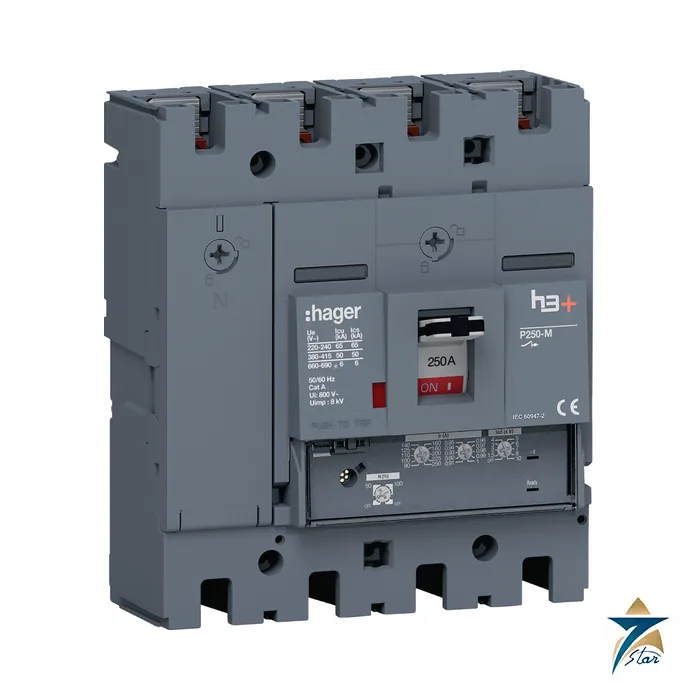
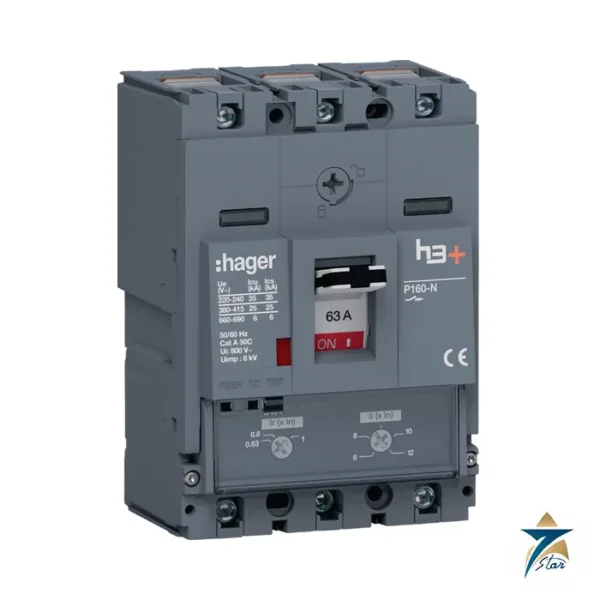
The Hager HMT251GR is the four-pole member of the h3+ P250 family covered on this site. It has a rated current of 250 A, an LSnI electronic trip unit and an ultimate breaking capacity of 50 kA at 400 V and 415 V AC (65 kA at 230 and 240 V AC). The Hager description lists the neutral setting as N0-50-100%, meaning the neutral pole can be left unprotected, protected at half the phase setting or protected at the full setting.
That makes it relevant for three-phase, four-wire systems with significant harmonic or unbalanced neutral current, where a fixed neutral rating is not enough. The neutral position is on the left of the device.
Technical specifications
| Parameter |
Specification |
| Manufacturer / order code |
Hager / HMT251GR |
| Product description |
MCCB h3+ P250 LSnI 4P4D N0-50-100% 250A 50kA FTC |
| Poles |
4 (neutral position: left) |
| Rated current IN |
250 A |
| Icu at 230 / 240 V AC |
65 kA |
| Icu at 400 / 415 V AC |
50 kA |
| Ics at 230 V AC / 400 V AC |
65 kA / 50 kA |
| Single-pole breaking capacity, 230 V / 400 V |
2.5 kA |
| Trip unit |
LSNI electronic |
| Overload dial Ir1 |
ten steps from 90 A up to the 250 A rating |
| Short-time pickup dial Isd |
1.5 to 10 times Ir; release range 122.9 – 2500 A |
| Rated operational voltage Ue |
220 – 690 V |
| Insulation voltage Ui / Uimp |
800 V / 8000 V |
| Ingress protection |
IP4X |
| Power dissipation at IN |
45 W (15 W per pole) |
| Electrical / mechanical endurance |
10000 / 40000 operations |
| Cable |
Copper or aluminium; 35 – 185 mm2 rigid, 35 – 150 mm2 flexible |
| Tightening torque |
12 Nm |
| Operating temperature |
-25 to 70 °C |
| Compatible with RDC AOB residual current add-on |
Yes |
| Dimensions H x W x D |
165 x 140 x 97 mm |
| Motor drive integrated |
No |
What differs from the three-pole P250 breaker
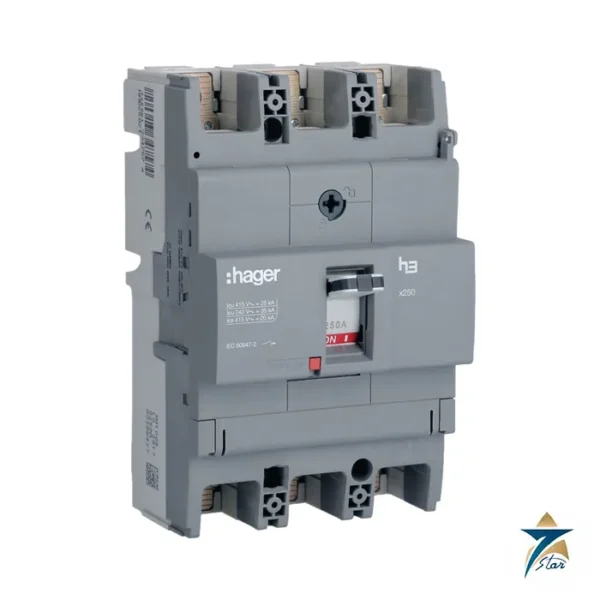
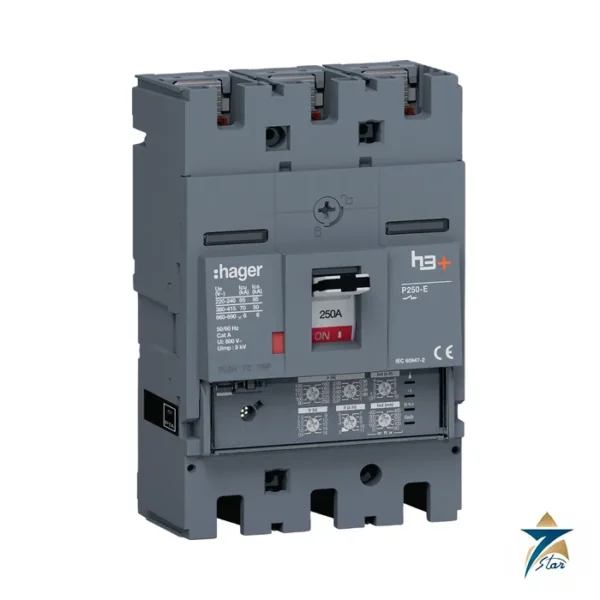
The HMT251GR has the same frame depth and dial ranges as the three-pole HET250JR, but its fourth pole increases the width from 105 to 140 mm and its rating drops from 70 kA to 50 kA at 400 V. Hager lists it as compatible with the RDC AOB add-on, which the three-pole model is not, so it can be combined with an earth-leakage function where the design requires it. Check the accessory documentation for the exact add-on part.
Selection notes
Use the neutral setting that matches the system: a full neutral is appropriate where non-linear loads create large neutral currents, while reduced settings are common where the neutral is sized smaller. Verify the fault level at the board against 50 kA at 400 V and confirm the long-time dial Ir1 so that it protects the actual cable. Add the 45 W power loss to the enclosure heat balance.
Choosing the neutral setting and trip settings
The main reason to specify a four-pole breaker with an adjustable neutral is to protect the neutral conductor correctly in installations where its current is not simply a fraction of the phase current. Office buildings, data rooms, hotels and malls with many single-phase electronic loads, LED lighting and small inverters often carry triplen harmonics that add up in the neutral. In such boards the neutral can carry as much current as a phase, or more, so a reduced or unprotected neutral setting would leave the conductor exposed.
- Use the unprotected neutral setting only where the design and local regulations allow it and the neutral is fully rated and cannot be overloaded.
- Use the half setting where the neutral conductor has been deliberately sized smaller than the phases and the loads are mainly balanced and linear.
- Use the full setting where the neutral is the same size as the phases and harmonic or unbalanced current is expected.
- Coordinate the overload and short-time settings with the upstream and downstream devices so that the breaker nearest the fault trips first, using the Hager selectivity documentation where available.
Installation and commissioning
Check the orientation of the breaker before fixing it, because the neutral pole position on the left must match the busbar or cable arrangement in the panel. Prepare cable lugs or terminals for the conductor size and material being used, and tighten every connection to the torque in the specification table with a calibrated tool. Loose terminals on a 250 A breaker cause local heating that can damage the device and the insulation of the cables.
Before energising, set the overload, short-time and neutral dials according to the protection study and record the settings on the panel schedule. If the residual current add-on is part of the design, fit and test it in line with the accessory instructions. After energisation, check the load current on each phase and on the neutral with a clamp meter to confirm that the chosen neutral setting is appropriate for the actual load.
Maintenance in service
Include the breaker in the routine thermographic survey of the board. Hot spots at the terminals are an early sign of loose connections or overloaded conductors. Operate the breaker mechanism periodically during planned shutdowns so that it does not stiffen after long periods without switching, and use the trip test facilities described by Hager to confirm the electronic trip unit is working. If the breaker trips unexpectedly, record the conditions and check the neutral current before assuming a fault in the device.
Switchboard conditions in Oman and the GCC
Main distribution boards in the region frequently sit in rooms where the air temperature is high for much of the year, and the 45 W of losses from this breaker adds to the heat inside the enclosure. Make sure the switchroom ventilation or air conditioning is sized for all devices in the board, and check the Hager temperature derating information for boards running warm. Fine dust can enter switchrooms through doors and cable trenches, so keep panels closed and gland plates sealed. For coastal substations and industrial plants near the sea, a well-sealed enclosure and regular inspection of terminals help limit corrosion caused by humid, salty air.
Documents and quotation
The attached datasheet lists the printed electrical values. For a quotation send the order code, system type, fault level, neutral requirement and quantity. See the circuit breakers category for other breakers.










Reviews
There are no reviews yet.