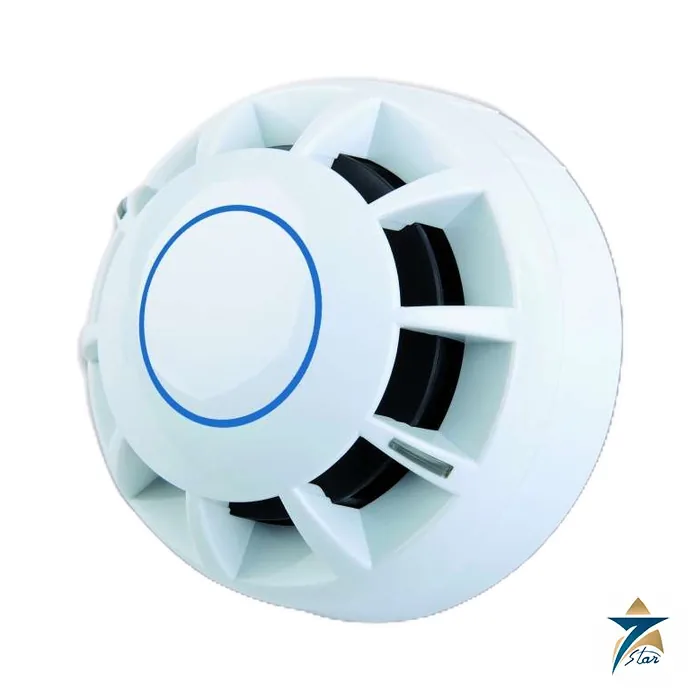
The C-TEC CA414 is a CAST multisensor fire detector that combines optical smoke sensing with heat enhancement. It is third-party certified to EN54-5, EN54-7 and EN54-17, and works with C-TEC’s XFP and ZFP CAST-protocol addressable fire panels. It has a blue colour-coded ring, a white polycarbonate body and two bright red LED strips that give 360 degree visibility, and an on-board short-circuit loop isolator protects the loop.
Technical specifications
| Parameter |
Specification |
| Part number |
CA414 CAST multisensor fire detector (detector base CA408 ordered separately) |
| Sensing |
Optical smoke sensitivity with heat enhancement; sampling frequency once per second |
| Standards |
EN54-5:2017+A1:2018, EN54-7:2018, EN54-17:2005, CEA 4021:2003 |
| Certificates |
LPCB 176m/01; CPR 2831-CPR-F2270; UKCA 0832-UKCA-CPR-F0797; DoP0000044 |
| Protocol and panels |
CAST (C-TEC); XFP or ZFP CAST versions |
| Compatible bases |
CA408 CAST detector base, or CAST base mount devices CA431A/W, CA432A/W, CA456A/W, CA459A/W, CA460A/W |
| Operation modes |
Mode 1 high optical plus Class A2 heat; 2 standard optical; 3 standard optical plus Class A2 heat (default); 4 low optical plus Class A2 heat; 5 Class A1R heat (not approved) |
| Optical triggers |
Mode 1: 0.1 dB/m; modes 2 and 3: 0.2 dB/m; mode 4: 0.3 dB/m; mode 5: off |
| Heat triggers |
Modes 1, 3 and 4: 62 degC; mode 2: off; mode 5: 56 degC |
| Operating voltage and current |
22 to 40 V DC; quiescent 370 uA at 40 V; alarm 5.5 mA with LEDs illuminated |
| Indicators |
Two red LED strips, 360 degree visibility; on-board short-circuit loop isolator |
| Materials |
White polycarbonate casing rated UL94 V-2, nylon internal parts |
| Dimensions and weight |
Detector 102.2 mm diameter x 37 mm; with base 57.5 mm deep; detector 99 g, CA408 base 55 g |
| Environment |
-10 to +55 degC; 0 to 95 percent RH; insensitive to atmospheric pressure |
Five operating modes
The detector can be set from the panel’s PC programming tools to one of five modes that change the optical and heat triggers. High optical with Class A2 heat triggers at 0.1 dB/m and 62 degC, standard optical at 0.2 dB/m, standard optical with Class A2 heat is the default, and a low optical mode at 0.3 dB/m with heat at 62 degC suits less clean areas. The heat-only Class A1R mode at 56 degC is marked in the datasheet as not approved. This lets one detector type be used across areas with different nuisance alarm risk, for example near cooking areas or in plant rooms, instead of fitting separate smoke and heat heads, though the final selection is a fire engineering decision.
Installation and compatibility
The detector is fitted with a click-and-twist action to a CA408 CAST detector base, which has a locking mechanism against tampering, or to one of the listed CAST base mount devices; refer to the CA408 document DFU0002408 for wiring and fitting. It needs a 22 to 40 V DC loop and draws 370 uA in quiescent state. The datasheet also lists programmable heat and optical smoke variants as separate products. Because the protocol is CAST, it will not work on an Apollo or Hochiki loop, and the panel firmware and programming tools must support the device. The site also lists the C-TEC CP416 CAST-PRO optical smoke detector for CAST-PRO loops.
How the C-TEC CA414 works
The detector draws air through its chamber and measures the smoke with an optical sensor. A heat sensor adds to the reading. The detector samples once per second. It reports its state to the panel over the CAST loop. If a fire signal is found, the red LED strips light up.
Where the CA414 is used
- Offices and corridors
- Hotels and residential blocks
- Schools and hospitals
- Retail areas
- Industrial buildings
Selection checklist for the CA414
- Panel type, XFP or ZFP
- Detector base
- Operating mode
- Room type and cleanliness
- Ceiling height
- Loop capacity
- Indicator visibility
- Spare detectors
Installation, commissioning and maintenance notes for the CA414
Fix the CA408 base to the ceiling and wire the loop. Plug the detector into the base. Set the operating mode from the panel software. Test the detector with a smoke test unit. Clean the detector head at the intervals the site plan sets.
Requesting a quotation for the C-TEC CA414
Please send the quantity, the panel type and the base needed. Seven Star LLC serves industrial customers in Oman and the GCC and replies with a quotation based on the information provided.
CA414 sensing
The CA414 combines optical smoke sensing with heat enhancement.
CA414 protocol
It uses the CAST protocol of C-TEC.
CA414 base
The CA408 detector base is ordered separately.
CA414 operating modes
Five operating modes change the optical and heat triggers.
CA414 default mode
The default mode is standard optical plus Class A2 heat.
CA414 optical triggers
The optical triggers run from 0.1 to 0.3 dB/m.
CA414 heat trigger
The heat trigger is 62 degrees C in modes 1, 3 and 4.
CA414 operating voltage
The voltage is 22 to 40 V DC.
CA414 current draw
The quiescent current is 370 uA, and the alarm current is 5.5 mA.
CA414 indicators
Two red LED strips give 360 degree visibility.
CA414 loop isolator
An on-board short-circuit isolator protects the loop.
CA414 size and weight
The detector is 102.2 mm in diameter and weighs 99 g.
Detector records for the CA414
Record the address, the mode and the date of each test and cleaning.
Choosing the right CA414 mode
Choose a lower optical mode for less clean areas, so that dust does not trigger false alarms.
Documents and quotation
The linked file is the one-page C-TEC CA414 product datasheet (DFU4140000), whose certificate numbers can also be checked on the manufacturer’s website. Before ordering confirm the panel protocol, the base type (the CA408 base is a separate part), the detector mode required by the design and the approvals demanded locally; browse other fire and gas detectors. Seven Star LLC, an independent supplier in Muscat, will prepare a quotation from your project requirements.










Reviews
There are no reviews yet.