Low-voltage wet-sponge detection of pinholes in thin insulating coatings
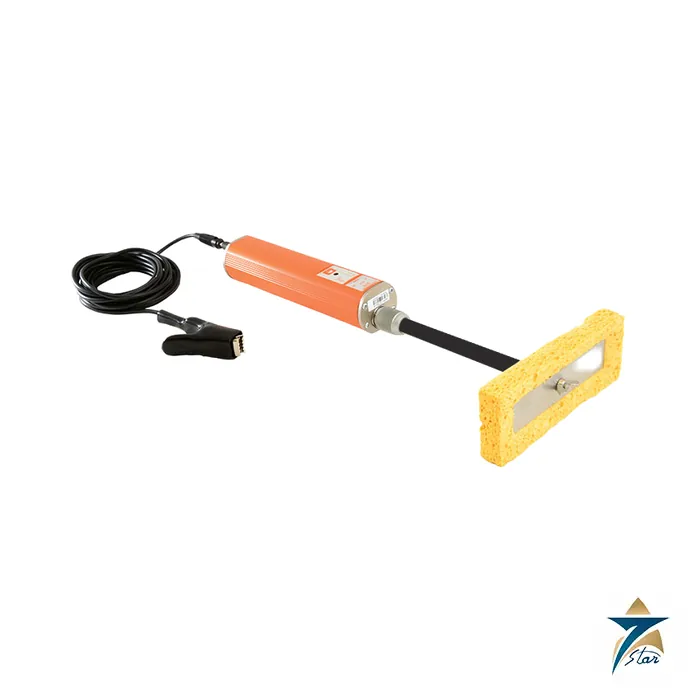
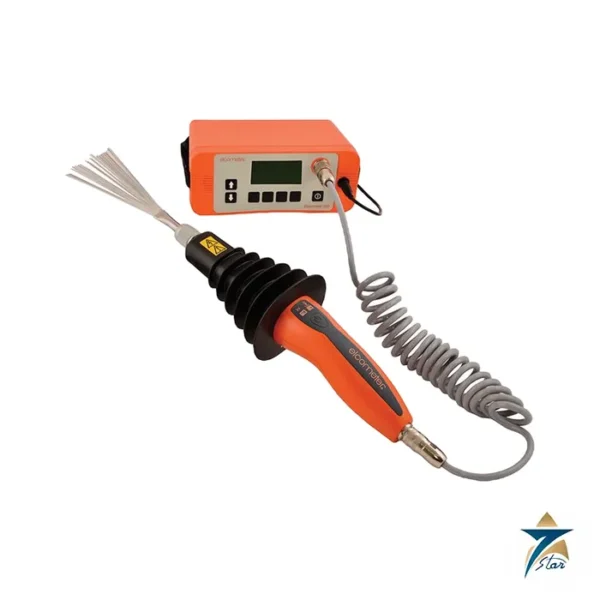
The Elcometer 270 is a low-voltage, wet-sponge pinhole detector. A damp sponge is drawn across the coating while a return lead is connected to the metal substrate; where a pinhole lets liquid reach the substrate, the circuit closes and visual and audible alarms operate. Elcometer says the 270 sets the standard for wet sponge, high quality, low voltage detectors, with a maximum coating range of 500 micrometres (20 mils). The wet-sponge technique is intended for insulating coatings on conductive substrates and is described by Elcometer as ideal for powder coatings.
Technical specifications
| Parameter |
Elcometer 270/3 |
Elcometer 270/4 |
| Part number |
D270—-3 |
D270—-4 |
| Part number with certificate |
D270—-3C |
D270—-4C |
| Selectable voltages |
9 V and 90 V |
9 V, 67.5 V and 90 V |
| Maximum coating range |
500 um (20 mils) |
500 um (20 mils) |
| Sensitivity |
9 V: 90 kOhm +/-5 %; 90 V: 400 kOhm +/-5 % |
9 V: 90 kOhm +/-5 %; 67.5 V: 125 kOhm +/-5 %; 90 V: 400 kOhm +/-5 % |
| Battery life, continuous use |
9 V: up to 200 h; 90 V: up to 80 h |
9 V: up to 200 h; 67.5 V: up to 100 h; 90 V: up to 80 h |
| Parameter |
Specification |
| Battery type |
3 x AA; rechargeable cells can be used but battery life is reduced by up to 75 % |
| Accuracy of voltage setting |
+/-5 % |
| Dimensions |
Without wand 210 x 42 x 37 mm (8.3 x 1.7 x 1.5 in); standard wand 175 mm (6.9 in) long including sponge |
| Weight |
610 g (21 oz) with wand, cable and batteries |
| Standards listed |
AS 3894.2, ASTM D 5162-A, ASTM G6, ASTM G62-A, BS 7793-2, ISO 8289-A, ISO 14654, JIS K 6766, NACE SP0188, NACE TM0384 and others as printed |
| Packing list |
Pinhole detector, standard wand and flat sponge, 4 m (13 ft 2 in) return lead with crocodile clip, 3 x AA batteries, operating instructions; calibration certificate supplied as standard on the C part numbers |
Wands, sponges and accessories
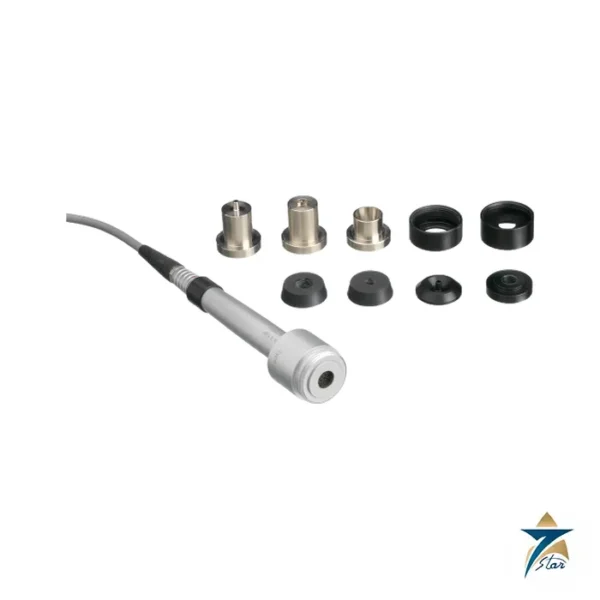
Voltages of 9 V, 67.5 V (270/4) and 90 V are user-selectable, and an automatic internal voltage check confirms that the selected voltage can be achieved. Each unit converts into a separate wand with a base unit using the separate wand adaptor. Elcometer lists a standard flat-sponge wand (T27016867), a roller sponge wand for large flat surfaces (T27016960), a telescopic wand adaptor extending to 1 m (39 in), 420 mm extension pieces, spare sponge sets, a 10 m (32 ft 10 in) return cable on a drum and a 50 ml wetting agent (T27018024) that is added to the water to speed pinhole detection. A Pinhole Inspector kit (T27018191) bundles the wand handle, roller wand, extensions, wetting agent and spares; it does not include the main instrument.
Selection and use
Choose the voltage by coating thickness and the pinhole standard that applies; thicker films need higher voltages, and a film over 500 um is outside the 270 range and needs a high-voltage holiday detector such as the Elcometer 266 or 280. Wet-sponge testing suits insulating coatings on conductive substrates, so it cannot be used on non-conductive substrates. See Portable Test and Measurement for related inspection instruments, including the Elcometer 456 thickness gauge used to confirm the film thickness before testing.
Documents and quotation
The attached Elcometer catalogue contains the 270 specification and accessory list. Send the coating thickness, the substrate and the standard, and state whether the 270/3 or 270/4, the wand type and the calibration certificate are needed before ordering.










Reviews
There are no reviews yet.