- AC Drives
- Industrial Communications
- PLC & I/O Cards
- Vibration Monitoring
- Automation Accessories
- Controllers & Data Acquisition
- Safety Switches & Guard Locking
- CCTV & Security
- Encoders
- Industrial Computers
- HMI Displays
- Motor Soft Starters
- Isolator & Barrier
- Pneumatic Cylinders
- Servo Drives
- Automation Software
- Robotics
- Machine Vision
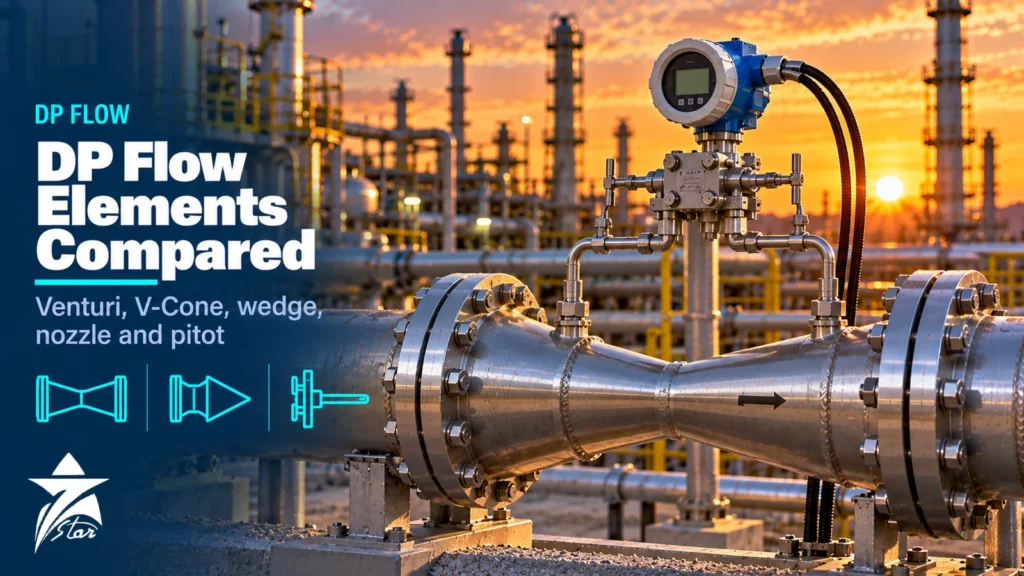
The orifice plate is the default differential pressure meter, but it is not always the best one. Its permanent pressure loss costs pumping or compression energy, its sharp edge wears, and it needs long straight runs. Other DP flow elements keep the advantages of differential pressure measurement, such as no moving parts, a well-understood physical basis and transmitters that every instrument technician knows, while addressing some of those weaknesses. This guide compares the venturi tube, V-cone, wedge meter, flow nozzle and averaging pitot tube, and explains where each one makes sense. For the orifice plate itself, see our separate article on orifice plate flow measurement to ISO 5167.
The Common Principle Behind DP Flow Elements
All of these devices create or sense a pressure difference that is related to flow velocity. A restriction (venturi throat, nozzle, cone, wedge) accelerates the fluid and lowers its static pressure, following Bernoulli’s principle. An averaging pitot instead senses the difference between impact pressure facing the flow and a reference pressure behind or beside the probe.
In each case, flow is proportional to the square root of the differential pressure, multiplied by a discharge coefficient (or flow coefficient), geometry terms, and density. The consequences are the same for every element:
- Turndown is limited by the square-root relationship. A 10:1 flow range means a 100:1 differential pressure range, so transmitter accuracy at low DP matters. Stacked transmitters or a high-performance DP transmitter can extend usable range.
- Density must be known or measured. For gas and steam, pressure and temperature compensation, often in a multivariable transmitter or flow computer, is needed for mass or standard volume.
- The discharge coefficient is either predicted by a standard, for geometries built to that standard, or established by calibration.
The ISO 5167 series covers orifice plates (Part 2), nozzles and venturi nozzles (Part 3), classical venturi tubes (Part 4), cone meters (Part 5) and wedge meters (Part 6). Averaging pitot tubes are not covered by ISO 5167, and their coefficients come from manufacturer testing.
Classical Venturi Tube
A venturi tube has a converging inlet cone, a cylindrical throat where the low-pressure tap is located, and a long, gently diverging outlet cone. The gradual outlet recovers most of the pressure, so permanent pressure loss is much lower than for an orifice at the same differential.
Strengths:
- Low permanent pressure loss, valuable on large water mains, cooling water and low-pressure gas where energy cost or available head matters.
- Good tolerance of solids and dirty liquids, since there are no sharp edges or dead zones to trap debris.
- Long-term stability, because wear changes the geometry slowly.
- Standard-based coefficients for venturis built and installed in line with ISO 5167-4, or calibrated values for better uncertainty.
Limitations are size, weight and cost. A venturi is much longer than an orifice assembly and is difficult to retrofit into existing pipework. Insert venturis and short-form designs reduce length but may need calibration.
Flow Nozzle
A flow nozzle has a smooth, rounded inlet leading to a short cylindrical throat, with no diverging outlet. It sits between the orifice and venturi in most respects.
- Higher discharge coefficient than an orifice, so for the same DP it passes more flow.
- More rugged than a sharp-edged orifice in high-velocity, high-temperature service. Long-radius nozzles are widely used for steam and boiler feedwater, and in power plant performance testing.
- Permanent pressure loss is lower than an orifice but higher than a venturi; a venturi nozzle, which adds a diverging section, recovers more.
- Usually welded in the line, which makes inspection and replacement harder than for an orifice plate.
ISO 5167-3 covers ISA 1932 nozzles, long-radius nozzles and venturi nozzles.
V-Cone (Cone Meter)
A cone meter places a cone-shaped element on the centreline of the pipe, facing upstream. Fluid accelerates through the annulus between the cone and the pipe wall, and the low pressure is sensed through a port at the back of the cone. The best-known proprietary version is the V-Cone; similar designs are offered by other manufacturers.
Reported advantages include:
- Very short straight-run requirements, because the cone reshapes the velocity profile ahead of the measurement. Manufacturers commonly quote a few diameters upstream; check the specific model.
- Good stability of the DP signal and a wide usable turndown when paired with suitable transmitters.
- Lower permanent pressure loss than an orifice of the same beta ratio, according to manufacturer comparisons.
- No sharp edge to wear, so the coefficient stays more stable over time.
Cone meters are often supplied with an individual calibration. ISO 5167-5 now provides a standard basis for cone meters built to its geometry, but many users still specify flow calibration for custody or high-accuracy duties. They are popular in wet gas, compact offshore skids and retrofit locations with little straight pipe.
Wedge Meter
A wedge meter uses a V-shaped restriction across the top of the pipe, leaving an open segment at the bottom. Pressure taps sit on either side of the wedge, often with diaphragm seals or remote seals.
- Suits slurries, viscous liquids, sludge and fluids with solids, because the open bottom lets material pass without clogging.
- Works at low Reynolds numbers where an orifice coefficient becomes uncertain, making it useful for heavy oils and viscous chemicals.
- Bidirectional versions are available because the element is symmetric.
- Tolerates abrasion better than an orifice.
ISO 5167-6 covers wedge meters. Accuracy without calibration is moderate, so wedge meters are typically chosen for robustness rather than custody-grade uncertainty.
Averaging Pitot Tube
An averaging pitot tube, often called an Annubar-type probe after the best-known brand, is a bar inserted across the full diameter of the pipe. Upstream-facing ports sense impact pressure at several points across the profile; downstream or side ports sense a reference pressure. The averaged difference relates to mean velocity.
- Very low permanent pressure loss, because the probe blocks only a small part of the pipe.
- Low installed cost on large pipes and ducts, since one probe serves a large diameter.
- Hot-tap and retractable versions allow installation without shutdown.
- Integrated assemblies combine the probe, manifold and multivariable DP transmitter for compensated gas and steam flow.
Limitations are a relatively small differential pressure, which narrows turndown, sensitivity to profile distortion (straight-run requirements are often longer than for a cone meter), and possible port blockage in dirty service. Coefficients come from the manufacturer rather than ISO 5167.
Comparing DP Flow Elements
| Element | Permanent pressure loss | Straight-run need | Dirty or viscous fluids | Standard basis | Typical uses |
|---|---|---|---|---|---|
| Orifice plate (reference) | High | Long | Poor | ISO 5167-2 | General process, gas, steam |
| Classical venturi | Low | Moderate to long | Good | ISO 5167-4 | Water mains, cooling water, large gas lines |
| Flow nozzle | Medium | Moderate to long | Fair | ISO 5167-3 | Steam, feedwater, high-velocity service |
| Cone meter | Medium to low | Short | Fair to good | ISO 5167-5 or calibration | Retrofits, wet gas, compact skids |
| Wedge meter | Medium | Moderate | Very good | ISO 5167-6 | Slurries, sludge, heavy oils |
| Averaging pitot | Very low | Moderate to long | Fair | Manufacturer data | Large pipes and ducts, air, steam, cooling water |
The ratings are relative and general; actual figures depend on beta ratio, size and design. Manufacturers’ data sheets and calculation software give the expected DP and pressure loss for a given duty.
The Secondary Side: Transmitters, Impulse Lines and Manifolds
The primary element is only half the meter. Uncertainty and reliability often depend more on the secondary side:
- DP transmitter: choose range and accuracy so that the lowest flow of interest is still well within the transmitter’s performance. Multivariable transmitters add static pressure and temperature for compensated gas and steam flow. See our pressure transmitter selection guide and the pressure instrumentation category.
- Impulse lines: slope them correctly (down to the transmitter for liquids, up for gas), keep them short, and fill steam lines with condensate. Blocked or partially filled impulse lines are a common cause of drifting readings.
- Manifolds: three- or five-valve manifolds allow zeroing and isolation without removing the transmitter.
- Remote seals: for wedge meters and dirty fluids, diaphragm seals avoid impulse line plugging, at the cost of some temperature effect.
- Flow computer: for fiscal or custody gas measurement, a flow computer applies the applicable calculation standard with live density.
Notes for Oman and GCC Installations
Large seawater intake, brine and potable water lines in desalination plants often favour venturi tubes or averaging pitots, because pressure loss on continuous high flows translates directly into pumping energy. Wetted materials then need to suit seawater, for example duplex or super duplex stainless steel, or lined and coated carbon steel, confirmed against the plant specification. In gas processing, sour service rules apply to the element and the transmitter wetted parts. Outdoor DP transmitters exposed to strong sun benefit from sunshades, and impulse lines filled with liquid should be protected from heating unevenly, which can create false differential pressure. Sand and dust also argue for diaphragm seals or purge arrangements on dirty services.
Choosing the Right DP Element
- Start with the fluid: clean liquid, gas, steam, slurry or viscous liquid.
- Check available straight run; if short, cone meters stand out.
- Weigh the energy cost of permanent pressure loss over the meter’s life, especially on large continuous flows.
- Decide on uncertainty: standard-based coefficients, or flow calibration.
- Consider installation constraints: weld-in, flanged, insertion or hot-tap.
- Compare installed cost, not only element cost, including transmitters, manifolds and pipework changes.
For a wider comparison that includes magnetic, ultrasonic, Coriolis and vortex meters, read our guide on how to choose the right flow meter.
DP Flow Element Specification Checklist
- Fluid, phase and composition, including solids or liquids in gas
- Minimum, normal and maximum flow, and required turndown
- Operating and design pressure and temperature
- Pipe size, schedule and measured internal diameter
- Allowable permanent pressure loss
- Available upstream and downstream straight run
- Required uncertainty and whether flow calibration is needed
- End connections, materials and any sour service requirements
- DP transmitter range, manifold and impulse line or remote seal arrangement
- Hazardous area classification of the secondary instruments
Flow Elements and DP Transmitters We Supply
A DP flow measurement is the primary element plus a transmitter. These examples cover both parts.
| Product | Type | Where it fits |
|---|---|---|
| ABB Orifice plates for flow FPD150 | Orifice plates | General flow measurement in clean liquids, gases and steam. |
| Daniel Senior Dual-Chamber Orifice Fitting 2 to 24 in | Dual-chamber orifice fitting | Gas metering where plates must be changed without shutting down the line. |
| ABB Compact integral orifice flowmeter IOMaster FPD510 | Integral orifice flowmeter | Small line sizes and low flows. |
| ABB Torbar averaging pitot tube FPD350 | Averaging pitot tube | Large pipes and ducts where low permanent pressure loss matters. |
| Tokyo Keiso VC Series V-Cone Differential Pressure Flowmeter | Cone-type DP flowmeter | Installations with short straight runs. |
| Yokogawa EJX110A Differential Pressure Transmitter | DP transmitter | Converting the measured differential pressure into a flow signal. |
We also source venturi tubes and wedge elements built to your data sheet. Send the fluid, flow range, line size, pressure and temperature through our quote request form.
Sourcing DP Flow Elements Through Seven Star LLC
Seven Star LLC supplies venturi tubes, flow nozzles, cone meters, wedge meters, averaging pitot tubes and matching DP transmitters and manifolds on request, from manufacturers such as McCrometer, Emerson (Rosemount), ABB, Endress+Hauser and Badger Meter. Browse the flowmeters category for typical models. We help with selection and with cross-checking sizing data and part numbers; availability and lead time are confirmed at quotation.
Send us your process data sheet, line size and flow range, or a nameplate photo of the existing element and transmitter, and we will return a matched quotation.
Frequently asked questions
Which DP flow element has the lowest pressure loss?
Averaging pitot tubes and classical venturi tubes have the lowest permanent pressure loss of the common DP elements. Pitots block only a small part of the pipe, while venturis recover most of the pressure in their diverging outlet. Orifice plates have the highest loss for a given differential.
When should I choose a cone meter instead of an orifice?
Cone meters are attractive where straight pipe is short, because the cone conditions the profile ahead of the measurement. They also have no sharp edge to wear and are used in wet gas and compact skids. Many are supplied with individual flow calibration.
Are wedge meters suitable for slurries?
Yes. The open segment under the wedge lets solids pass, and diaphragm seals on the taps prevent impulse lines from plugging. Wedge meters also work at low Reynolds numbers, which suits viscous liquids. They are chosen for robustness more than for custody-grade accuracy.
Is an averaging pitot tube covered by ISO 5167?
No. ISO 5167 covers orifice plates, nozzles, venturi tubes, cone meters and wedge meters. Averaging pitot coefficients come from the manufacturer's test data, so check the published uncertainty and installation requirements for the specific model.
Why is turndown limited on DP flow meters?
Flow is proportional to the square root of differential pressure, so a 10:1 flow range requires a 100:1 differential pressure range. At low flow, the transmitter is working at a small fraction of its span. High-performance or stacked transmitters can extend the usable range.
Where are flow nozzles typically used?
Flow nozzles are common in steam and boiler feedwater lines and in high-velocity, high-temperature service where a sharp-edged orifice would erode. Long-radius nozzles are also used in power plant performance testing. They are usually welded in place, which makes inspection harder.
Was this guide helpful?One click helps us write better guides for engineers.
Thank you! Glad it helped. Need this equipment for your project? Request a quotation
Thank you. We will use this to improve the guide.