- Vibration Monitoring
- Industrial Communications
- PLC & I/O Cards
- Automation Accessories
- AC Drives
- Controllers & Data Acquisition
- Industrial Computers
- Encoders
- Safety Switches & Guard Locking
- Isolator & Barrier
- Motor Soft Starters
- CCTV & Security
- HMI Displays
- Automation Software
- Pneumatic Cylinders
- Servo Drives
- Robotics
- Machine Vision
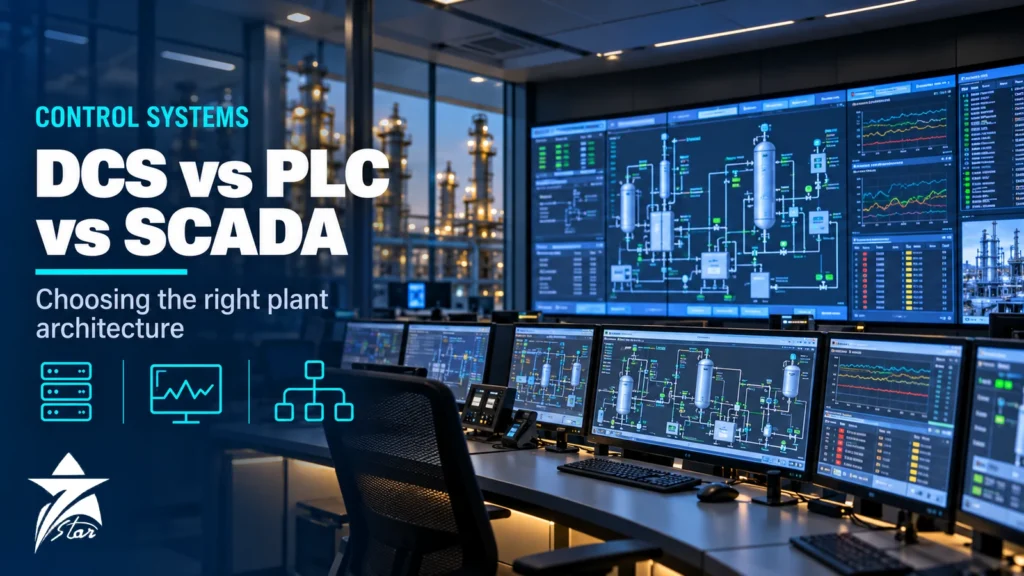
Project specifications often use DCS, PLC and SCADA as if they were interchangeable, and vendors blur the lines further by selling PLC-based process systems and DCS platforms with PLC-style controllers. The result is confusion at the front-end design stage, when the architecture decision has the biggest effect on cost and operability. This article explains DCS vs PLC vs SCADA in practical terms: what each system is, where the boundaries really lie today, how they are combined in a typical plant, and a set of criteria for choosing the right architecture for a process unit, utility or pipeline.
Three Different Jobs
The cleanest way to separate the terms is by the job each one does.
- PLC (programmable logic controller): a rugged controller that reads inputs, executes a program cyclically and drives outputs. It is a component. Engineering, HMI and historian are added separately, often from the same or different vendors.
- DCS (distributed control system): an integrated plant-wide system in which controllers, I/O, operator stations, engineering tools, alarm management and historian share one database and one engineering environment, supplied as a single system by one vendor.
- SCADA (supervisory control and data acquisition): software and communication infrastructure that supervises geographically spread assets. It collects data from PLCs and RTUs over wide-area links, presents it to operators and sends setpoints and commands. Closed-loop control normally stays in the field controllers.
In other words, a PLC is a controller, a DCS is a complete control system built around its own controllers, and SCADA is a supervisory layer that sits above field controllers, often across long distances.
How Each Architecture Is Built
PLC-based system
One or more PLCs with local or remote I/O, connected over an industrial Ethernet network to HMI panels or a SCADA/HMI software package on PCs. Each PLC is programmed in its own project. Tags are created in the PLC and then mapped again in the HMI. Integration depends on the system integrator.
DCS
Redundant process controllers, redundant I/O and redundant control networks are standard. Operator consoles, engineering workstations, historian and alarm system are part of the same product. A tag defined once is available everywhere, with consistent faceplates, alarm handling and audit trail. Platforms such as Yokogawa CENTUM VP, Emerson DeltaV, ABB System 800xA and Honeywell Experion are typical examples; our article on Yokogawa CENTUM VP DCS looks at one of them in detail.
SCADA system
A central or redundant SCADA server polls remote sites, typically through RTUs or PLCs, over radio, cellular, satellite or fibre links, using telemetry protocols such as DNP3, IEC 60870-5-104 or Modbus. It is designed to cope with slow, intermittent communication, time-stamped data buffered at the remote end, and many sites with small I/O counts.
The field device at each SCADA site is either an RTU or a PLC. A traditional RTU is optimised for telemetry: low power consumption for solar sites, wide temperature range, native DNP3 or IEC 60870-5-104, event buffering with time stamps and store-and-forward when the link drops. A PLC offers stronger local control and programming flexibility. Many current products combine both roles, so the decision rests on power budget, protocol, local control needs and the operator’s standard.
DCS vs PLC vs SCADA: Comparison Table
| Aspect | PLC-based system | DCS | SCADA |
|---|---|---|---|
| Primary role | Fast discrete, sequential and machine control; also process control | Continuous and batch process control across a plant | Supervision and data acquisition over wide areas |
| Geography | Machine, skid, unit or building | Single plant or site, control room based | Pipelines, well fields, water networks, power grids |
| Database | Separate in controller and HMI | Single integrated database | Central database fed by many remote devices |
| Redundancy | Optional, depends on family and design | Standard for controllers, I/O, networks and servers | Usually server and communication redundancy |
| Engineering | Integrator-built, flexible, varied tools | Vendor environment with standard libraries and change tracking | Configuration of servers, drivers and telemetry |
| Typical scan / update | Milliseconds to tens of milliseconds | Typically 100 ms to 1 s for process loops | Seconds to minutes per site poll, report by exception |
| Typical I/O scale | Tens to thousands of points per controller | Thousands to tens of thousands of points | Many small sites, large total point count |
| Lifecycle model | Hardware components replaced individually | Vendor-managed system upgrades and migration paths | Software versions plus field RTU/PLC lifecycle |
The figures above are typical ranges to show the character of each system, not limits. Modern PLCs run process loops well and modern DCS controllers handle fast logic; the difference today is less about what the controller can execute and more about integration, engineering model and lifecycle.
Where the Boundaries Have Blurred
Several developments have narrowed the gap between the three.
- Large PLC families offer redundant CPUs, hot-swap I/O, HART pass-through and process function-block libraries, and are sold with integrated SCADA as so-called process automation systems.
- DCS vendors offer compact controllers and electronic marshalling, so small units and remote sites can be part of the DCS.
- SCADA packages now include alarm management, historians and web clients that used to be DCS features.
- Open standards such as OPC UA make it easier to integrate mixed systems, and IEC 62443 applies to all three for cybersecurity.
Because of this overlap, the decision should be based on the plant’s needs rather than on the label in the vendor’s brochure.
How They Work Together in a Typical Plant
A gas processing plant or desalination facility in the GCC usually combines all three. The main process is controlled by a DCS. Packaged equipment such as compressors, chemical dosing skids, filtration units and HVAC arrive with their own PLCs and connect to the DCS over Modbus TCP, OPC UA or a native interface. Emergency shutdown and fire and gas functions run in a separate safety system, as described in our guide to safety instrumented systems and safety PLCs. Outlying wellheads, water intake stations or pipeline block valves are supervised through SCADA, with RTUs or PLCs at each site. The system architecture document should define which system owns each function and what data passes between them.
DCS vs PLC: Decision Criteria for Choosing an Architecture
- Process type. Continuous, highly interactive processes with many PID loops and advanced control favour a DCS. Sequential, discrete or machine-centred processes favour PLCs.
- Size and growth. A few hundred I/O points on one unit can be handled economically by PLCs with HMI. Several thousand points with frequent future expansion favour the single database of a DCS.
- Geography. If assets are spread over kilometres with limited communication, SCADA with RTUs or PLCs is the natural fit, regardless of what controls the central plant.
- Availability requirement. If a controller failure stops a high-value continuous process, redundancy must be standard. Both DCS and higher-end PLC families can provide it, but in a DCS it is the default design.
- Operations model. A central control room with permanent operators benefits from DCS-style consistent displays and alarm management; unmanned remote sites need SCADA-style telemetry.
- Engineering and change management. Plants that change frequently benefit from integrated version control, audit trails and standard libraries.
- Site standards and skills. Existing platforms, spares and trained staff often outweigh small technical differences.
- Lifecycle cost. Compare not only purchase price but licences, support agreements, upgrade cycles and the cost of integrating separate products.
Cost Behaviour Over the Project Life
A PLC-based solution usually has a lower entry cost for small systems because hardware is cheaper and integrators are widely available. As the system grows, the cost of mapping tags twice, integrating separate alarm and historian products, and maintaining consistency across many PLC projects increases. A DCS has a higher starting cost but lower incremental engineering per loop on large plants. SCADA cost is dominated by telemetry infrastructure and the number of remote sites rather than by I/O count. Make the comparison over the expected life of the plant, including upgrades, not only at the capital stage.
GCC-Specific Considerations
- Remote oil and gas and water assets in Oman are spread over large distances, so SCADA communication design (radio, cellular, VSAT, fibre) and solar-powered RTU sites are part of the decision.
- Equipment rooms and field shelters in summer heat need cooling designed for the full controller and network load; specify conformal coating where H2S, humidity or salt is present.
- Many operators in the region publish their own control system and cybersecurity standards; check the approved vendor list early, because it may decide the architecture for you.
- Long project lifetimes make vendor migration paths and regional support important factors.
Common Architecture Mistakes
- Choosing a DCS for a small, mainly sequential unit, then paying for features nobody uses.
- Building a large continuous plant from dozens of independent PLC projects without a common library, tag standard or alarm philosophy.
- Running closed-loop control through a SCADA server over a wide-area link, so a communication outage stops control.
- Combining basic process control and safety functions in one controller to save hardware.
- Leaving the interface list between DCS, package PLCs and SCADA undefined until commissioning.
Architecture Selection Checklist
- Process description: continuous, batch, sequential or mixed
- Total I/O count, loop count and expected growth
- Geographic spread of assets and available communication links
- Availability target and required redundancy
- Package equipment list with controller type and interface protocol
- Safety system boundary defined separately
- Operator philosophy: manned control room, unmanned sites or both
- Client or site standards and approved vendor list
- Cybersecurity requirements under IEC 62443
- Lifecycle cost comparison over the plant’s planned life
Sourcing Control System Hardware Through Seven Star LLC
Seven Star LLC supplies PLC CPUs and I/O modules, DCS controller and I/O cards, RTUs, data acquisition units and communication hardware on request, from manufacturers such as Siemens, Rockwell Automation, Schneider Electric, ABB, Emerson, Honeywell and Yokogawa. Browse our PLC and I/O cards, controllers and data acquisition and wider automation and control categories, and we can help with selection and cross-checking part numbers. Availability and lead time are confirmed at quotation.
Need spare cards for a DCS, PLC or RTU, or hardware for a new control system? Send Seven Star LLC the module part numbers, nameplate photos or your RFQ for a clear, itemised quotation.
Frequently asked questions
What is the main difference between a DCS and a PLC?
A PLC is a controller; a DCS is a complete, integrated control system. In a DCS the controllers, I/O, operator stations, alarm system and historian share one database and engineering environment from one vendor, while a PLC-based system combines separate controller, HMI and software products integrated by the engineer.
Is SCADA a control system?
SCADA is a supervisory system. It collects data from remote PLCs and RTUs, displays it to operators and sends setpoints and commands, but closed-loop control normally runs in the field controllers so that a communication failure does not stop control.
Can a PLC do process control like a DCS?
Yes. Modern PLC families run PID loops, support redundancy and HART, and are sold with process libraries. The difference for large plants is mainly integration, engineering consistency and lifecycle management rather than control capability.
When is a DCS the better choice?
A DCS is usually preferred for large continuous processes with many interacting loops, a central manned control room, high availability requirements and frequent changes, such as refineries, gas plants and large desalination or power plants. Its single database and standard redundancy reduce engineering effort per loop at scale.
Which protocols do SCADA systems use for remote sites?
Common telemetry protocols include DNP3, IEC 60870-5-104 and Modbus, chosen for their ability to handle slow or intermittent links, time-stamped events and report-by-exception. The choice often follows the utility or operator's own standard.
Should the safety system be part of the DCS or PLC?
Safety instrumented functions should run in a safety-certified system designed to IEC 61511, kept functionally separate from basic process control. Many vendors offer integrated safety controllers that share engineering tools with the DCS, but independence between control and safety layers must still be demonstrated.
Was this guide helpful?One click helps us write better guides for engineers.
Thank you! Glad it helped. Need this equipment for your project? Request a quotation
Thank you. We will use this to improve the guide.