- Vibration Monitoring
- Industrial Communications
- PLC & I/O Cards
- Automation Accessories
- AC Drives
- Controllers & Data Acquisition
- Industrial Computers
- Encoders
- Safety Switches & Guard Locking
- Isolator & Barrier
- Motor Soft Starters
- CCTV & Security
- HMI Displays
- Automation Software
- Servo Drives
- Pneumatic Cylinders
- Robotics
- Machine Vision
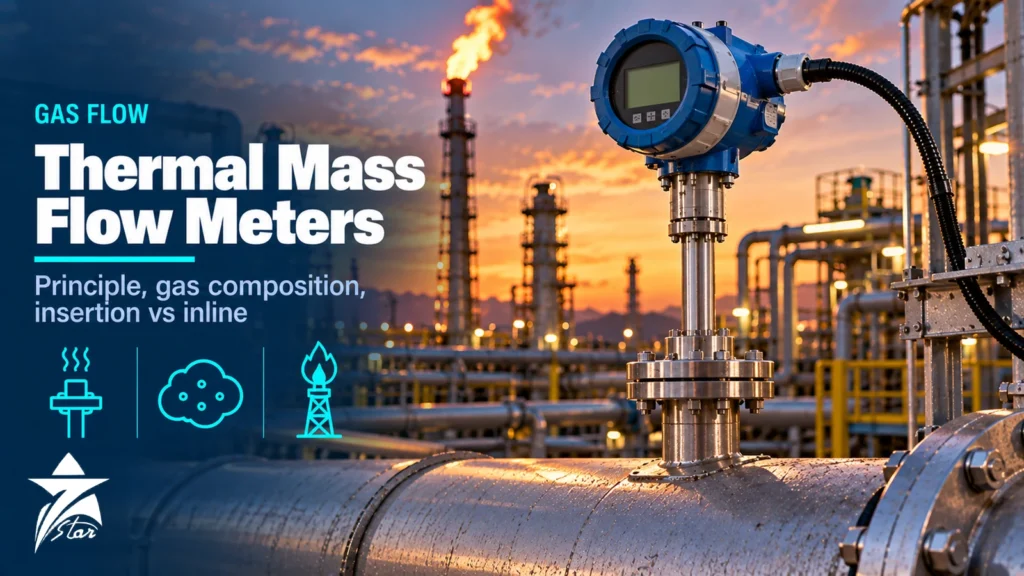
Measuring gas flow in large, low-pressure lines has always been awkward: differential pressure devices lose signal at low velocity, and volumetric meters need pressure and temperature compensation to give a standard flow. A thermal mass flow meter solves much of this by measuring heat transfer, which responds to the mass of gas passing the sensor rather than its volume. That makes it a strong fit for compressed air, nitrogen, natural gas to burners, biogas and flare lines. It also has one major weakness: the calibration is tied to the gas composition. This guide explains the principle, how composition affects accuracy, how to choose between insertion and inline designs, and what to watch for in compressed air and flare applications.
How a Thermal Mass Flow Meter Works
A thermal meter for process lines normally has two temperature sensors, usually platinum RTDs, mounted in a probe. One measures the gas temperature. The other is heated. As gas flows past, it carries heat away from the heated sensor, and the rate of heat removal depends on the number of gas molecules striking the sensor per unit time, which is essentially mass velocity.
Two operating methods are common:
- Constant temperature differential: the electronics keep the heated sensor a fixed number of degrees above the gas temperature and measure the power needed to do so. Power rises with mass flow. This method responds quickly and is used by most modern process meters.
- Constant power (or constant current): a fixed heating power is applied and the temperature difference between the two sensors is measured. The difference falls as flow rises.
The relationship between heat transfer and mass flow is non-linear and depends on the gas’s thermal conductivity, specific heat and viscosity. Manufacturers therefore calibrate each meter with the actual gas or a reference gas and apply correlations. The output is mass flow, usually displayed as standard or normal volumetric flow (for example Nm³/h or SCFM) at defined reference conditions.
A separate family, capillary-type thermal mass flow controllers, routes a small bypass stream through a heated tube. These suit laboratory, analyser and small-bore gas dosing duties rather than process pipelines, and are not the focus of this article.
Why Thermal Meters Are Popular for Gas
- Direct mass flow without separate pressure and temperature transmitters or a flow computer, within the meter’s rated conditions.
- High sensitivity at low velocity, which suits leak detection, purge flows and flare base load.
- Wide turndown; many process models are specified around 100:1, and some manufacturers state more for specific designs.
- Negligible pressure drop, especially with insertion probes in large ducts.
- No moving parts, and a single insertion probe can serve pipes and ducts of many sizes.
Thermal meters are covered by ISO 14511, which deals with thermal mass flowmeters for gases. Accuracy statements vary by design and calibration; check whether the figure is a percentage of reading or of full scale, because a full-scale term dominates at low flow.
Gas Composition: The Key Limitation
Because the measurement relies on heat transfer, the meter is calibrated for a specific gas or mixture. If the composition changes, the thermal properties change, and the reading shifts even though the mass flow does not.
- Air, nitrogen, oxygen and argon: stable composition, ideal for thermal metering.
- Natural gas to burners and boilers: usually acceptable if the gas quality is reasonably consistent; large swings in heavier hydrocarbons or inerts introduce error.
- Biogas and landfill gas: methane and carbon dioxide ratios vary with the process, so composition correction or periodic recalibration matters.
- Hydrogen-rich streams: hydrogen has a much higher thermal conductivity than hydrocarbons, and a stream whose hydrogen content varies can produce very large errors.
- Flare gas: composition may change from almost pure methane to heavy hydrocarbons, nitrogen purge or hydrogen during different events.
Some manufacturers offer field-selectable gas mixtures or algorithms that let the user update the composition without returning the meter. A few can accept live composition data from an analyser. These options reduce error but do not remove it; the correction is only as good as the composition data. Where composition varies widely and accuracy matters, compare thermal technology against ultrasonic or other meters. Gas chromatographs and other instruments in our gas analytics category can provide the composition input.
Moisture is a related issue. Water droplets striking a heated sensor remove heat very efficiently and cause spikes or high readings. Wet gas, saturated biogas and lines with condensate need drainage, sensor positioning away from liquid paths, or a different technology.
Insertion vs Inline Thermal Meters
The physical form of the meter affects accuracy, cost and maintenance more than many buyers expect.
| Feature | Insertion probe | Inline (flow body) |
|---|---|---|
| Pipe sizes | Medium to very large pipes and rectangular ducts | Small to medium pipes |
| Installation | Through a threaded or flanged branch; hot-tap retraction possible on some models | Flanged or threaded spool in the line |
| Accuracy | Depends on correct insertion depth, pipe area input and flow profile | Typically better, because the flow body is calibrated as a unit |
| Profile sensitivity | Higher; samples velocity at one point or a short span | Lower; often includes a flow conditioner |
| Maintenance | Probe can be withdrawn for cleaning, sometimes without shutdown | Line must be isolated |
| Cost on large lines | Low; one probe serves a large diameter | High; large spools are expensive |
Multi-point insertion arrays and probes with several sensors along their length are available for very large ducts or short straight runs. In all cases, the meter’s configuration must contain the correct internal diameter or duct area, because the meter converts point velocity into total flow.
Installation Requirements
- Straight run: point-velocity insertion meters are sensitive to profile distortion. Many manufacturers ask for long upstream runs, often in the range of 15 to 20 diameters or more after elbows and valves, with shorter runs if a flow conditioner is fitted. Follow the specific manual.
- Insertion depth: set the sensor at the depth stated by the manufacturer, often the pipe centreline or a defined fraction of the diameter, and record the measured value.
- Orientation: align the probe’s flow-direction mark with the flow. A probe rotated a few degrees can read differently, depending on the sensor design.
- Liquid avoidance: on wet gas, install on top of the pipe or on vertical runs where condensate drains away, and add drain points upstream.
- Hazardous areas: many gas lines are in classified zones; confirm the Ex marking, gas group and temperature class against the zone. Our hazardous area classification guide explains the markings.
- Retraction assemblies: for lines that cannot be shut down, specify a retractable probe with isolation valve and safety restraint to prevent blow-out.
Compressed Air Applications
Compressed air is one of the best applications for thermal meters: the gas is known, the pressure is moderate and the operating value of the data is high.
- Consumption by area or production line, to allocate energy cost and spot abnormal use.
- Leak detection by measuring flow during non-production periods, when demand should be close to zero.
- Compressor performance, comparing delivered air with electrical input to calculate specific power.
- Monitoring for energy management programs, where compressed air audits often reference ISO 11011.
Two cautions apply. First, oil carryover and condensate from poorly maintained dryers can coat the sensor, so install the meter downstream of dryers and filters where possible. Second, pipe size and internal condition matter; old galvanised lines may have an internal diameter well below nominal. If you are reviewing compressor capacity as well, the compressors category covers the equipment side.
Flare Gas Applications
Flare lines combine very low base flows with sudden high-velocity releases, large diameters and low pressure. Thermal insertion meters are attractive because they read the low base flow well and cost relatively little on large lines. The challenges are:
- Composition variability between normal operation, purge and emergency release.
- Very high velocities during blowdown, which may exceed the meter’s upper range.
- Condensate and heavy hydrocarbons that can foul the sensor.
- Regulatory reporting, where measurement uncertainty must be justified; API MPMS Chapter 14.10 addresses measurement of flow to flares.
Thermal meters are often used where the flare gas composition is relatively stable or where they are combined with composition correction. Where composition swings widely, many operators select ultrasonic flare meters, which also estimate molecular weight from sound speed. The right answer depends on the flare system, reporting obligations and budget.
GCC Site Considerations
In Oman and the GCC, outdoor gas lines see high ambient and solar heating, so check the electronics temperature rating and consider a remote electronics version with a sunshade. Sour gas service needs wetted materials that meet the project’s sour service requirements, often referencing NACE MR0175/ISO 15156; ask the manufacturer for the material statement. Dusty air intakes and fine sand in compressed air systems can abrade or coat sensors, so filtration upstream is worth the cost.
Troubleshooting a Thermal Meter
- Reading high and spiky: suspect liquid droplets or condensate.
- Slow drift upward or downward: suspect sensor coating or a composition change.
- Wrong reading from day one: check pipe area, insertion depth, probe orientation and gas selection in the configuration.
- Reading at zero flow: thermal convection in large vertical ducts can create a small apparent flow; use the low-flow cutoff and check installation position.
- Field verification: many meters offer in-situ checks of sensor resistance and electronics, which support longer intervals between laboratory calibrations.
Thermal Mass Flow Meter Selection Checklist
- Gas composition, with expected range of variation
- Moisture, condensate, oil or particulate content
- Pipe or duct internal dimensions, measured where possible
- Minimum, normal and maximum flow, including upset or blowdown cases
- Operating pressure and temperature, plus design conditions
- Insertion or inline, and whether hot-tap retraction is needed
- Available straight run and need for a flow conditioner
- Hazardous area classification and sour service requirements
- Output signals (4–20 mA, HART, Modbus, pulse) and totaliser needs
- Reference conditions for standard flow units
For a broader comparison with vortex, Coriolis, ultrasonic and DP meters, see our guide on how to choose the right flow meter.
Sourcing Thermal Mass Flow Meters Through Seven Star LLC
Seven Star LLC supplies thermal mass flow meters, insertion probes, retraction assemblies and spare electronics on request, from manufacturers such as Endress+Hauser, ABB, Sierra Instruments, FCI and Kurz. The flowmeters category shows typical ranges. We help with selection and with cross-checking model codes; availability and lead time are confirmed at quotation.
Send us the gas composition, line size, flow range and process conditions, or a nameplate photo of the meter you want to replace, and we will return a matched quotation.
Frequently asked questions
Does a thermal mass flow meter need pressure and temperature compensation?
Within its rated operating conditions, a thermal meter responds to mass flow directly, so separate pressure and temperature transmitters are not normally needed to obtain standard flow. The meter's internal gas temperature sensor is used in the measurement. Large deviations from the calibration conditions should still be discussed with the manufacturer.
Can a thermal mass flow meter measure different gases?
Each meter is calibrated for a specific gas or mixture, because heat transfer depends on thermal conductivity, specific heat and viscosity. Many models allow selection of several gases or entry of a mixture, but switching gas without the correct configuration causes errors. Hydrogen-rich gases are particularly sensitive.
Is a thermal meter suitable for wet gas or biogas?
Liquid droplets remove heat from the sensor very efficiently and cause spikes and over-reading. Saturated biogas and wet gas need condensate drainage, careful sensor positioning or a different technology. Composition changes in biogas also require configuration updates or correction.
How much straight run does an insertion thermal meter need?
Insertion thermal meters measure velocity at a point, so they are sensitive to flow profile. Manufacturers commonly ask for long upstream runs, often in the range of 15 to 20 diameters or more after disturbances, reduced when a flow conditioner is used. Use the specific model's installation manual.
Are thermal meters good for flare gas measurement?
They read low base flows well and are economical on large flare headers. Their weakness is composition change during purge, upsets and blowdowns, and possible condensate fouling. Where composition varies widely or regulatory uncertainty limits are strict, ultrasonic flare meters are often evaluated as well.
What is the typical turndown of a thermal mass flow meter?
Many process thermal meters are specified with a turndown of around 100:1, and some manufacturers state higher values for particular designs. Check whether the accuracy statement is a percentage of reading or of full scale, because a full-scale term makes low-flow accuracy worse.
Was this guide helpful?One click helps us write better guides for engineers.
Thank you! Glad it helped. Need this equipment for your project? Request a quotation
Thank you. We will use this to improve the guide.