Two voltage outputs for valves, drives and meters
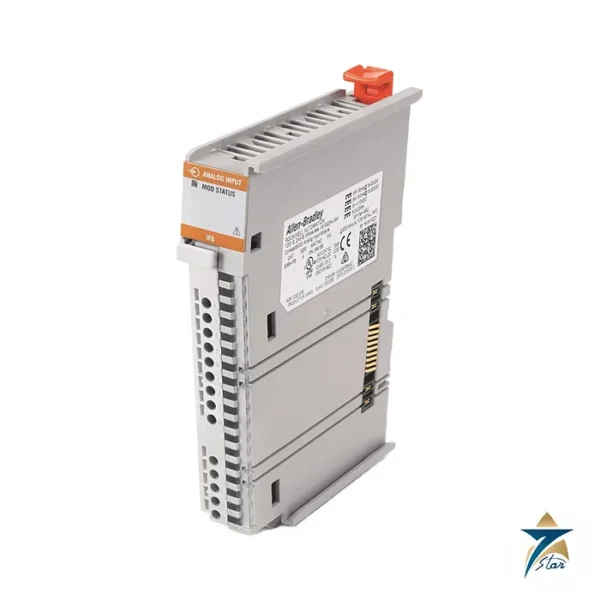
The Allen-Bradley 1734-OE2V gives a POINT I/O node two analog voltage outputs, either 0 to 10 V or plus and minus 10 V, for speed references, valve positioners, dampers and panel meters. It is a 12 mm wide slice, so two output channels can be added to an existing rail node with minimal space.
Resolution is 13 bits plus sign, equal to 1.28 mV per count, with a stated absolute accuracy of 0.1 percent of full scale at 25 °C and 5 ppm per °C drift. The converter settles to 63 percent of a step in 24 microseconds, and the output holds at 0 V until communication with the controller is established, which is a useful safe start-up condition.
Technical specifications
| Parameter |
Specification |
| Catalog number |
1734-OE2V (1734-OE2VK conformal coated), series C documentation |
| Module type |
POINT I/O 2-point analog voltage output module |
| Outputs |
2 single-ended, non-isolated, voltage |
| Output range |
0…10V configurable (-0.0V under, +0.5V over) or ±10V user configurable (-0.5V under, +0.5V over); 0V until communication is established |
| Resolution |
13 bits plus sign; 1.28 mV per count in unipolar or bipolar mode |
| Absolute accuracy |
0.1% of full scale at 25 °C; drift 5 ppm per °C |
| Step response to 63% of full scale |
24 µs |
| Conversion rate |
20 µs; digital to analog converter, signed integer data format |
| Current load on voltage output |
3 mA |
| Calibration |
Factory calibrated |
| External DC power |
24V DC nominal, 10…28.8V DC; 35 mA at 24V DC including outputs at 3 mA |
| POINTBus current |
75 mA at 5V DC, maximum |
| Power dissipation / thermal |
1.0 W maximum; 3.4 BTU/hr maximum |
| Isolation |
50V continuous, tested at 2200V DC for 60 s; no isolation between channels |
| Terminal bases |
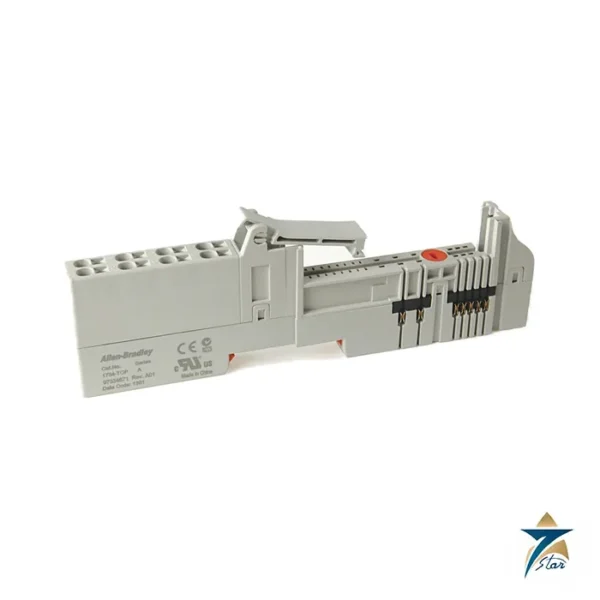
1734-TB, 1734-TBS, 1734-TB3, 1734-TB3S, 1734-TOP, 1734-TOPS, 1734-TOP3 or 1734-TOP3S; keyswitch position 4 |
| Dimensions / weight |
56.6 x 12.1 x 77.5 mm (2.23 x 0.48 x 3.05 in.); 36 g |
| Operating temperature |
-20…+55 °C (-4…+131 °F); non-operating -40…+85 °C |
| Temperature codes (as printed) |
North American T4A; UKEX/ATEX T4; IECEx T4 |
Wiring, power and fault behaviour
The outputs are single-ended and non-isolated from each other. Each channel has an output terminal, a common and a supply terminal, and the load must not draw more than 3 mA per output. The module needs 24 V DC field power in the 10 to 28.8 V range, taking 35 mA including 3 mA outputs, in addition to up to 75 mA at 5 V DC from the POINTBus.
Output status indicators turn steady green for normal operation and flash red when a low or high clamp is active; a steady red indicator means no field power is present. Use the 1734-TB, TBS, TOP or TOPS family of bases with the keyswitch at position 4, and keep a minimum of 2.54 cm (1 in.) clearance above the module.
Voltage or current output
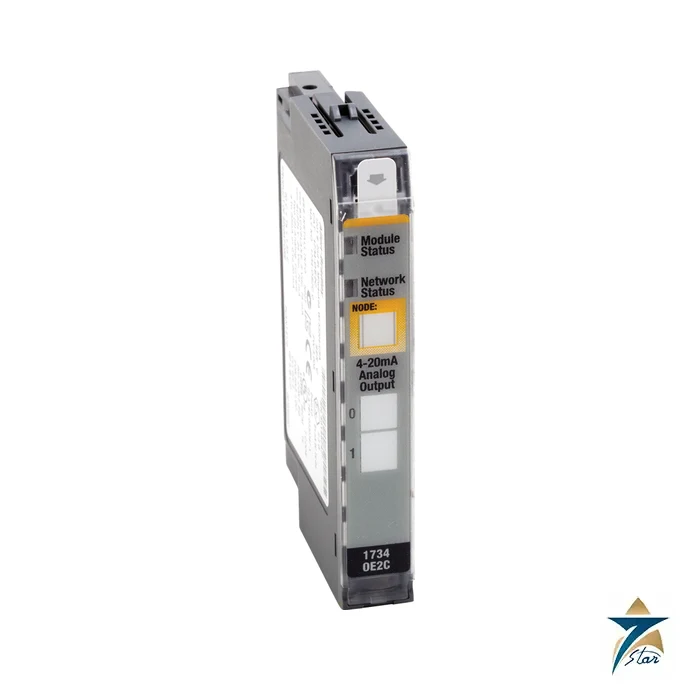
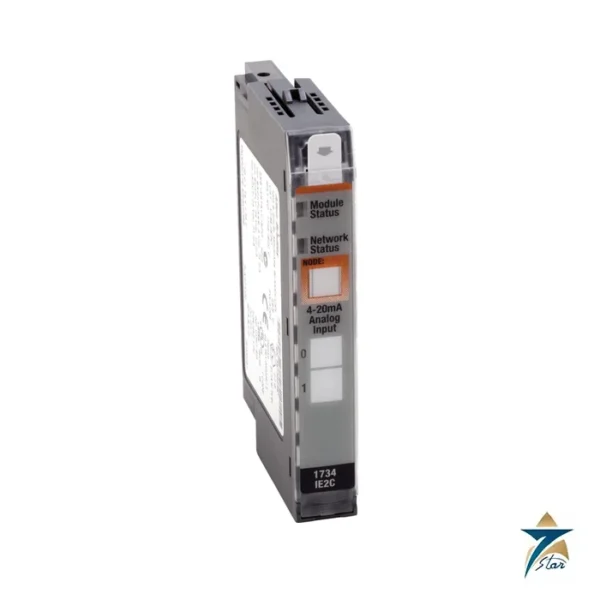
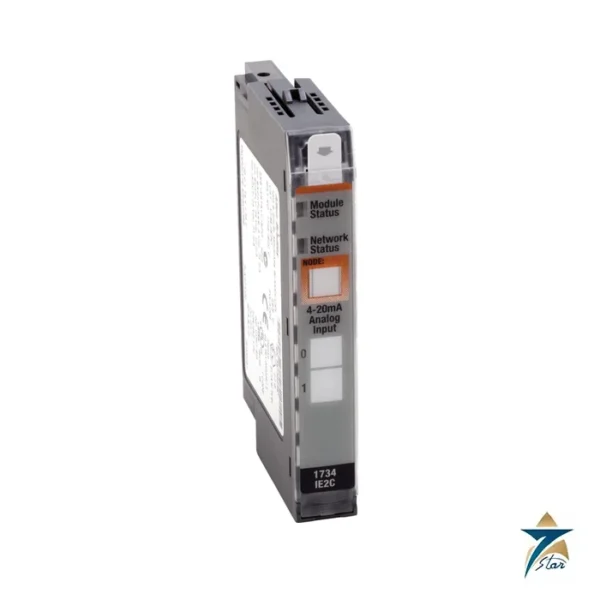
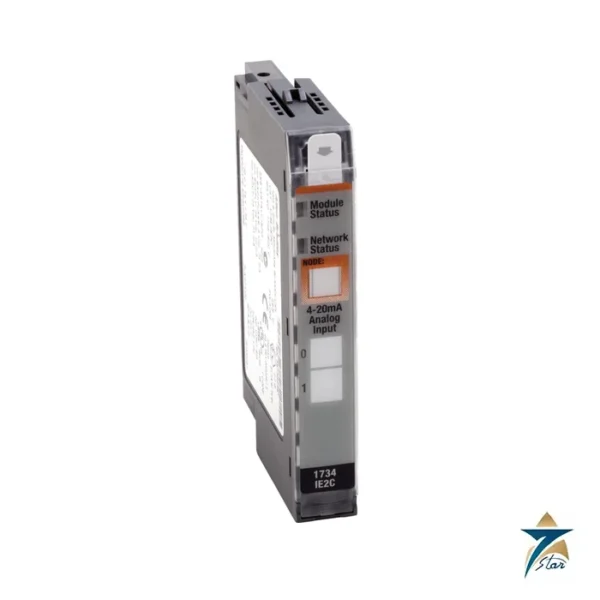
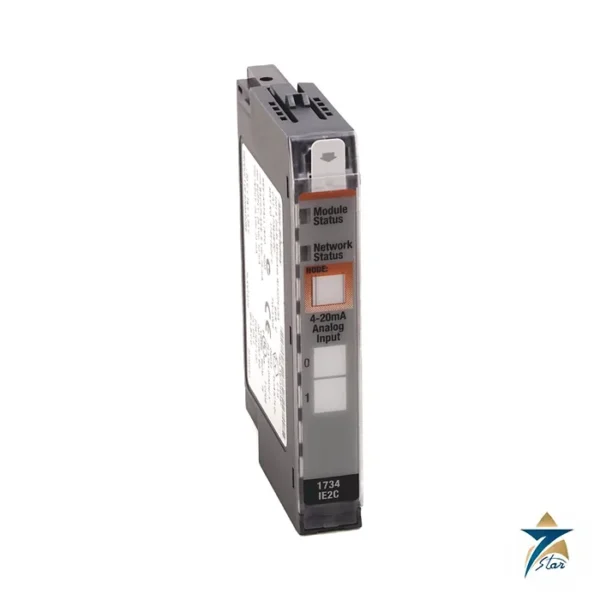
The 1734-OE2C in the same document provides 0-20 mA and 4-20 mA with 14-bit resolution into loads up to 750 ohms. Choose it for current-loop actuators and use the voltage version for inputs that expect 0-10 V. If a group of analog modules will exceed the field power available from the adapter, add a field power module or expansion supply in the middle of the node.
Documents and quotation
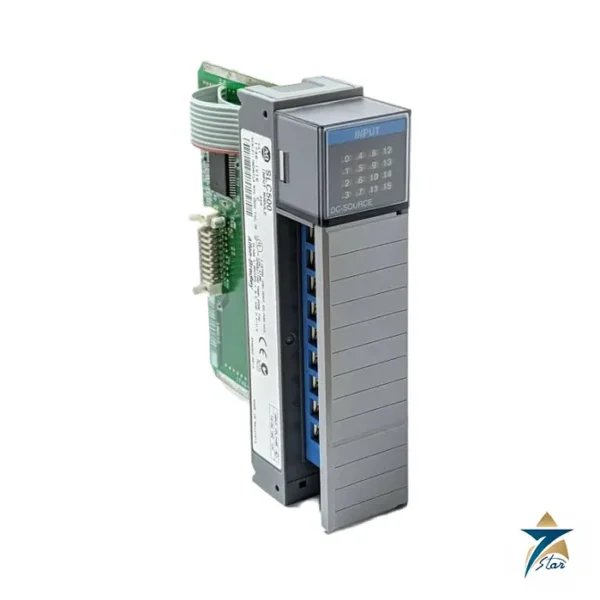
Rockwell Automation publishes installation instructions that cover both the 1734-OE2C and 1734-OE2V modules; the official POINT I/O documentation is linked at the end of this page. See the PLC and I/O cards category and the 1734-IB8 digital input module for companion POINT I/O parts. Confirm the exact catalog number, series letter and firmware or hardware revision on the product label, and the compatibility with your existing system, before ordering. Seven Star LLC quotes against the exact catalog number, with stock and lead time confirmed at quotation.
How the 1734-OE2V Works
The controller writes a signed integer for each channel to the 1734-OE2V through the network adapter and the POINTBus backplane. The module’s digital-to-analog converter turns that number into a voltage at the output terminal, within either the 0–10 V or the ±10 V range chosen in the configuration. Because the converter settles to 63% of a step in 24 µs, the output follows changes in the controller program almost instantly; in practice the update rate is set by the network connection rather than by the module.
A voltage output is a low-impedance source, so the receiving device must have a high input impedance. With the 3 mA load limit, a 10 V signal needs a load of roughly 3.3 kΩ or more; most drive analog inputs, valve amplifiers and panel meters are well above this. The bipolar ±10 V range lets a single signal carry both magnitude and direction, which is common for proportional valve amplifiers and some drive speed references.
Selection & Ordering Guide for the 1734-OE2V
- 1734-OE2V – two voltage outputs, 0–10 V or ±10 V.
- 1734-OE2VK – the same module with conformal coating for harsh atmospheres.
- 1734-OE2C – two current outputs (0–20 mA or 4–20 mA) for current-loop actuators.
- 1734-OE4C – four current outputs where more channels are needed in one slot.
Each module needs a POINT I/O terminal base with the keyswitch at position 4 and an adapter at the head of the node. Check the input type of the receiving device before ordering: a device that expects 4–20 mA will not work correctly from a voltage output. Our team can help confirm the correct ordering code when you request a quote.
Installation & Maintenance
- Voltage signals are best kept to short runs, for example inside one panel or between neighbouring panels. For long field runs, a current output is usually the more robust choice.
- Use shielded twisted-pair cable, route it away from drive output and motor cables, and follow the shield-grounding practice in Rockwell’s wiring and grounding guidelines, publication 1770-4.1.
- The two channels are not isolated from each other. If a receiving device has its signal common tied to a different earth, add a signal isolator to avoid ground loops.
- Watch the status indicators: a flashing red output indicator means a clamp limit is active, and a steady red indicator means field power is missing.
- When commissioning, check the output with a calibrated meter at several points of the range and confirm that the receiving device scales the signal the same way as the controller.
Typical Applications in Oman & the GCC
The 1734-OE2V commonly provides 0–10 V speed references to variable-frequency drives on pumps and fans, positioning signals to damper and valve actuators in district cooling plants and HVAC systems, set-points for proportional hydraulic valves on mobile and process equipment, and signals to panel meters and recorders. In water transmission and desalination facilities, a POINT I/O node with a few voltage outputs can sit inside a motor control panel and drive several local devices over short cables, while the node talks to the main controller over the plant network.
Why Source from Seven Star LLC
Seven Star LLC is an independent supplier in Muscat. Seven Star LLC supplies Allen-Bradley POINT I/O and other automation components across Oman and the GCC. Send the 1734-OE2V catalog number, the quantity and a short description of the receiving devices and request a quote; our team can help confirm the correct ordering code and the companion terminal base and adapter.




Reviews
There are no reviews yet.