- Industrial Communications
- AC Drives
- Vibration Monitoring
- PLC & I/O Cards
- Automation Accessories
- Controllers & Data Acquisition
- CCTV & Security
- Encoders
- Industrial Computers
- Safety Switches & Guard Locking
- HMI Displays
- Motor Soft Starters
- Isolator & Barrier
- Pneumatic Cylinders
- Servo Drives
- Automation Software
- Robotics
- Machine Vision
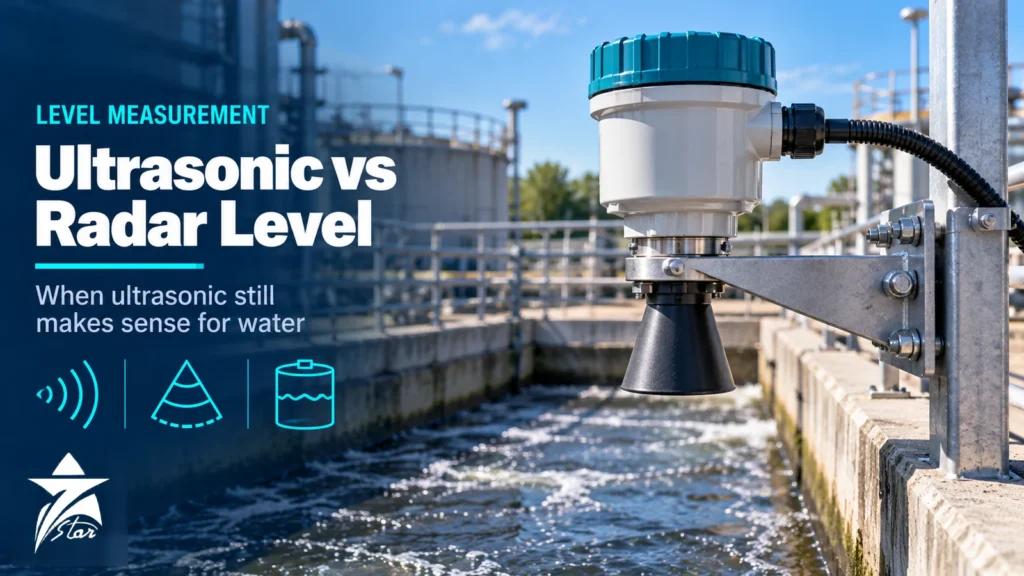
The question of ultrasonic vs radar level measurement comes up whenever a water utility, a wastewater plant or an industrial site replaces old level instruments. Non-contact radar has improved enormously, and compact 80 GHz devices now compete in applications that were once purely ultrasonic. Yet thousands of ultrasonic transmitters still work reliably in reservoirs, wet wells, sumps and open channels. This article looks at the physics behind both technologies, where ultrasonic remains a sound engineering choice, where radar is clearly better, and how to decide for a specific point.
How Each Technology Works
Both are non-contact time-of-flight methods mounted above the liquid, but they use very different signals.
- Ultrasonic transmitters send a sound pulse, typically in the tens of kilohertz, from a transducer and measure the time for the echo to return from the surface. Lower frequencies travel further and tolerate more disturbance; higher frequencies give smaller transducers and shorter blanking distances.
- Radar transmitters send microwaves, mostly as FMCW signals at around 26 GHz or 80 GHz, and calculate distance from the frequency difference or travel time of the reflection. Microwaves travel at the speed of light and are hardly affected by the gas above the liquid.
The key difference is the medium the signal travels through. Sound depends on the air or gas in the tank; microwaves largely do not. For a detailed look at radar types, antennas and frequencies, see our radar level transmitter selection guide.
Ultrasonic vs Radar Level: Side-by-Side Comparison
| Factor | Ultrasonic | Radar (FMCW, 26/80 GHz) |
|---|---|---|
| Effect of air temperature | Speed of sound changes about 0.18 % per °C; compensated by built-in sensor | Negligible |
| Vapour, gas layers, steam | Can absorb or bend the signal | Little effect in most cases |
| Foam | Often absorbs the echo | Light foam usually tolerated; dense foam can still be difficult |
| Pressure and vacuum | Near-atmospheric only; no measurement in vacuum | Wide pressure and vacuum ranges |
| Beam angle | Wider; depends on transducer | Narrow at 80 GHz, useful in tight tanks |
| Blanking distance | Typically a few tens of centimetres | Usually small |
| Integrated pump and flow functions | Common in controller-type products | Available in some models; often done in the PLC |
| Typical home | Water tanks, wet wells, sumps, channels, flumes | Process vessels, chemicals, pressurised tanks, solids silos |
Where Ultrasonic Still Makes Sense
Ultrasonic is not an outdated technology; it simply has a narrower comfort zone. Inside that zone it is mature, well understood by maintenance teams and often comes with useful application software.
- Open water reservoirs and storage tanks with a calm surface and no vapour.
- Wastewater wet wells and lift stations, where controllers handle pump alternation, duty/standby and alarm relays directly.
- Open channel flow at Parshall flumes and weirs, where the sensor measures head and the transmitter converts it to flow.
- Differential level across screens and filters, using two sensors and one controller.
- Sumps, drainage pits and chemical-free process water tanks at atmospheric pressure.
- Replacements where operators know the existing system and the installation has proven stable.
In these applications the conditions above the liquid are usually benign, and the long experience of utilities with ultrasonic controllers counts for a lot.
Temperature and the Speed of Sound
Sound travels in air at roughly 331 m/s at 0 °C, rising by about 0.6 m/s per °C. That is about 0.18 % per degree, so an uncompensated 20 °C error in air temperature would shift a 5 m reading by about 18 cm. Every ultrasonic transmitter therefore includes a temperature sensor, usually in the transducer, and corrects the speed of sound automatically.
The weakness is that the sensor sees only the temperature at the transducer. In GCC summers, a sun-heated tank roof or an enclosed wet well can create strong temperature layers between the transducer and the surface. Practical steps:
- Shade the sensor and, where possible, the tank roof area around it.
- Use an external temperature probe midway down the air column on long ranges, if the controller supports one.
- Avoid mounting next to warm ventilation outlets or sunlit metal walls.
- Verify the reading against a manual dip at different times of day after commissioning.
Foam, Vapour, Condensation and Wind
These four conditions cause most ultrasonic problems.
- Foam absorbs sound. Aeration basins and some industrial effluents produce foam that makes the echo weak or unstable. Radar copes better with light foam, but heavy foam can challenge both; contact methods such as hydrostatic sensors may be the answer.
- Vapour and gases change the speed of sound and absorb energy. Solvent tanks and heated tanks are not suitable.
- Condensation on the transducer face weakens the signal. Self-cleaning transducer designs and correct mounting reduce the problem, but in very humid closed spaces radar with a suitable antenna is more robust.
- Wind and air currents across open channels and outdoor tanks can scatter the beam over long ranges. A shield or a lower mounting height helps.
Open Channel Flow Measurement
Ultrasonic level transmitters are widely used to measure flow in open channels because a non-contact sensor above the flow avoids fouling. The method relies on a primary element, typically a Parshall flume or a weir, with a known relationship between head and flow.
Key points for good results:
- Mount the sensor at the head measurement point specified for the flume or weir, not simply where it is convenient.
- Keep the sensor perpendicular to the surface and above the maximum head plus blanking distance.
- Ensure the approach channel gives smooth, non-turbulent flow, and keep the flume free of silt and debris.
- Enter the correct flume size or weir geometry in the transmitter; a wrong table gives large flow errors even when the level is correct.
Compact radar sensors are increasingly used for the same job, especially where condensation or temperature layers are a problem. For discharge monitoring and other water quality points, see our article on water quality analysers for desalination and wastewater.
When Radar Is the Better Choice
- Closed process vessels with vapour, temperature layers or pressure.
- Chemical storage tanks, especially with volatile liquids.
- Narrow tanks, nozzles or tanks with internal obstructions, where a narrow beam avoids false echoes.
- Long ranges where sound attenuation becomes a limiting factor.
- Tanks with frequent condensation on the sensor, or where the transducer face cannot be kept clean.
- Hazardous-area process installations where a wider range of certified radar models is available.
The price gap between compact radar and ultrasonic has narrowed in recent years, so when conditions are uncertain, radar is often the lower-risk choice. Radar is not free of installation rules either: nozzle length, antenna size and false-echo suppression still matter, and a poorly placed radar can perform worse than a well-placed ultrasonic sensor.
Installation Rules for Ultrasonic Transmitters
- Keep the beam clear of walls, ladders, inlets and pump bodies; check the beam angle against the tank geometry.
- Avoid the inlet stream, which creates turbulence and false echoes.
- Mount on a stand-off so that the maximum level stays below the blanking distance.
- Ensure the transducer face is parallel to the liquid surface.
- Use the echo profile tools during commissioning to suppress fixed obstruction echoes.
- Fit sunshades in outdoor locations and seal cable entries against humidity.
Troubleshooting a Problem Ultrasonic Point
Before replacing an ultrasonic transmitter that gives erratic readings, it is worth finding the cause, because the same conditions may also affect a new instrument.
- Look at the echo profile. A weak true echo suggests foam, vapour, condensation or misalignment; a strong false echo at a fixed distance points to an obstruction or a nozzle wall.
- Compare the reading against a manual dip or a sight glass at several levels, including the lowest and highest normal levels.
- Check the temperature reading in the diagnostics against the real air temperature near the surface.
- Inspect the transducer face for scale, grease, spider webs or insects, which are common in outdoor wet wells.
- Review the configuration: empty distance, span, damping and the rate settings that limit how fast the reading may change.
- Confirm that nothing has changed in the tank, such as a new inlet pipe, ladder or mixer within the beam.
If the root cause is foam, vapour or persistent condensation, a move to radar or to a contact method is justified. If it is mounting or configuration, a correction often restores reliable operation at little cost.
Alternatives Beyond Non-Contact Methods
Non-contact transmitters are not the only option for water and wastewater. Submersible hydrostatic transmitters work well in deep wells, boreholes and foaming basins because they do not depend on the surface at all; they need a vented cable, protection against silt and suitable lightning protection on long cable runs. Float switches remain a simple and dependable backup for high and low alarms in wet wells, independent of the main transmitter. Our pressure instrumentation range covers hydrostatic and differential pressure options for these cases. Many utilities combine a non-contact transmitter for control with independent float switches for alarms, which gives a diverse and robust arrangement.
Ultrasonic vs Radar Level Selection Checklist
- Liquid, surface condition (calm, turbulent, foam) and presence of vapour.
- Tank or channel geometry, range and maximum level relative to the sensor.
- Air temperature range and exposure to direct sun.
- Pressure or vacuum conditions.
- Required functions: level, volume, pump control, open channel flow, differential level.
- Output and communication: 4–20 mA, HART, relays, Modbus or fieldbus.
- Hazardous-area classification, enclosure rating and mounting materials.
- Existing make and model if replacing like-for-like.
Sourcing Ultrasonic and Radar Level Transmitters Through Seven Star LLC
Seven Star LLC supplies ultrasonic and radar level transmitters, controllers and accessories on request for water, wastewater and industrial customers in Oman and the GCC, with products from manufacturers such as Siemens, VEGA, Endress+Hauser, KROHNE and Pulsar as neutral examples. We help with technology selection and with cross-checking model codes and part numbers; availability and lead time are confirmed at quotation. Browse our level instrumentation and flowmeters categories.
Send us the datasheet or nameplate of your existing level transmitter, or an RFQ with the tank or channel details, range and required outputs, and we will propose suitable ultrasonic or radar options.
Frequently asked questions
Is radar always better than ultrasonic for level measurement?
No. Radar is less affected by temperature, vapour, pressure and air movement, so it is the safer choice in process vessels. In open water tanks, wet wells and channels, however, a well-installed ultrasonic transmitter often performs reliably and integrates pump control and flow functions. The right choice depends on the conditions above the liquid, not on the technology alone.
Why does temperature affect ultrasonic level readings?
Ultrasonic transmitters calculate distance from the time a sound pulse takes to travel to the surface and back, and the speed of sound in air rises by roughly 0.17–0.18 % per °C. The built-in temperature sensor corrects for this, but it measures only near the transducer. If the air column is stratified, for example in a sun-heated tank or a covered wet well, some error remains.
What is the blanking distance of an ultrasonic sensor?
It is the zone immediately below the transducer where no measurement is possible, because the transducer is still ringing after sending the pulse. It is typically a few tens of centimetres and is stated on the datasheet for each model. The highest expected level must stay below this zone, which is why sensors are often mounted on a stand-off or riser.
Can ultrasonic transmitters measure open channel flow?
Yes. Many ultrasonic transmitters include level-to-flow functions for Parshall flumes, V-notch and rectangular weirs, or a custom head-flow table. The sensor measures the head at the correct position upstream of the primary element, and the transmitter calculates and totalises flow. Accuracy depends heavily on the flume or weir installation, not only on the level sensor.
When should I replace an ultrasonic level transmitter with radar?
Consider radar when you see lost echoes from foam, condensation on the transducer, errors from vapour or temperature layering, or when the tank is pressurised or contains chemicals. Radar is also preferable in narrow tanks with internal obstructions, where a narrow 80 GHz beam helps. Where the ultrasonic unit works reliably, there is no need to change it.
Do ultrasonic level sensors work under vacuum or pressure?
Sound needs a gas to travel through, so ultrasonic transmitters cannot work under vacuum, and their pressure rating is usually low. They are designed mainly for atmospheric or near-atmospheric tanks and open channels. Pressurised vessels are normally fitted with radar or other technologies.
Was this guide helpful?One click helps us write better guides for engineers.
Thank you! Glad it helped. Need this equipment for your project? Request a quotation
Thank you. We will use this to improve the guide.