A compact optical flame sensor for single-burner gas, oil and coal plants
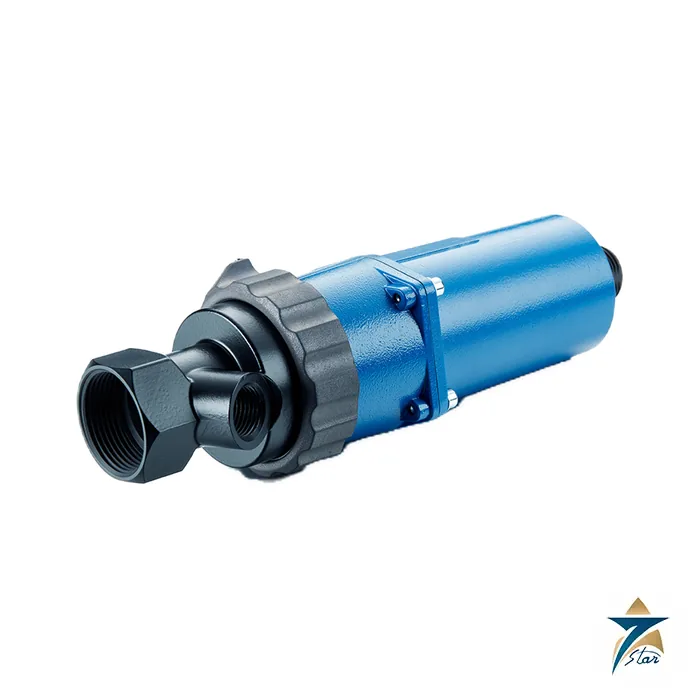
The DURAG D-LE 103 is a flame sensor that converts flame radiation into a signal for a control unit or burner control. A photo element inside the sensor generates a signal proportional to the flame radiation intensity, and the output is used as the input of the evaluating device. DURAG positions it for monitoring gas, oil and coal flames, primarily in single-burner view applications such as steam generators, heating plants, refineries, power stations and waste incinerators.
Several photo elements are available in the same housing, so one sensor family covers UV, visible and IR flame monitoring. The sensor is self-monitoring and fail-safe when used with a DURAG control unit or burner control, and all versions share the same output signal, which makes them mutually interchangeable.
Technical specifications
| Parameter |
Specification |
| Function |
Flame sensor for gas, oil and coal flames, primarily single-burner view applications |
| Spectral ranges |
UV, VIS, IR (depending on the photo element) |
| Available versions |
D-LE 103 UL, UAF, UA, IS and IG photo elements; with cable gland (-CG) or axial plug (-P) |
| Operational mode |
Intermittent, continuous and 72-hour operation without permanent supervision |
| Safety |
Self-monitoring and fail-safe in conjunction with a control unit or burner control |
| Control units |
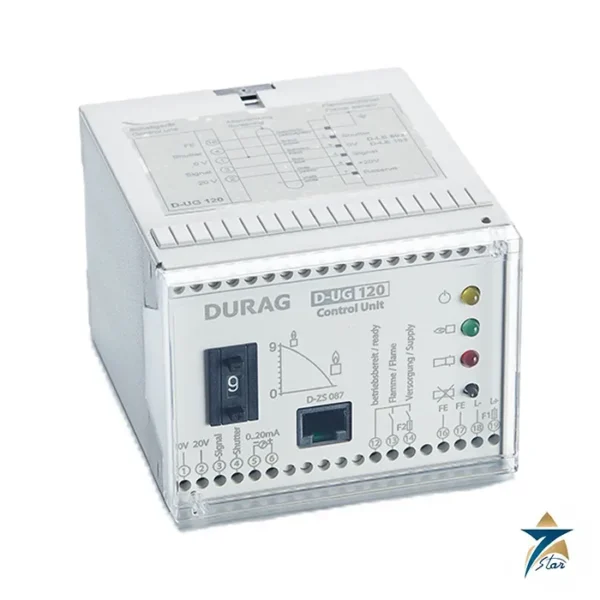
D-UG 120, D-UG 660 control units; D-GF 150 (-MB) burner control |
| Protection |
IP65 with cable gland (-CG); IP67 with axial plug (-P) |
| Gain and high-pass filter |
Pre-set |
| Viewing angle |
6 degrees |
| Permissible ambient temperature |
-20 to +60 degC |
| Dimensions |
Diameter 80 mm, length approx. 350 mm |
| Weight |
Approx. 1 kg |
| Sighting tube connection |
G 1 1/4 inch |
| Purge air connection |
G 1/2 inch |
| Certifications listed |
DVGW, UL 372, FM Class 7610, AGA AS 4625, EAC, SIL3 |
Choosing the photo element for the fuel
The DURAG datasheet rates each version against the fuel. It rates the UL version ideally suited to gas and well suited to oil. The UAF version is conditionally suited to gas and ideally suited to oil, while UA is well suited to gas, ideally suited to oil, conditionally suited to coal and well suited to wood. The IS version is not permitted for gas, but ideally suited to oil and coal and well suited to wood. The IG version is conditionally suited to gas and ideally suited to oil, coal and wood. These ratings are from experience, according to the datasheet, so confirm the choice for your fuel and burner with the plant designer.
Accessories and what to confirm before ordering
Listed accessories include the D-ZS 118 optical adjustment aid, the UV-C test light source D-ZS 077-10, the UV-A, UV-B and IR test light source D-ZS 093, a swivel mount, a thermal isolator with electrical insulation, a ball valve for closing the sighting tube, and the D-ZS 140 terminal box. A purge air flange is shown in the installation sketch. State the photo element version (UL, UAF, UA, IS or IG), the connection type (-CG or -P), the fuel and the control unit the sensor will connect to. Related combustion safety equipment is listed under flame detection and sensors, including the DURAG D-HG 400 ignition device.
Documents and quotation
The attached DURAG datasheet (dated 08/2016 in the document footer) is a one-page summary of the D-LE 103 family. Send the full type code, the burner type and the quantity so the quotation matches the exact version.










Reviews
There are no reviews yet.