- AC Drives
- Industrial Communications
- PLC & I/O Cards
- Vibration Monitoring
- Automation Accessories
- Controllers & Data Acquisition
- CCTV & Security
- Safety Switches & Guard Locking
- Encoders
- Industrial Computers
- Servo Drives
- HMI Displays
- Motor Soft Starters
- Isolator & Barrier
- Pneumatic Cylinders
- Automation Software
- Machine Vision
- Robotics
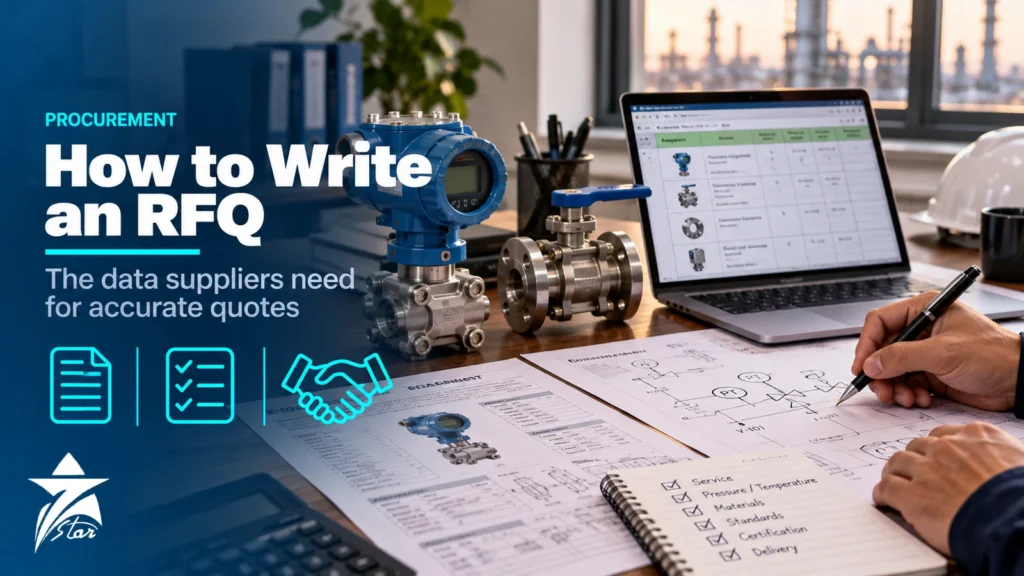
A supplier can only quote what it can identify. When an enquiry says “pressure transmitter, 0–10 bar, qty 4” or “spare card for compressor panel”, the reply will be a list of questions, a guessed offer that later needs revising, or no reply at all. Knowing how to write an RFQ for instruments and spare parts is therefore one of the most effective ways for a procurement or maintenance engineer to shorten lead time and avoid wrong deliveries. This guide sets out the information that turns an enquiry into a firm, comparable quotation: the commercial header, line-item identification, technical data by product type, documents and certificates, how to handle obsolete parts and alternatives, and the mistakes that most often stall quotations.
Why Vague RFQs Cost Time and Money
Every missing detail forces one of three outcomes. The supplier asks a clarification question, adding a round of emails for each gap. The supplier makes an assumption, and the quotation is for something slightly different from what you need. Or several suppliers make different assumptions, and their prices cannot be compared because they are not quoting the same item. In the worst case the difference is discovered only on delivery, when a transmitter arrives with the wrong process connection or a valve with the wrong trim material and the shutdown is days away.
A complete RFQ lets the supplier go straight to the manufacturer or distributor with an unambiguous order code, so you receive a firm price, an accurate lead time and a technical offer you can evaluate line by line.
The Commercial Header: What Every RFQ Needs
- Buyer details: company, contact name, email and phone of someone who can answer technical questions, not just a generic procurement inbox.
- Reference: RFQ number, project or work order and the end-user site if relevant, so revisions and clarifications stay linked.
- Delivery location and terms: the city or site and the Incoterms 2020 rule you want quoted (for example EXW, FCA, CPT, DAP or DDP), which defines who pays freight, insurance and import duties.
- Required date: the date the goods must be on site, so the supplier can say honestly whether it is achievable and suggest air freight where needed.
- Quotation deadline and validity: when you need the offer and for how long prices must remain valid.
- Currency and payment terms you expect, if fixed by company policy.
- Acceptance of alternatives: whether equivalent brands, newer models or refurbished items may be offered, and whether partial quotation or partial shipment is acceptable.
Identifying Each Line Item Correctly
The single most valuable piece of data is the full manufacturer model code or part number exactly as printed on the nameplate or in the original documentation, including every suffix and option character. A pressure transmitter model code may contain twenty characters, each defining range, materials, housing, output, approvals and options; dropping one character changes the product. For each line give:
- Manufacturer name.
- Complete model code or part number, copied without abbreviation.
- Short description in plain words (what it is and what it does).
- Quantity and unit (each, set, metre, box).
- Tag number and service, where it is an installed instrument.
- For spare parts: the parent equipment make, model and serial number, and the part position or item number from the parts list or drawing.
- A clear nameplate photograph, taken square-on and in focus, with the whole label visible.
If the model code is unknown or the nameplate is unreadable, say so openly and provide the process data and installation details instead. A supplier can configure a correct new instrument from good specification data far more easily than it can decode a partial code.
Technical Data to Send by Product Type
When a full model code is not available, or when you are buying a new item rather than a direct replacement, the following data allows a supplier to configure the right product:
| Product type | Essential data |
|---|---|
| Pressure and DP transmitters | Measurement type (gauge, absolute, differential), range and units, process connection, wetted materials, fill fluid for seals, output and protocol, housing and cable entry, hazardous area approval, accuracy class |
| Temperature sensors and transmitters | Sensor type (RTD or thermocouple and type), element class, insertion length and diameter, thermowell data, connection, head or transmitter output, approvals |
| Flow meters | Fluid, flow range, pressure and temperature, density and viscosity, line size and flange rating, accuracy needed, output, power supply, approvals |
| Control and on-off valves | Size, pressure class, end connection, body and trim materials, Cv or flow conditions, leakage class, actuator type and air supply, positioner and accessories, fail position |
| Electrical components | Rated voltage and frequency, current, poles, breaking capacity, coil voltage, mounting, IP rating |
| Motors and drives | Power, voltage, frequency, speed, frame size, mounting, enclosure, efficiency class, hazardous area rating |
| PLC, DCS and monitoring modules | Full part number including revision, firmware version, chassis or rack type, and the system model |
| Bearings and seals | Full designation including suffixes, dimensions, cage and clearance, lubricant and seal type |
Our pressure transmitter selection guide shows how much of a model code depends on these process details.
Process Conditions and Service Requirements
Process conditions decide materials, ratings and certifications. State them even when they seem obvious to the plant team:
- Process fluid and composition, including H2S, CO2, chlorides, solids or abrasives.
- Normal, minimum and maximum pressure and temperature, plus design values.
- Sour service requirements under NACE MR0175 / ISO 15156 where applicable.
- Ambient conditions: outdoor installation, high ambient temperature, dust, salt-laden coastal or offshore air.
- Hazardous area classification (zone, gas group and temperature class) and the certification scheme required, such as ATEX or IECEx; see our guide to hazardous area classification.
- Any project or end-user specification that applies, with the document number.
Documents and Certificates
Certificates cost time and sometimes money, so request them in the RFQ rather than after the order:
- Instrument data sheets, preferably on a recognised format such as ISA or IEC 61987 style sheets, or the project’s own templates.
- Material test certificates, typically EN 10204 type 3.1 for pressure-retaining parts.
- Calibration certificates and the points required.
- Hazardous area certificates and declarations of conformity.
- Certificate of origin and certificate of conformity.
- Drawings, dimensional data and manuals required for approval or for the maintenance file.
- Packing, marking and tagging requirements.
Obsolete Parts, Alternatives and Supersessions
Maintenance RFQs often involve products that are discontinued. Write the RFQ so suppliers can respond usefully:
- State whether you need the exact original part (for example, because of qualification or configuration constraints) or whether a manufacturer-recommended successor is acceptable.
- Say whether new surplus or refurbished units may be offered, and what test evidence you would require.
- For electronic modules, give hardware revision and firmware version, because a newer revision may need different software or configuration.
- Ask suppliers to identify clearly any line where they offer an alternative and to list the differences.
Our article on sourcing obsolete automation parts covers legacy PLC, DCS and safety system modules in more detail.
How to Write an RFQ Document That Is Easy to Quote
A clear format reduces errors on both sides. A spreadsheet or table with one row per line item works best, using columns for item number, manufacturer, model or part number, description, quantity, unit, tag, required date and remarks. Attach nameplate photos and data sheets named with the item number. Keep the technical requirements in one place and refer to them by item; avoid scattering details through a long email thread. When the RFQ is revised, issue a new revision number and highlight what changed.
Ask suppliers to respond in the same structure, with unit price, total, lead time, country of origin, HS code where known, and a deviation list. Responses in the same format can be compared side by side quickly.
Evaluating the Quotations You Receive
A good RFQ also makes evaluation faster. Separate the review into a technical check and a commercial comparison, and do the technical check first, because a cheap offer for the wrong item has no value.
- Compare each offered model code character by character against the requested code or data sheet, and confirm any differences are listed as deviations.
- Check that offered certificates, documents and approvals match the RFQ list.
- Confirm lead time is stated from order date or from drawing approval, and whether it is ex-works or delivered.
- Normalise prices to the same Incoterms rule, currency and validity before ranking them.
- Ask clarification questions in writing, referencing RFQ and line numbers, and keep answers with the evaluation file.
How to Write an RFQ Without the Mistakes That Delay Quotations
- Truncated model codes, or codes copied from an internal stock description rather than the nameplate.
- Photos taken at an angle, blurred or showing only part of the label.
- Spare parts requested without the parent equipment model and serial number.
- Missing quantity, units or delivery location.
- No statement on alternatives, so some suppliers quote equivalents and others decline.
- Certificates demanded only after the order, causing re-quotation and delay.
- Several unrelated items bundled with one item that is hard to source, holding up the whole RFQ; split difficult lines into a separate enquiry.
- Unrealistic deadlines without saying whether air freight or partial delivery is acceptable.
RFQ Checklist for Instruments and Spare Parts
- RFQ number, contact person, delivery location, Incoterms rule and required date.
- One row per item with manufacturer, full model code, description, quantity and unit.
- Nameplate photo for every replacement item.
- Parent equipment make, model and serial number for spare parts.
- Process conditions, materials and hazardous area requirements for configured instruments.
- Required certificates and documents listed.
- Policy on alternatives, successors and refurbished items.
- Quotation deadline and required validity.
- Request for lead time, origin and deviation list in the reply.
Sourcing Instruments and Spare Parts Through Seven Star LLC
Seven Star LLC supplies sensors and transmitters, control valves, electrical, automation, bearing and analyzer products on request for operators and contractors in Oman and the GCC. We help with selection and cross-checking part numbers, flag supersessions where we find them, and confirm availability and lead time at quotation.
Have a list ready? Send us your RFQ with model codes, quantities and nameplate photos, or just the nameplates and process data if the codes are missing, and we will come back with a structured quotation line by line.
Frequently asked questions
What is the most important information in an RFQ for spare parts?
The full manufacturer part number or model code exactly as shown on the nameplate, with the parent equipment make, model and serial number. A clear nameplate photograph removes most ambiguity. Quantity and delivery location complete the essentials.
Should I include Incoterms in an RFQ?
Yes. Stating the Incoterms 2020 rule, such as EXW, DAP or DDP, together with the delivery location tells suppliers who pays freight, insurance and duties. Without it, quotations are priced on different bases and cannot be compared fairly.
What if the nameplate is missing or unreadable?
Say so in the RFQ and provide process conditions, dimensions, connection details and photos of the installed item and its surroundings. A supplier can often identify or configure an equivalent from good specification data, and partial nameplate information still helps.
Should an RFQ allow alternative brands?
It depends on your qualification and maintenance constraints, but you should always state your position. If alternatives are allowed, ask suppliers to mark alternative lines clearly and list technical differences so you can evaluate them.
Which certificates should be requested at RFQ stage?
Request everything you will need, for example EN 10204 3.1 material certificates, calibration certificates, hazardous area certificates, certificates of origin and conformity, and drawings or manuals. Adding them after ordering often means re-quotation and delay.
Why do I get different prices for the same item from different suppliers?
Often they are not quoting the same item: model code options, certificates, delivery terms or validity differ. A complete RFQ with full model codes, Incoterms and document requirements makes offers comparable.
Was this guide helpful?One click helps us write better guides for engineers.
Thank you! Glad it helped. Need this equipment for your project? Request a quotation
Thank you. We will use this to improve the guide.