- AC Drives
- Industrial Communications
- PLC & I/O Cards
- Vibration Monitoring
- Automation Accessories
- Controllers & Data Acquisition
- Safety Switches & Guard Locking
- CCTV & Security
- Encoders
- Industrial Computers
- HMI Displays
- Motor Soft Starters
- Servo Drives
- Isolator & Barrier
- Pneumatic Cylinders
- Automation Software
- Robotics
- Machine Vision
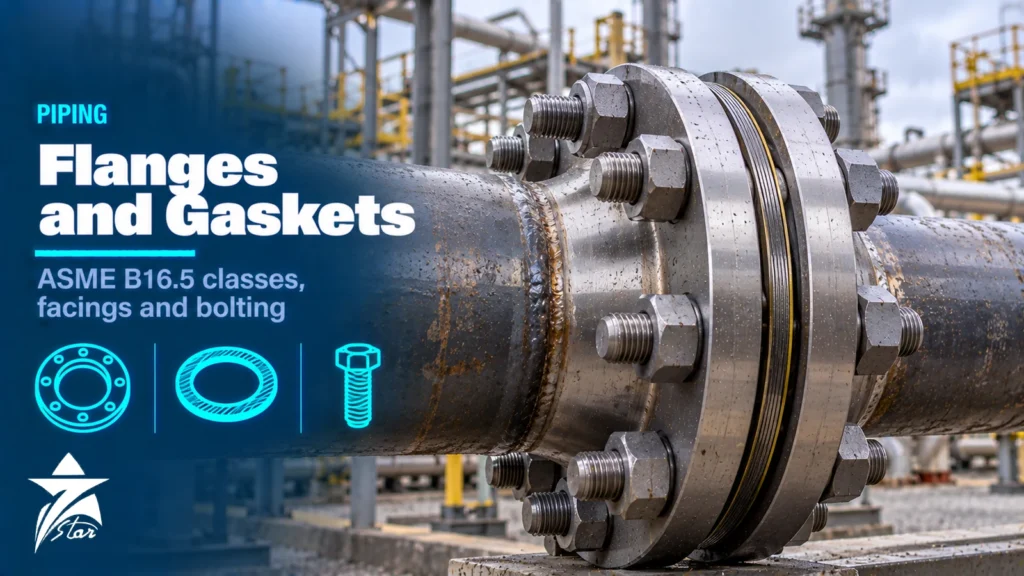
Most flange leaks are not caused by a bad flange. They come from the wrong gasket for the facing, the wrong pressure class for the temperature, a damaged sealing surface, or bolts tightened unevenly. This flanges and gaskets guide covers what a maintenance or piping engineer needs to specify and assemble a tight joint: ASME B16.5 pressure classes and pressure-temperature ratings, flange types and facings, spiral wound gaskets to ASME B16.20 and their colour codes, bolting materials, and the assembly practice set out in ASME PCC-1. It closes with the mistakes that cause most leaks and a checklist for ordering flanges, gaskets and bolts together.
ASME B16.5 Scope and Pressure Classes
ASME B16.5 covers pipe flanges and flanged fittings from NPS ½ to NPS 24 in seven pressure classes: 150, 300, 400, 600, 900, 1500 and 2500. Larger sizes, NPS 26 to 60, fall under ASME B16.47 (Series A and Series B), which are not bolt-compatible with each other. The class number is not a pressure in psi or bar. It is a rating designation, and the actual allowable pressure depends on the flange material group and the design temperature.
For the most common carbon steel material group (Group 1.1, which includes forged ASTM A105 and cast A216 WCB), the ratings at ambient temperature (−29 to 38 °C) are:
| Class | Rating at −29 to 38 °C (Group 1.1) | Typical service |
|---|---|---|
| 150 | 19.6 bar | Utilities, cooling water, low-pressure process |
| 300 | 51.1 bar | General process, steam, hydrocarbons |
| 600 | 102.1 bar | High-pressure hydrocarbon and gas lines |
| 900 | 153.2 bar | Wellhead gathering, high-pressure gas |
| 1500 | 255.3 bar | High-pressure gas injection, compressor discharge |
| 2500 | 425.5 bar | Very high-pressure service |
These ratings fall as temperature rises. A Class 150 carbon steel flange at 200 °C is rated well below its ambient value, so always read the B16.5 table for the actual material group and maximum design temperature. Stainless steels, alloy steels and duplex grades sit in different material groups with their own tables.
Flange Types
- Weld neck: long tapered hub butt-welded to the pipe; the best choice for high pressure, high temperature and cyclic service, and it allows full radiography of the weld.
- Slip-on: slides over the pipe and is fillet welded inside and outside; cheaper and easier to align, but lower fatigue strength.
- Socket weld: for small bore lines, usually NPS 2 and below; avoid where crevice corrosion is a concern.
- Threaded: no welding, used for small bore utility lines and where hot work is restricted; not for cyclic or severe service.
- Lap joint: loose backing flange over a stub end; useful with expensive alloy piping and where bolt-hole alignment is difficult.
- Blind: closes the end of a line or nozzle; carries the highest bending load in the class.
Flange Facings and Surface Finish
The facing must match the gasket type. A spiral wound gasket on a flat face flange, or a sheet gasket on a ring-type joint groove, will not seal properly.
| Facing | Description | Gasket used |
|---|---|---|
| Raised face (RF) | Raised sealing area: 1.6 mm (1/16 in) high on Class 150 and 300, 6.4 mm (1/4 in) on Class 400 and above | Spiral wound, sheet, kammprofile |
| Flat face (FF) | Flat across the whole face, used to mate with cast iron or non-metallic equipment flanges | Full-face sheet gasket |
| Ring-type joint (RTJ) | Machined groove for a metal ring | Oval or octagonal R ring, RX ring; BX rings for API 6A flanges |
| Tongue and groove / male and female | Matching raised and recessed faces that confine the gasket | Flat metal-jacketed or sheet gaskets |
Raised face flanges for spiral wound gaskets normally have a concentric or spiral serrated finish, commonly specified between 3.2 and 6.3 µm Ra (125–250 µin). Radial scratches across the serrations are a leak path; small circumferential marks are usually acceptable, but check against ASME PCC-1 guidance on flange face blemishes.
Spiral Wound Gaskets to ASME B16.20
A spiral wound gasket consists of a V-shaped metal strip wound together with a soft filler, usually flexible graphite or PTFE, held in a solid outer centring ring. It handles a wide range of pressures and temperatures and is the default gasket for RF flanges in Class 150 to 2500 process piping.
- Outer (centring) ring: normally carbon steel; locates the gasket on the bolt circle and acts as a compression stop.
- Winding: 316L stainless is common; other alloys such as Inconel or Monel for corrosive or high-temperature duty.
- Filler: flexible graphite for most services and high temperature; PTFE for chemical resistance at lower temperatures; mica or ceramic blends for very high temperature.
- Inner ring: protects the winding from buckling inward and reduces turbulence and erosion. B16.20 requires inner rings on PTFE-filled gaskets and on larger high-class sizes, for example NPS 24 and above in Class 900, NPS 12 and above in Class 1500 and NPS 4 and above in Class 2500. Many operators specify inner rings on all spiral wound gaskets as a company standard.
Colour coding on the outer ring identifies the materials. A solid colour on the rim indicates the winding metal (for example yellow for 304 and green for 316L), and stripes indicate the filler (grey stripes for flexible graphite, white for PTFE). Always confirm against the manufacturer’s marking and the stamped details on the ring, not colour alone.
Other Gasket Types
- Compressed fibre and graphite sheet (ASME B16.21): low-pressure utilities, water and air, especially on flat face flanges.
- Kammprofile (grooved metal): serrated metal core with graphite or PTFE facings; good recovery and low bolt load, popular on heat exchangers.
- Ring-type joint gaskets: solid metal rings in soft iron, low carbon steel or stainless for RTJ grooves; ring hardness must be lower than the groove hardness.
- Insulating gasket kits: isolate cathodically protected pipelines from plant piping, with sleeves and washers for each bolt.
Choosing between these types comes down to four questions: the flange facing, the design pressure and temperature, the chemical compatibility of the filler or sheet with the process fluid, and the bolt load the flange can actually deliver. Low-class flanges with few, small bolts may not compress a spiral wound gasket fully, which is why sheet or kammprofile gaskets are often preferred on Class 150 equipment nozzles and lightweight flanges. Where a joint has a leak history, a review of gasket stress against the gasket manufacturer’s minimum and maximum values usually explains why.
Bolting Materials
For carbon and low-alloy steel flanges the common combination is ASTM A193 Grade B7 stud bolts with A194 Grade 2H heavy hex nuts. For sour service under NACE MR0175/ISO 15156, hardness-controlled B7M studs and 2HM nuts are used, and bolting buried, insulated or otherwise shielded from the atmosphere is the usual trigger for the hardness limits. Low-temperature service uses A320 L7 or L7M; high-temperature and stainless systems may call for A193 B8 or B16. Coatings such as zinc-nickel, PTFE-based fluoropolymer or hot-dip galvanising help in coastal and offshore Gulf environments, but they change the nut factor, so torque values must be calculated for the coating and lubricant actually used.
Assembly and Bolt Tightening Practice
ASME PCC-1 (Guidelines for Pressure Boundary Bolted Flange Joint Assembly) is the reference most plants use for assembly procedures. Its key points are:
- Inspect both flange faces for damage, scratches and corrosion, and clean them; never reuse a spiral wound or RTJ gasket.
- Check alignment: flanges should be parallel and concentric without forcing them with bolts.
- Lubricate stud threads and nut faces with the lubricant specified in the procedure.
- Install the gasket centred, without tape or grease on the faces unless the gasket manufacturer allows it.
- Tighten in stages (for example around 20–30 %, then 50–70 %, then 100 % of target) using a cross pattern or the PCC-1 alternative patterns.
- Finish with circular passes at the target torque until nuts no longer turn.
- Record the joint: gasket type, bolt material, lubricant, target torque or tension, tool serial number and technician.
For critical joints, hydraulic bolt tensioning or verified torque with ultrasonic bolt elongation measurement gives more consistent bolt load than manual torque alone.
Common Mistakes With Flanges and Gaskets That Cause Leaks
- Choosing the class from the pressure only and ignoring design temperature.
- Mating a raised face steel flange to a flat face cast iron flange, which can crack the cast flange.
- Using a spiral wound gasket without an inner ring in PTFE service or where B16.20 requires one.
- Over-compressing gaskets with impact wrenches or uneven tightening.
- Mixing bolt grades, or using non-sour bolting in sour service.
- Ignoring flange face damage from careless handling or grinding.
- Reusing gaskets after a joint has been opened.
GCC Conditions
Coastal plants and offshore platforms around Oman face chloride-laden air, high humidity and surface temperatures well above 50 °C in summer. Uncoated carbon steel studs corrode quickly at the nut-bolt interface, which makes joints hard to break and can reduce bolt load over time. Specify coated bolting, use flange protectors or tapes where appropriate, and inspect exposed flanges during routine corrosion surveys. In sour gas fields, confirm that every bolt, nut and gasket material meets the project’s NACE requirements, not only the pipe and valve bodies.
Flanges and Gaskets: Specification and Bolting Checklist
- Standard (B16.5 or B16.47 Series A/B), NPS, class and material group confirmed
- Design pressure and temperature checked against the rating table
- Flange type and facing selected, with face finish specified
- Gasket type, winding, filler and inner/outer ring materials defined
- Bolting grade, coating, length and nut type matched to service and sour requirements
- Assembly procedure, lubricant and target torque or tension documented
- Spare gaskets ordered for every opened joint during shutdowns
Gasket Materials We Supply
Gasket material follows from the fluid, temperature and pressure class. These sheet and fitting products cover the common choices discussed above.
| Product | Type | Where it fits |
|---|---|---|
| Klinger KLINGERSIL C-4400 Aramid Fibre NBR Gasket Sheet | Fibre-reinforced gasket sheet | General service with water, oils and low-pressure steam. |
| Klinger top-graph 2000 Graphite Fibre NBR Gasket Sheet | Graphite-reinforced fibre sheet | Higher temperature service such as steam and hot oils. |
| Garlock GYLON Style 3504 Blue PTFE Gasket Sheet | Filled PTFE gasket sheet | Acids, caustics and other aggressive chemicals. |
| Klinger top-chem 2000 SiC-Filled PTFE Gasket Sheet | Filled PTFE gasket sheet | Chemical service where good creep resistance is needed. |
| Swagelok VCR Metal Gasket Face Seal Fitting | Metal gasket face seal fitting | High-purity, vacuum and leak-tight tubing connections. |
For spiral wound and ring joint gaskets, send the flange standard, size, class and facing, plus the winding, filler and ring material, through our quote request form.
Sourcing Flanges, Gaskets and Bolting Through Seven Star LLC
Seven Star LLC supplies pipes, flanges and fittings and industrial valves on request for plants and projects in Oman and the GCC. We help with selection and with cross-checking material groups, gasket specifications and bolting against your piping class; availability and lead time are confirmed at quotation. For the instruments and tools that support joint integrity work, see our portable test and measurement category and our guide to hazardous area classification for equipment in classified zones.
Send us your piping class, line list or the flange and gasket markings from site, and we will prepare a quotation for matching flanges, gaskets and bolting.
Frequently asked questions
What does a Class 300 flange rating mean?
Class 300 is a pressure rating designation in ASME B16.5, not a pressure in psi. The allowable pressure depends on the flange material group and temperature. For carbon steel Group 1.1 it is 51.1 bar at ambient temperature and decreases as temperature rises.
When is an inner ring required on a spiral wound gasket?
ASME B16.20 requires inner rings on all PTFE-filled spiral wound gaskets and on larger sizes in high classes, such as NPS 24 and above in Class 900, NPS 12 and above in Class 1500 and NPS 4 and above in Class 2500. Many operators specify inner rings on all spiral wound gaskets for better performance.
Can I bolt a raised face flange to a flat face flange?
It is not recommended, especially when one flange is cast iron or non-metallic. Bolt load concentrates on the raised face and can crack the flat face flange. The usual fix is to machine off the raised face and use a full-face gasket.
What bolting is used for sour service flanges?
Hardness-controlled ASTM A193 B7M studs with A194 2HM nuts are commonly used to meet NACE MR0175/ISO 15156 requirements. The project specification decides when sour bolting applies, often for bolts that are buried, insulated or otherwise not exposed to the atmosphere.
Can a spiral wound gasket be reused?
No. Once compressed, the windings deform permanently and will not recover to seal again. Always install a new gasket when a joint is opened.
What is ASME PCC-1?
ASME PCC-1 is a set of guidelines for assembling bolted flange joints in pressure equipment. It covers flange inspection, gasket installation, lubrication, tightening patterns, staged torque passes and joint records. Many plants base their bolting procedures on it.
Was this guide helpful?One click helps us write better guides for engineers.
Thank you! Glad it helped. Need this equipment for your project? Request a quotation
Thank you. We will use this to improve the guide.