- AC Drives
- Industrial Communications
- PLC & I/O Cards
- Vibration Monitoring
- Automation Accessories
- Controllers & Data Acquisition
- CCTV & Security
- Encoders
- Industrial Computers
- Safety Switches & Guard Locking
- HMI Displays
- Motor Soft Starters
- Isolator & Barrier
- Pneumatic Cylinders
- Servo Drives
- Automation Software
- Robotics
- Machine Vision
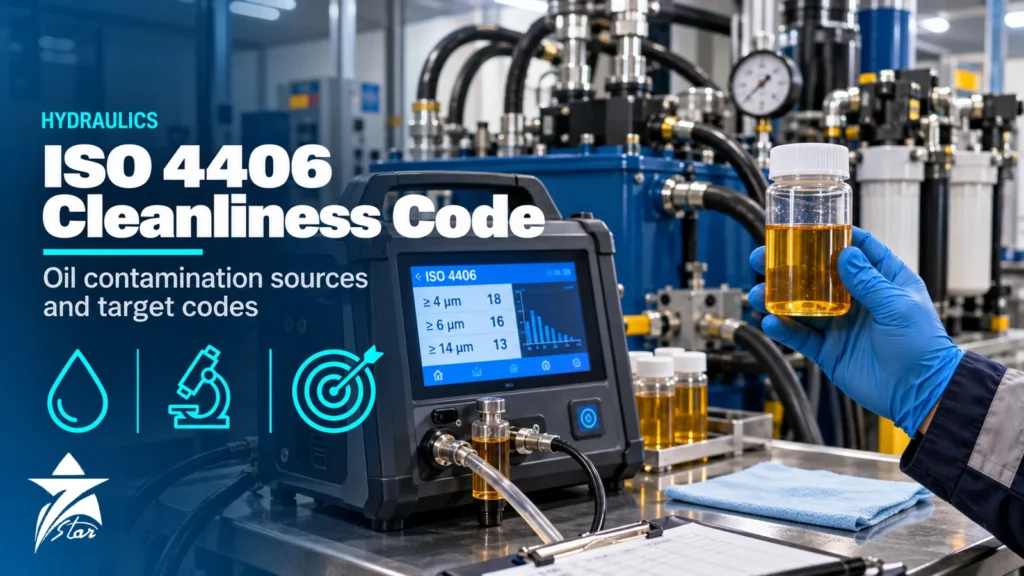
Most hydraulic failures are not caused by the pump or valve that fails; they are caused by the particles and water that reached it. Component manufacturers know this, which is why their warranty and design documents specify fluid cleanliness as an ISO 4406 cleanliness code. Yet many maintenance teams receive oil analysis reports showing codes such as 21/19/16 without a clear idea whether that is acceptable, what caused it or what to change. This guide explains how to read ISO 4406 codes, how samples should be taken so the numbers mean something, where contamination comes from, how to set target cleanliness for each system, and how to build a filtration and contamination-control strategy that holds the target.
How the ISO 4406 Code Is Built
ISO 4406 reports the number of solid particles per millilitre of fluid in three size channels, each given as a scale number rather than a raw count:
- First number: particles ≥ 4 µm(c) per mL.
- Second number: particles ≥ 6 µm(c) per mL.
- Third number: particles ≥ 14 µm(c) per mL.
The counts are cumulative, so the ≥ 4 µm figure includes all larger particles. The “(c)” denotes automatic particle counters calibrated according to ISO 11171. When particles are counted by microscope, only the ≥ 5 µm and ≥ 15 µm channels are reported and the first position is shown as a dash, for example -/16/13. Each scale number covers a range roughly double the one below it:
| Scale number | Particles per mL (more than) | Up to and including |
|---|---|---|
| 22 | 20,000 | 40,000 |
| 21 | 10,000 | 20,000 |
| 20 | 5,000 | 10,000 |
| 19 | 2,500 | 5,000 |
| 18 | 1,300 | 2,500 |
| 17 | 640 | 1,300 |
| 16 | 320 | 640 |
| 15 | 160 | 320 |
| 14 | 80 | 160 |
| 13 | 40 | 80 |
| 12 | 20 | 40 |
| 11 | 10 | 20 |
| 10 | 5 | 10 |
The practical consequence is simple: lowering a code by one number roughly halves the particle count in that channel, and lowering it by three numbers cuts it to about one-eighth. A change from 20/18/15 to 17/15/12 is not a small improvement; it is an eight-fold reduction in particles.
Related Codes You Will Still Meet
Older equipment manuals and some aerospace-derived specifications use NAS 1638 classes, which counted particles in size bands per 100 mL. SAE AS4059 replaced NAS 1638 and uses cumulative or differential counts with classes for each size. Conversion tables between these systems and ISO 4406 exist but are approximate, because the size bands and calibrations differ. When a component specification uses a different system, ask the manufacturer for the equivalent ISO 4406 target rather than relying on a generic conversion chart.
Sampling: The Step That Decides Whether the Result Is Real
A cleanliness code is only as reliable as the sample. Many “dirty oil” results are actually dirty bottles or poor technique. Good practice includes:
- Sample from a live, turbulent line through a dedicated sampling valve, as described in ISO 4021, ideally downstream of the working components and upstream of the return filter so the sample reflects what the system is generating.
- Avoid sampling from reservoir drains or dead legs, where sediment collects.
- Flush the sampling valve and hose with several times their internal volume before filling the bottle.
- Use certified clean bottles, with cleanliness verified according to ISO 3722, and do not open them until the moment of sampling.
- Sample at normal operating temperature and load, and at the same point and condition each time so results can be trended.
- Label each bottle with equipment, point, date, hours and oil type, and send it promptly.
Online particle counters and portable counters give immediate results and remove bottle effects, which makes them useful for verifying a flushing operation or confirming a new filter is working. Laboratory analysis remains valuable because it adds viscosity, water content, wear metals and additive condition.
Where the Contamination Comes From
Effective control starts with knowing the sources, because each needs a different remedy:
- Built-in contamination: machining swarf, weld spatter, sand and preservatives left in new pipework, cylinders and reservoirs. A proper flush before commissioning removes most of it.
- New oil: oil from drums, totes and bulk tanks is frequently dirtier than the target for precision hydraulics and often carries moisture from storage. Treat new oil as a contaminant source and filter it on transfer.
- Ingression: dust drawn in through reservoir breathers as the oil level changes, past worn cylinder rod seals and wipers, through open filler caps and during component replacement.
- Generated wear: particles produced inside pumps, motors and valves, which in turn accelerate further wear in a chain reaction.
- Water: condensation from humid air, leaking coolers and wash-down, which reduces lubricity, promotes rust and degrades additives.
Setting a Target ISO 4406 Cleanliness Code
The target code should come from the most sensitive component in the circuit, adjusted for operating pressure, duty and the cost of failure. Component manufacturers publish requirements; the values below are typical published targets for mineral hydraulic oil at moderate pressures and are given only as orientation:
| Component | Typical target range (ISO 4406) |
|---|---|
| Servo valves | Around 16/14/11 or cleaner |
| Proportional valves | Around 17/15/12 |
| Variable piston pumps | Around 17/15/12 to 18/16/13 |
| Vane pumps | Around 18/16/13 |
| Gear pumps, directional valves, cylinders | Around 19/17/14 to 20/18/15 |
Many practitioners tighten the target by one code at high system pressure, in safety-critical service or where downtime is very expensive. Where the manufacturer of a pump or hydraulic valve specifies a figure, that figure governs.
Building a Filtration Strategy
Filters are placed to do different jobs, and a cleanliness target is usually met by a combination rather than a single element:
- Pressure filters directly protect sensitive components such as servo valves downstream of the pump.
- Return filters capture particles generated in the circuit before oil returns to the reservoir; they see surge flows, so sizing and bypass setting matter.
- Off-line (kidney loop) filtration runs continuously at steady flow, where elements perform close to their laboratory rating, and allows elements to be changed without stopping the machine.
- Suction strainers protect against coarse debris only; fine suction filtration risks pump cavitation.
- Breathers with fine particulate media, and desiccant breathers where humidity is high, stop ingression at the most common entry point.
- Transfer filtration, using a filter cart for every top-up and oil change, so new oil enters the system already cleaner than the target.
Element efficiency should be specified as a beta ratio at a stated particle size, and elements should be changed on differential pressure, not on a calendar. A range of beta-rated filtration elements and complete off-line and transfer filtration systems covers most industrial hydraulic and lube requirements.
Water: The Second Contaminant
ISO 4406 does not measure water, but water is often as damaging as particles. It exists in three states: dissolved, emulsified and free. Mineral hydraulic oils can hold only a limited amount dissolved, typically in the low hundreds of ppm, depending on oil type and temperature; above saturation, water appears as haze and then as free water. Laboratory Karl Fischer titration gives water content in ppm, while in-line moisture sensors report relative saturation, which is often the more useful trending value. Remedies include desiccant breathers, water-absorbing elements for small quantities, and vacuum dehydration or coalescing units for larger ingress.
GCC Conditions That Push Codes Up
Equipment in Oman and the Gulf faces fine airborne dust that passes through standard breathers, large daily temperature swings that make reservoirs breathe, and coastal humidity that condenses water inside tanks overnight. Mobile and outdoor hydraulics on rigs, cranes and construction plant are especially exposed. High oil temperatures in summer also accelerate oxidation, producing soft contaminants and varnish that particle counters do not always show. Sealed reservoirs, high-efficiency desiccant breathers, rod boots on exposed cylinders and well-sized oil coolers all have a direct effect on achievable cleanliness codes.
Reading ISO 4406 Cleanliness Code Trends and Troubleshooting
- All three numbers rising together: general ingression or failing filtration; check breathers, seals and filter bypass indicators.
- Third number (≥ 14 µm) rising sharply: possible active wear or a damaged element; correlate with wear metals in the lab report.
- Good code but recurring valve sticking: look for varnish, water or silt-size particles not captured well by the current element.
- Sudden improvement after poor results: confirm it is real and not a change in sampling point or method.
- Code worse after maintenance: component replacement or top-up without filtration; review procedures.
Trending also benefits from in-house measurement. Portable particle counters and moisture meters from the portable test and measurement range allow fast checks after flushing and component changes, while sampling valves, breathers and transfer equipment sit alongside lubrication and bearing maintenance products in a complete contamination-control programme.
Contamination Control Checklist
- Target ISO 4406 code defined for each system from the most sensitive component.
- Dedicated sampling valves installed at representative points; sampling procedure written.
- Sampling interval and trend limits (alert and action) set.
- All new oil filtered on transfer; containers sealed and stored out of sun and dust.
- Breathers upgraded to fine particulate or desiccant type where needed.
- Elements specified by beta ratio and changed on differential pressure.
- Off-line filtration considered for large reservoirs and critical machines.
- Water content monitored and corrected before it reaches saturation.
Filtration Products We Supply for Hydraulic Systems
Reaching and holding a target cleanliness code depends on filters at the right points in the circuit and on changing elements at the right time. These products cover the main positions discussed above.
| Product | Type | Where it fits |
|---|---|---|
| Hydac DF and DFF High-Pressure Inline Filter, up to 420 bar | High-pressure inline filter | Protecting servo and proportional valves, the components most sensitive to contamination. |
| Hydac RFN Tank-Top Return Line Filter to DIN 24550, up to 10 bar | Return line filter | Capturing wear particles before the oil returns to the tank. |
| Hydac BDE Breather Dryer with Two-Stage Desiccant | Breather dryer | Stopping dust and moisture from entering the reservoir as the oil level rises and falls. |
| Hydac VD Differential Pressure Clogging Indicator, up to 420 bar | Clogging indicator | Changing elements on differential pressure instead of on the calendar. |
| Bosch Rexroth R928006678 Hydraulic Filter Element | Replacement filter element | Spare elements for Bosch Rexroth filter housings. |
For replacement elements, send the part number printed on the old element or the filter housing nameplate through our quote request form. If you are moving to a finer element to reach a lower code, tell us the flow rate and viscosity so we can check the clean pressure drop.
Sourcing Hydraulic Filtration and Contamination Control Products Through Seven Star LLC
Seven Star LLC supplies hydraulic and lube filter elements, off-line filtration units, filter carts, breathers, sampling valves and particle and moisture measurement equipment on request for plants and contractors in Oman and the GCC. We help with selection and with cross-checking element and component part numbers; availability and lead time are confirmed at quotation.
Struggling to hit your target cleanliness code? Send us your latest oil analysis report, the filter element part numbers and the hydraulic unit nameplate, and we will prepare a quotation for the elements, breathers and filtration equipment that suit your system.
Frequently asked questions
What does an ISO 4406 code of 18/16/13 mean?
The first number shows that the fluid holds more than 1,300 and up to 2,500 particles per mL at 4 µm(c) and larger. The second covers particles of 6 µm(c) and larger, and the third covers 14 µm(c) and larger, each read from the ISO 4406 scale table. Lower numbers mean cleaner oil.
How much cleaner is oil when the code drops by one number?
Each scale number covers roughly double the particle range of the one below it. Dropping one number therefore roughly halves the particle count in that size channel, and dropping three numbers reduces it to about one-eighth.
Why does an ISO 4406 code sometimes start with a dash?
A dash in the first position, such as -/16/13, shows the count was made by microscope, which does not report the smallest size channel. Microscope counting reports particles of 5 µm and 15 µm and larger instead.
Is new hydraulic oil clean enough to use directly?
Often not. Oil delivered in drums or from bulk storage is frequently dirtier than the cleanliness targets for precision hydraulics and may contain moisture. Filtering new oil through a filter cart during transfer is standard good practice.
Does ISO 4406 include water content?
No, ISO 4406 covers solid particles only. Water should be measured separately, usually by Karl Fischer titration in the laboratory or by in-line sensors that report relative saturation.
Where should a hydraulic oil sample be taken?
From a live, turbulent line through a dedicated sampling valve, typically downstream of working components and upstream of the return filter, after flushing the valve. Reservoir drain samples tend to give misleading results because sediment collects at the bottom.
Was this guide helpful?One click helps us write better guides for engineers.
Thank you! Glad it helped. Need this equipment for your project? Request a quotation
Thank you. We will use this to improve the guide.