- AC Drives
- Industrial Communications
- PLC & I/O Cards
- Vibration Monitoring
- Automation Accessories
- Controllers & Data Acquisition
- Safety Switches & Guard Locking
- CCTV & Security
- Encoders
- Industrial Computers
- HMI Displays
- Motor Soft Starters
- Isolator & Barrier
- Pneumatic Cylinders
- Servo Drives
- Automation Software
- Robotics
- Machine Vision
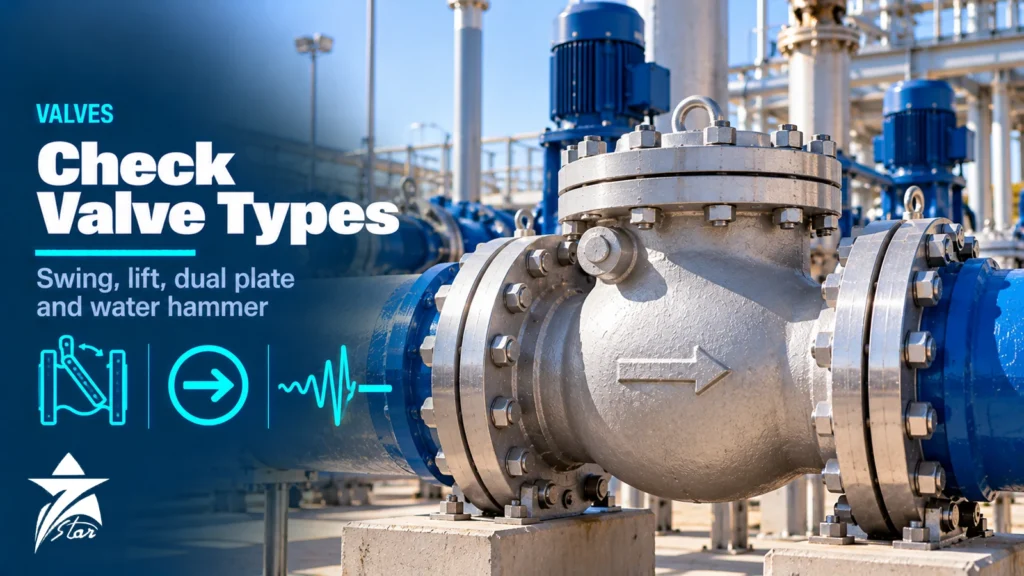
A check valve has one job – stop reverse flow – and no operator, positioner or control signal to help it. It opens and closes purely on the flow and pressure in the line, which is why a poorly chosen check valve can stay quiet for years and then crack a flange or lift a pipe support the first time a pump trips. Choosing between the main check valve types – swing, lift, dual plate and nozzle – is really a question of how fast the valve closes compared with how fast the flow reverses. This guide explains how each type works, why check valve slam and water hammer happen, how to size and install check valves correctly, and what to look for when one starts to fail.
How a Check Valve Works
Forward flow pushes the closure member – a disc, plate, piston or ball – off its seat. When forward flow decelerates and stops, gravity, a spring, or the beginning of reverse flow pushes it back onto the seat. The time the closure member takes to travel back is the critical number. If the valve closes before significant reverse velocity builds up, closure is quiet. If it closes late, the reverse-flowing column is stopped suddenly by the closing disc, and that sudden velocity change generates a pressure surge.
So a check valve is not just a fitting; it is a dynamic component whose closing behaviour has to match the system it protects.
The Main Check Valve Types
Swing Check Valves
A swing check has a disc hinged at the top of the seat that swings out of the flow path. Fully open, it gives low pressure drop and an almost straight flow path, and it suits large sizes and relatively steady flows. The disc is heavy and travels a long arc, so it closes slowly, which makes conventional swing checks prone to slam on systems with rapid flow reversal. Variants with external levers and weights or springs, and with dampers, change the closing behaviour and are chosen after surge analysis. Bolted-cover swing check valves are covered as Type B in API 594, and pipeline swing checks also appear in API 6D.
Lift Check Valves
In a lift check, a disc, piston or ball lifts vertically off a seat in a body similar to a globe valve. The short stroke gives reasonably fast closure and good sealing, but the flow path changes direction, so pressure drop is higher than in a swing check. Lift checks are common in small-bore forged valves on steam, condensate, high-pressure gas and utility lines. Most piston-type lift checks must be installed horizontally with the cover upward unless the design is specifically made for vertical flow. A stop-check valve combines a lift check with a screw-down stem, so the valve can also be closed manually, a common arrangement on boiler outlets.
Dual Plate (Wafer) Check Valves
A dual plate check valve has two half-discs hinged on a central pin, with a torsion spring that pushes them closed. The plates are light and travel a short distance, and the spring starts closing them as soon as forward flow decelerates, so closure is fast and slam is much lower than with a conventional swing check. The body is short and light – wafer, lug or double-flanged – which is why dual plate valves have replaced swing checks in many water, cooling water and hydrocarbon systems. They are covered as Type A in API 594. The central pin and plates stay in the flow path, so pressure drop is higher than a full-open swing check, and the valve cannot be pigged.
Nozzle (Axial Flow) Check Valves
A nozzle check valve, also called an axial flow or non-slam check, has a venturi-shaped body with an annular disc that moves a short distance along the flow axis, assisted by a spring. The short stroke, low disc mass and spring assistance make it the fastest-closing type in common use, so it is chosen for pump and compressor discharges where flow reverses quickly: parallel pumps, high-head systems and compressor stations. The streamlined body recovers pressure well, giving low permanent pressure drop for the closure speed. Nozzle checks cost more and are heavier than dual plate valves, and they are not within the scope of API 594; pipeline designs are commonly supplied to API 6D.
Other Types
- Ball check valves: a free or guided ball seals on a seat; common on wastewater and slurry pumps because there is no hinge to foul.
- Tilting disc check valves: the disc pivots near its centre of pressure, giving shorter travel and faster closure than a conventional swing check with low pressure drop.
- Foot valves: a lift or ball check with a strainer at the bottom of a pump suction line to keep the pump primed.
- In-line spring-loaded (poppet) check valves: compact small-bore valves with a defined cracking pressure, used on instrument air, chemical injection and hydraulics.
Check Valve Types Compared
The comparison below is qualitative; closure performance depends on size, spring selection and the manufacturer’s design, so always ask for the dynamic characteristic data for critical services.
| Type | Closing speed | Pressure drop | Slam resistance | Orientation | Typical standards |
|---|---|---|---|---|---|
| Swing (conventional) | Slow | Low | Poor on rapid reversal | Horizontal or vertical upflow | API 594 Type B, API 6D, BS 1868 |
| Tilting disc | Moderate | Low | Moderate | Horizontal or vertical upflow | Manufacturer design, API 6D |
| Lift (piston/disc) | Moderate to fast | High | Moderate | Usually horizontal; vertical only if designed for it | API 602 (small forged) |
| Dual plate | Fast | Moderate | Good | Horizontal (hinge pin vertical) or vertical upflow | API 594 Type A |
| Nozzle / axial | Very fast | Low to moderate | Very good | Horizontal or vertical, per design | API 6D, manufacturer design |
| Ball | Moderate | Moderate | Moderate | Per design | Manufacturer design |
Water Hammer and Check Valve Slam Explained
When a pump stops, the liquid column in the discharge line decelerates. In systems with high static head, short pipes, air vessels or parallel pumps still running, the flow can reverse within a fraction of a second. A slow check valve is still open when reverse flow starts, so it is slammed shut by the reversing column. The pressure rise from suddenly stopping a liquid column is estimated with the Joukowsky relation:
ΔP = ρ × a × Δv, where ρ is the liquid density, a is the pressure wave speed in the pipe, and Δv is the change in velocity – here, the reverse velocity at the moment of closure.
For water in steel pipe, the wave speed is typically in the order of 1,000 to 1,400 m/s. Using 1,200 m/s, a reverse velocity of just 1 m/s stopped instantly gives roughly 1,000 × 1,200 × 1 = 1.2 MPa, or about 12 bar, on top of the existing pressure. That is why check valve slam can damage pumps, valve internals, flanges and pipe supports even when the steady operating pressure is modest.
The practical answer is to choose a valve whose closure is fast enough for the system deceleration. Manufacturers of non-slam valves publish dynamic characteristic curves that relate system deceleration to reverse velocity at closure; combined with a surge analysis, they show whether a dual plate, nozzle or damped swing check is adequate. Surge vessels, slower pump rundown with flywheels or VFD ramps, and air valves are system-level measures that work alongside the valve choice.
Sizing a Check Valve
Check valves are often ordered at line size without a second thought, but an oversized check valve is one of the most common causes of failure. If normal flow is too low to hold the disc fully open against its stop, the disc floats in the stream, flutters, and wears hinge pins, plate bushings and seats. Size the valve so that normal flow keeps it fully and stably open, using the manufacturer’s minimum velocity or minimum flow data, and check pressure drop at maximum flow. For variable-speed pumps, check the lowest operating flow, not just the design point. For spring-loaded designs, confirm the cracking pressure is compatible with the available pressure at minimum flow.
Data to Send With a Check Valve Enquiry
- Line size, pressure class, end connection and body style (wafer, lug, flanged, butt-weld)
- Fluid, density, temperature, and minimum, normal and maximum flow rates
- Installation orientation: horizontal, vertical upflow or vertical downflow
- Application: pump discharge, compressor discharge, parallel pumps, pipeline, utility
- Body, disc, spring, hinge pin and seat materials; NACE MR0175 / ISO 15156 for sour service
- Required design standard (API 594, API 6D or other) and leakage test standard
- Surge analysis results or system deceleration data for critical pump stations
- Nameplate data and photos if replacing an existing valve
Installation Guidelines
- Allow straight pipe upstream of the check valve; manufacturers commonly recommend several pipe diameters, often in the range of 5 to 10, between the valve and pump discharges, elbows or reducers, so turbulence does not make the disc flutter.
- Install dual plate valves in horizontal lines with the hinge pin vertical, so both plates close evenly and the lower plate does not carry the weight of the upper one.
- Never install swing or dual plate checks in vertical downflow unless the valve is specifically designed and spring-rated for it.
- Check disc clearance on wafer valves against adjacent pipe bore, lined pipe and butterfly valves.
- Follow the flow arrow and confirm upstream and downstream isolation for maintenance access.
Maintenance and Troubleshooting
- Banging on pump stop: slam from late closure; consider a faster-closing type and review the surge analysis.
- Chattering or rattling during operation: disc flutter from oversizing, low flow or turbulence close upstream.
- Reverse rotation of a stopped pump: the check valve is passing or stuck open; inspect seat, disc and hinge.
- Gradual pressure loss in an isolated line: seat leakage from debris, wear or damaged soft seals.
- Broken springs or hinge pins: often a symptom of continuous flutter rather than a material defect.
Clamp-on or inline flowmeters and pressure trends at pump discharge are useful for confirming whether a check valve is passing or fluttering before the line is opened.
GCC Considerations
Large seawater intake and product water pumping stations in Oman and the Gulf rely heavily on dual plate and nozzle check valves, often with several pumps operating in parallel – a classic rapid-reversal case where slam is likely with slow valves. Materials need care in seawater and brine: duplex or super duplex stainless steel, nickel-aluminium bronze, or coated and lined bodies, with springs and hinge pins in alloys suitable for chlorides. In oil and gas, check valves on sour service must meet NACE MR0175 / ISO 15156, and springs in particular need material selection that resists sulphide stress cracking.
Check Valve Selection Checklist
- System behaviour understood: pump trips, parallel pumps, static head, deceleration
- Type selected for required closing speed, not just pressure drop
- Valve sized for full, stable opening at normal and minimum flow
- Orientation compatible with the selected design
- Materials of body, disc, spring and hinge pin suitable for the fluid
- Design and test standards specified
- Straight-run and clearance requirements met at installation
- Surge protection measures reviewed alongside the valve
Check Valves We Supply
Preventing slam starts with matching the check valve to how fast the flow reverses. These examples cover the main designs discussed above.
| Product | Type | Where it fits |
|---|---|---|
| Weflo Fig. 5306 Wafer Double Door Check Valve | Wafer dual-plate check valve | Compact check for water and cooling lines; the short closing travel helps reduce slam. |
| Cla-Val 81-02 No-Slam Hydraulic Check Valve | No-slam hydraulic check valve | Pump discharges in water networks where slam must be controlled. |
| Cla-Val 60-11 Booster Pump Control Valve with Built-In Check | Booster pump control valve with built-in check | Booster stations, where the valve opens and closes slowly with pump start and stop to limit surges. |
| Hattersley Fig. 1013 Bronze Horizontal Lift Check Valve PN32 | Bronze horizontal lift check valve | Small-bore water and steam lines. |
| Swagelok CH Series High-Pressure Poppet Check Valve | High-pressure poppet check valve | Instrument, sampling and chemical injection tubing. |
| Atos ADR In-Line Check Valve, G1/4 to G1 1/4 | In-line hydraulic check valve | Hydraulic circuits. |
To select a check valve, send the line size, pressure class, medium, flow rate and the pump or system arrangement through our quote request form.
Sourcing Check Valves Through Seven Star LLC
Seven Star LLC supplies swing, lift, dual plate and nozzle check valves within its fittings and valves range on request, along with pipes and fittings and pumps for the same systems. We help with type selection and cross-checking part numbers against existing nameplates and drawings. Availability and lead time are confirmed at quotation.
Send us your check valve datasheet, nameplate photo or RFQ with size, class, flow range and service, and we will prepare a matched quotation.
Frequently asked questions
What causes check valve slam?
Slam occurs when flow reverses before the check valve has closed. The reverse-flowing liquid then drives the disc onto the seat and stops suddenly, creating a pressure surge. Fast-closing valves such as dual plate and nozzle types reduce the reverse velocity at closure.
Which check valve type closes fastest?
Nozzle (axial flow) check valves generally close fastest because of their short stroke, low disc mass and spring assistance. Spring-loaded dual plate valves are also fast, while conventional swing check valves are the slowest.
Can a swing check valve be installed vertically?
Yes, in vertical upflow, where gravity helps close the disc. Swing check valves should not be installed in vertical downflow unless the design is specifically made for it.
Why should a check valve not be oversized?
If normal flow cannot hold the disc fully open, the disc floats and flutters in the stream. This wears hinge pins, bushings and seats and can break springs. Size the valve using the manufacturer's minimum flow or velocity data rather than simply matching line size.
What standard covers dual plate check valves?
API 594 covers wafer, lug, double-flanged and butt-welding check valves; dual plate valves fall under its Type A short-pattern design. Pipeline check valves, including many nozzle check valves, are commonly supplied to API 6D.
How large can a water hammer surge be?
The Joukowsky relation estimates the surge as density times wave speed times velocity change. For water in steel pipe, stopping a reverse velocity of 1 m/s instantly can add roughly 10 to 14 bar, depending on the wave speed of the specific pipe.
Was this guide helpful?One click helps us write better guides for engineers.
Thank you! Glad it helped. Need this equipment for your project? Request a quotation
Thank you. We will use this to improve the guide.