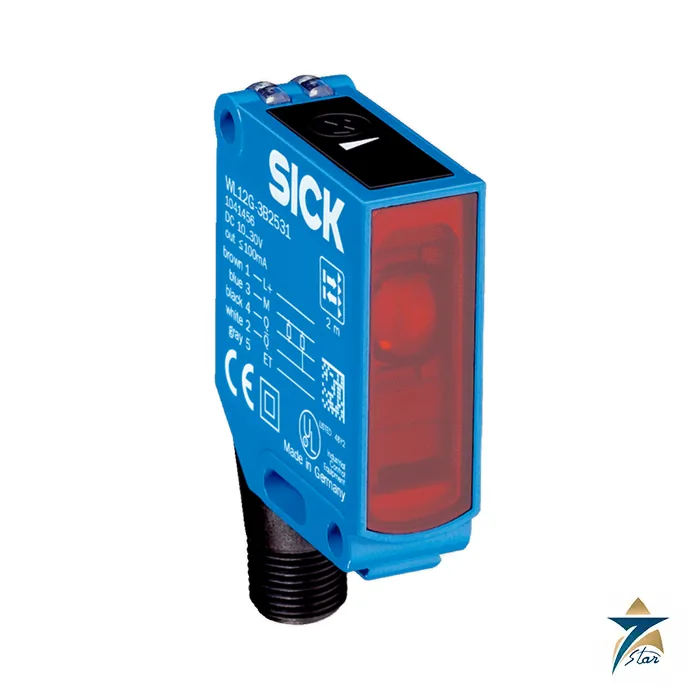
W12 reflex sensor for clear bottles and films, up to 4 m
The SICK WL12G-3B2531 (part no. 1041456) is a W12 retro-reflective sensor intended for detecting transparent objects. The coaxial optics read a PL80A reflector from 0 m to 4 m with a 25 mm spot at 1.5 m, and an 11-turn potentiometer provides fine sensitivity adjustment for clear glass or film. The output can be wired PNP or NPN, selected via the L/D control cable, and the connection is an M12 5-pin plug.
The zinc diecast housing is rated IP66, IP67 and IP69K and tolerates -40 °C to +60 °C.
Technical specifications
| Parameter |
Specification |
| Manufacturer |
SICK |
| Type / family |
WL12G-3B2531 / W12 |
| Part no. |
1041456 |
| Functional principle |
Photoelectric retro-reflective sensor, autocollimation (coaxial optics) |
| Special application |
Detecting transparent objects |
| Sensing range max. |
0 m … 4 m (reflector PL80A) |
| Polarisation filter |
Yes |
| Light source / type |
LED, visible red light, 640 nm |
| Light spot size / angle |
25 mm at 1.5 m; dispersion approx. 1.5 degrees |
| Adjustment |
Potentiometer, 11 turns |
| Items supplied |
2 x clamps BEF-KH-W12 with screws |
| Supply voltage UB |
10 V DC … 30 V DC |
| Ripple |
below 5 Vpp |
| Current consumption |
30 mA |
| Output |
PNP or NPN; light or dark switching via L/D control cable |
| Output current Imax. |
100 mA |
| Response time / switching frequency |
330 microseconds max. / 1,500 Hz |
| Protection class |
III |
| Dimensions (W x H x D) |
15.6 mm x 48.5 mm x 42 mm |
| Housing / front screen |
Metal, zinc diecast / plastic PMMA |
| Connection |
Plug, M12, 5-pin |
| Weight |
120 g |
| Enclosure rating |
IP66, IP67, IP69K |
| Ambient temperature |
-40 °C … +60 °C operation; -40 °C … +75 °C storage |
| MTTFD |
823 years (DCavg 0 %) |
Setting up for clear materials
Clear PET bottles, glass jars and thin films let most light pass. The G-version optics and the 11-turn potentiometer allow the sensitivity to be raised until even a small beam attenuation switches the output. Because the sensor relies on the reflector as a reference, a clean PL80A and a firm mounting are essential.
Wire the five-pin plug according to the connection diagram, and use the L/D control cable to choose light or dark switching and the PNP or NPN output. The same housing and clamp kit as the other W12 types means the mounting pattern is reusable.
Ordering note
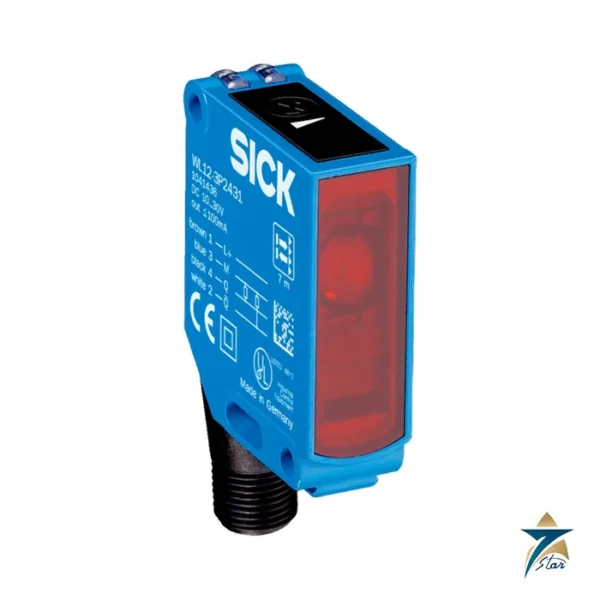
Quote WL12G-3B2531 with part no. 1041456. The data sheet lists detecting transparent objects as the special application of this type. The non-transparent WL12-3P2431 has a longer range and a PNP-only output with a 4-pin connector; the two are different articles.
Key features
- Autocollimation optics: sender and receiver share one optical axis, so the sensor sees the reflector from 0 m with no blind zone close to the lens. This matters when bottles pass very near the sensor face.
- Polarisation filter: polarised light rejects reflections from shiny surfaces such as glossy labels, foil or the glass itself, which otherwise could look like the reflector.
- Fast response: 330 µs response time and up to 1,500 Hz switching frequency keep up with high-speed filling and capping lines.
- Hygienic-grade sealing: IP69K together with IP66 and IP67 allows high-pressure, high-temperature washdown in food and beverage plants.
- Flexible output wiring: one article serves PNP or NPN inputs and light or dark switching, which simplifies spare-part stocking.
How transparent-object detection works
A standard reflex sensor switches when an object blocks most of the light returning from the reflector. A clear PET bottle may absorb or deflect only a small part of the beam, so a standard sensor can miss it. A transparent-object sensor is designed to switch on a much smaller drop in received light. That higher sensitivity also means the setup is less tolerant of dirt, misalignment and reflector damage, so the threshold is normally set with the actual product and reflector in place, and checked again after cleaning.
Practical setup steps
- Mount the sensor and PL80A reflector firmly, at right angles to the conveyor, with the beam passing through the thickest or most curved part of the container where possible.
- Align until the received signal is strong and stable with no object present.
- Introduce an empty clear container and adjust the 11-turn potentiometer until the output switches reliably.
- Test with labelled, filled and empty containers, and with the gaps between them, to confirm there are no missed or double counts.
Typical applications
- Counting and presence detection of PET bottles, glass jars and clear cups on conveyors.
- Detecting stretch film, shrink film and clear packaging webs.
- Monitoring clear trays and blister packs in pharmaceutical and cosmetics packaging.
- Jam detection in accumulation zones where bottles stand close together.
Maintenance in production environments
Because the switching threshold is close to the clear-beam signal level, dust or droplets on the PMMA front screen or the reflector reduce reserve faster than with opaque-object sensors. Include the lens and reflector in routine cleaning, use cleaning agents compatible with PMMA, and recheck the setting after a reflector is replaced. The zinc diecast housing withstands mechanical knocks better than plastic housings on busy conveyor lines.
Bottling and packaging in Oman and the GCC
Water bottling, juice and dairy plants across the region run high volumes of clear PET containers, often in warm, humid filling halls with frequent washdowns. The -40 to +60 °C operating range, IP69K rating and metal housing are well suited to these lines. Where condensation is likely, keep the lens out of the direct path of spray and route the M12 cable with a drip loop.
RFQ checklist
- Type WL12G-3B2531 and part number 1041456, with quantity.
- Reflector type and size, and the number of spare reflectors.
- M12 5-pin connecting cables: length, straight or angled, PVC or PUR jacket.
- Object description (material, diameter, speed) if you want us to confirm suitability.
Documents and quotation
Download the manufacturer data sheet for WL12G-3B2531 (part no. 1041456) from this page; it is the source of every specification listed here. To request a price, send the type code and part number to Seven Star LLC, an independent supplier based in Muscat, together with the quantity and the site where the goods are needed. Please confirm before ordering that the version, connector and accessories (clamps, reflector or a cable with connector) match your drawings, because published data may change without notice. Related items can be found in sensors and transmitters and in the SICK WTB4-3 miniature photoelectric sensor.












Reviews
There are no reviews yet.