W27 sensor with 1.6 m background-suppressed range
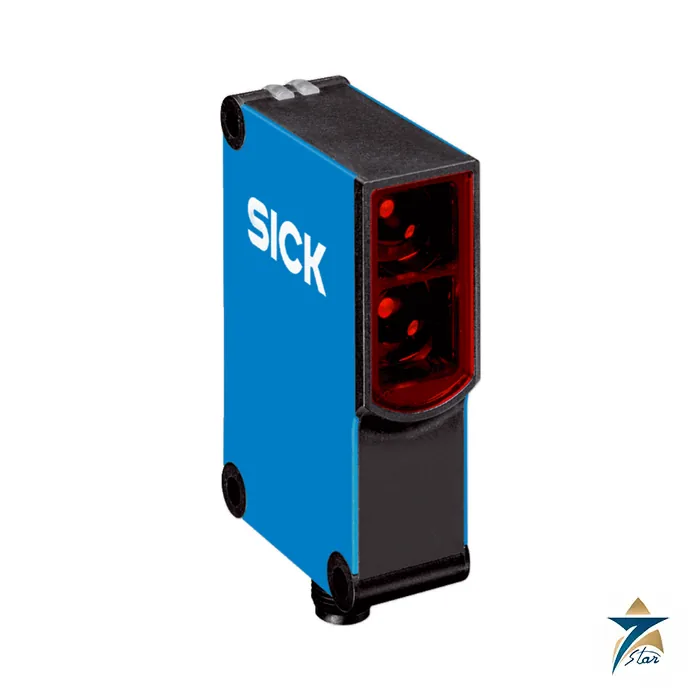
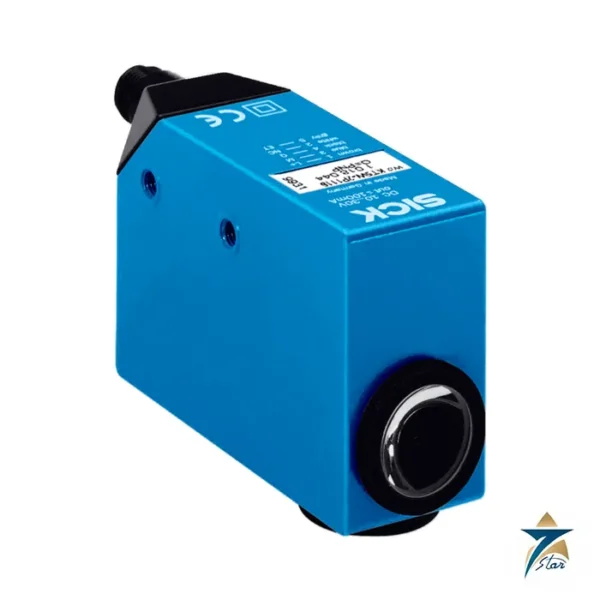
The SICK WTB27-3P2411 (part no. 1025994) is a W27 photoelectric proximity sensor with background suppression and a long reach of up to 1,600 mm. It uses infrared light at 880 nm, a plastic ABS housing with protection class II, and an M12 4-pin plug. The data sheet lists IP69K, which makes the plastic housing suitable for high-pressure, high-temperature cleaning.
On sick.com the type is shown in the catalogue archive, so confirm availability and any successor with SICK before specifying it for new designs.
Technical specifications
| Parameter |
Specification |
| Manufacturer |
SICK |
| Type / family |
WTB27-3P2411 / W27 |
| Part no. |
1025994 |
| Functional principle |
Photoelectric proximity sensor, background suppression |
| Sensing range max. / typical |
30 mm … 1,600 mm / 100 mm … 1,600 mm (90 % remission) |
| Light source / type |
LED, infrared light, 880 nm |
| Light spot size |
25 mm diameter at 800 mm |
| Adjustment |
Potentiometer |
| Supply voltage UB |
10 V DC … 30 V DC |
| Ripple |
below 5 Vpp |
| Current consumption |
40 mA |
| Output |
PNP, complementary, light/dark switching |
| Output current Imax. |
100 mA |
| Response time / switching frequency |
1.5 ms max. / 350 Hz |
| Protection class |
II |
| Dimensions (W x H x D) |
24.6 mm x 80.6 mm x 54 mm |
| Housing / optics |
Plastic ABS / plastic PMMA |
| Connection |
Male connector M12, 4-pin |
| Weight |
100 g |
| Enclosure rating |
IP69K |
| Ambient temperature |
-40 °C … +60 °C operation; -40 °C … +75 °C storage |
| MTTFD |
721 years |
| UL file no. |
NRKH.E181493 and NRKH7.E181493 |
Where a 1.6 m background-suppression sensor helps
A reach of 1,600 mm with defined background suppression covers jobs where an ordinary diffuse sensor would be triggered by the far wall: detecting boxes at a conveyor side, pallets at a docking station or vehicles at a barrier. Set the potentiometer so that the switching threshold sits just beyond the object and well in front of the background, then test with the darkest and brightest expected targets.
Infrared light is not visible, so alignment relies on trial positioning rather than watching a spot. Keep the lens clean and mount the housing rigidly; the protection class II rating and the 100 g body suit bracket mounting on frames. The data sheet gives a reference voltage of 50 V DC for the output circuit.
Lifecycle note and ordering
SICK still publishes the data sheet for the WTB27-3P2411, and the sick.com catalogue shows the type in its archive area. Seven Star LLC lists the part for quotation where stock or equivalent can be confirmed; it is not a statement that the item is currently produced. Confirm lifecycle status, any named successor and delivery before placing an order.
How background suppression works
A standard energetic proximity sensor switches when enough light is reflected back, so a bright background can trigger it and a dark object close by may be missed. A background suppression sensor such as the WTB27-3P2411 instead evaluates the angle at which light returns, which relates to the distance of the reflecting surface. Objects inside the set switching distance are detected, while anything beyond it is ignored, even if it is shiny or white. The result is reliable detection of objects of different colours at almost the same switching point.
Key features
- Long sensing range up to 1,600 mm, adjustable by potentiometer.
- Infrared light at 880 nm, which is less affected by visible ambient light.
- Complementary PNP outputs, giving light switching and dark switching signals at the same time.
- Fast 1.5 ms response and 350 Hz switching frequency for moving conveyors.
- IP69K housing for high-pressure, high-temperature washdown.
- Wide operating temperature range of −40 °C to +60 °C.
Setup and installation tips
- Set the switching distance with the actual target and background in place, then check the darkest and brightest product you expect to run.
- Mount the sensor so the light spot, 25 mm at 800 mm, falls fully on the object rather than on its edge.
- Avoid aiming the sensor directly at mirror-like surfaces at a perpendicular angle; tilting it slightly gives more stable switching.
- Use a rigid bracket. Vibration changes the aiming point on long ranges more than on short ones.
- Wire the M12 4-pin connector with a cable rated for the environment, especially where washdown or oil is present.
- Clean the PMMA front window with water or mild agents; strong solvents can damage plastic optics.
Applications in Oman and GCC industry
Long-range background suppression is useful in logistics hubs and warehouses for detecting pallets and cartons on conveyors, at palletisers, and in food and beverage plants where IP69K washdown resistance matters. In bottling and dairy plants in the region the sensor can detect packs while ignoring machine frames behind the conveyor. In outdoor or semi-open loading bays, strong sunlight and dust can affect any optical sensor, so a hood or shaded mounting position and periodic cleaning of the front window help to keep switching stable.
Planning for a successor
Since the type is listed in SICK’s archive, buyers maintaining existing machines should confirm stock availability, and for new designs ask for the current SICK successor with comparable range and output. When comparing alternatives, check sensing range, output type (PNP complementary), connector, housing rating and mounting dimensions so the replacement fits the existing bracket and wiring.
What to include in your RFQ
- Type WTB27-3P2411 and part number 1025994, with quantity.
- Whether a successor model is acceptable.
- Required accessories such as mounting brackets and M12 connecting cables of a given length.
Documents and quotation
Download the manufacturer data sheet for WTB27-3P2411 (part no. 1025994) from this page; it is the source of every specification listed here. SICK lists this type in its catalogue archive, so lifecycle status and any named successor should be checked first. To request a price, send the type code and part number to Seven Star LLC, an independent supplier based in Muscat, together with the quantity and the site where the goods are needed. Please confirm before ordering that the version, connector and accessories (a reflector, cordset or protective hood) match your drawings, because published data may change without notice. Related items can be found in sensors and transmitters and in the SICK WTB4-3 miniature photoelectric sensor.













Reviews
There are no reviews yet.