KT5 contrast sensor with PNP output for standard PLC inputs
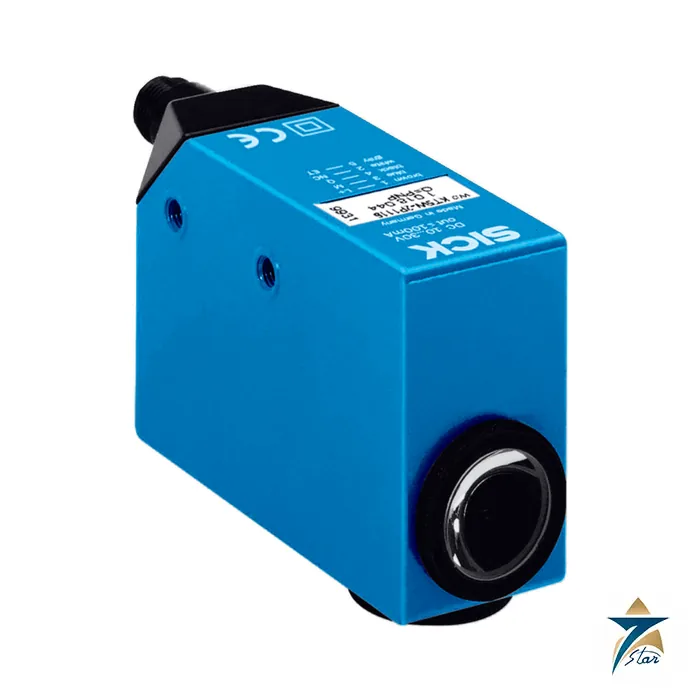
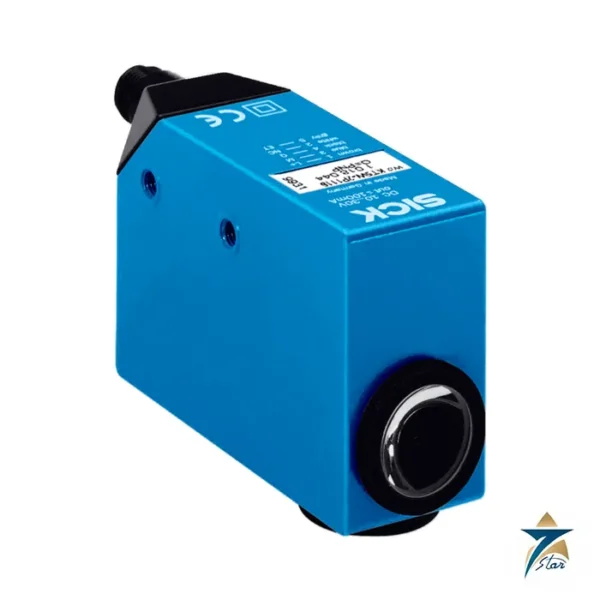
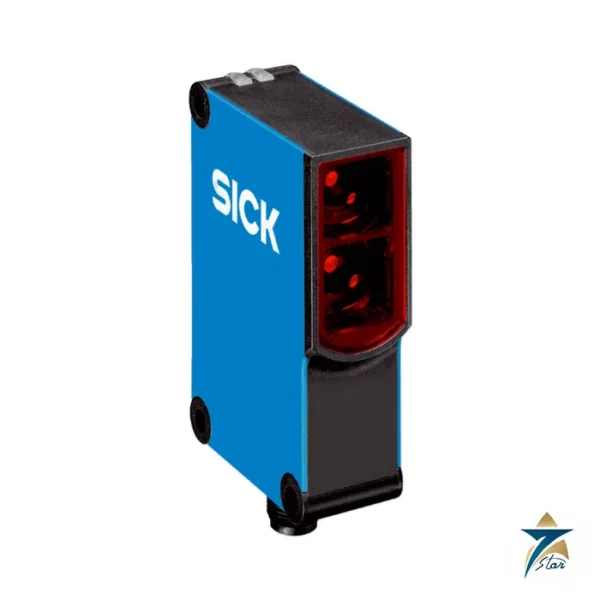
The SICK KT5W-2P1116 (part no. 1018044) is the PNP-output version of the KT5 contrast sensor. A white RGB LED (470, 525 and 640 nm) scans a 1.2 mm by 4.2 mm vertical spot at a distance of up to 10 mm, and the sensor switches when mark and background differ. It suits 24 V DC controllers with sourcing inputs, which is the common arrangement in Europe and most GCC plants.
The zinc diecast housing, 30.4 mm by 53 mm by 80 mm, weighs 400 g and has an M12 5-pin plug. SICK lists the type in the catalogue archive.
Technical specifications
| Parameter |
Specification |
| Manufacturer |
SICK |
| Type / family |
KT5W-2P1116 / KT5 |
| Part no. |
1018044 |
| Housing design |
Middle |
| Dimensions (W x H x D) |
30.4 mm x 53 mm x 80 mm |
| Light source |
LED, RGB |
| Wavelengths |
470 nm, 525 nm, 640 nm |
| Light emission |
Long and short side of housing, exchangeable |
| Light spot size / direction |
1.2 mm x 4.2 mm / vertical |
| Sensing distance |
up to 10 mm (from lens edge) |
| Adjustment / teach-in |
Teach-in button; static 2-point teach-in |
| Supply voltage |
10 V DC … 30 V DC |
| Ripple |
up to 5 Vpp |
| Current consumption |
below 80 mA |
| Switching frequency / response time |
10 kHz / 50 microseconds |
| Switching output |
PNP (HIGH = UV minus up to 2 V / LOW approx. 0 V) |
| Output current Imax. |
100 mA |
| Teach input (ET) |
PNP: teach U = 10 V to UV; run U below 2 V |
| Retention time (ET) |
25 ms, non-volatile memory |
| Protection class |
II |
| Circuit protection |
Reverse polarity protected, Q short-circuit protected, interference pulse suppression |
| Connection |
Plug, M12, 5-pin |
| Housing material |
Zinc diecast |
| Weight |
400 g |
| Enclosure rating |
IP67 |
| Ambient temperature |
-10 °C … +55 °C operation; -25 °C … +75 °C storage |
Installing and teaching a KT5
Mount the sensor at the specified distance from the lens edge, with the long side of the light spot across the mark. Use the teach button for a static two-point teach: first the mark, then the background. The result is stored in non-volatile memory, so the setting survives power-off. For remote teaching, apply the teach voltage of 10 V up to UV on the teach input.
The two-direction light emission lets you choose between long and short side of the housing, which helps in narrow machines. At 10 kHz the sensor follows fast web speeds, but the achievable resolution depends on the spot size and the mark width.
PNP versus NPN version
The NPN twin is KT5W-2N1116 (part no. 1018045). The optics, dimensions and teach method match, but output type and teach-input logic differ. Choose the type that matches your PLC input card and quote the full part number.
What a contrast sensor does
A contrast sensor such as the KT5 detects the difference in reflected light between a printed mark and its background. Typical marks are register or eye marks on packaging film, labels on a web, or a printed line used to position a cut. Because it reacts to contrast rather than to colour value, it is used where the task is to find a position quickly and repeatably, not to identify a colour.
Why an RGB light source
The KT5W-2P1116 uses an RGB LED with red, green and blue emitters at 640, 525 and 470 nm. During teach-in the sensor can use the light colour that gives the strongest contrast between the taught mark and the background. This is a practical advantage on multi-colour packaging, where a mark that is clear under one colour of light may be almost invisible under another. With a single-colour sensor the user would have to choose the right variant in advance.
Key features
- RGB light source for good contrast on coloured marks and backgrounds
- Fast switching frequency of 10 kHz and 50 µs response time for high web speeds
- Small vertical light spot of 1.2 x 4.2 mm for narrow marks
- Light emission on the long or short side of the housing, exchangeable to suit the machine
- Robust zinc diecast housing with IP67 and an M12 5-pin connector
- Teach-in by button or by remote teach input; settings stored in non-volatile memory
Application tips
- Glossy films and foils can reflect light directly back into the receiver. Tilting the sensor slightly from perpendicular is a common technique to reduce direct gloss reflection; check the operating instructions for the recommended angle.
- Keep the web flat and at a constant distance from the lens; flutter changes the signal.
- Re-teach after a change of film, print or colour.
- Use a shielded M12 cordset and route it away from drive motor cables.
Operation in GCC plants
Packaging, printing and food plants in Oman often operate with high indoor temperatures where cooling is limited. The KT5 is rated for operation from -10°C to +55°C, so sensors close to sealing jaws, heaters or shrink tunnels should be checked against this limit. The IP67 rating protects against dust and washdown, and the metal housing withstands the mechanical knocks common on production lines. Keep the lens clean, since dust and film residue reduce the contrast signal.
What to include in your RFQ
State the type KT5W-2P1116 and part no. 1018044, quantity, the controller input type (PNP), and any cordsets or mounting brackets required. Because the type is in SICK’s catalogue archive, please indicate whether a current successor model is acceptable.
Wiring the PNP output
With a PNP (sourcing) output, the sensor switches the positive supply to the load, and the PLC input is connected between the output and 0 V. The output delivers up to 100 mA and is short-circuit protected, so it can drive a PLC input or a small relay directly. Reverse polarity protection guards against wiring mistakes during commissioning. The supply range of 10 to 30 V DC fits standard 24 V DC control panels, and a residual ripple of up to 5 Vpp is tolerated, though a clean supply is always recommended for fast registration tasks.
Documents and quotation
This page links the original SICK data sheet for KT5W-2P1116 (part no. 1018044). Values in the specification table were copied from that document. SICK lists this type in its catalogue archive, so lifecycle status and any named successor should be checked first. Seven Star LLC supplies SICK products as an independent supplier in Muscat; send your request with the exact type and part number, the quantity and the delivery point, and mention any need for a reflector, cordset or protective hood. Please verify the details with us before placing an order, since the manufacturer may change data without notice. See also sensors and transmitters and the SICK WTB4-3 miniature photoelectric sensor.











Reviews
There are no reviews yet.