Sodium measurement for low-pH samples downstream of cation exchangers
The Swan AMI Sodium A is a sodium analyzer for quality control in high-purity water and for monitoring breakthrough of ion exchangers. The manual states that it applies only to waters with a pH above 2 and below 8, that is, samples taken after the cation exchanger. For samples at pH 7 or higher Swan points to the AMI Sodium P.
The measurement is potentiometric. A sodium-sensitive glass electrode and a reference electrode produce a potential, a temperature sensor corrects it by the Nernst law, and the value is expressed at 25 C. A measuring limit of 0.1 ppb needs the sample conditioned to at least pH 11, and the best results are obtained with diisopropylamine (DIPA). The swan.ch page gives a measuring range of 0.1 ppb to 10 ppm.
Technical specifications
Values are from the Operator’s Manual A-96.250.221 (section 2.1) and the swan.ch product page.
| Parameter |
Specification |
| Measuring range (product page) |
0.1 ppb to 10 ppm sodium |
| Accuracy (product page) |
+/-5% of reading |
| Repeatability (product page) |
5% |
| Response time (product page) |
180 s to 95% |
| Sample pH |
Above 2.0 and below 8.0 |
| Ammonium concentration |
Below 50 ppm |
| Sample flow |
Minimum 100 ml/min |
| Sample temperature |
5-45 C |
| Sample inlet pressure |
0.3-3 bar |
| Sample outlet |
Pressure-free |
| Sample purity |
No oil, no grease, no sand |
| Hydraulic connections |
Inlet: 4 x 6 mm tube. Outlet: 1/2 in hose nozzle |
| Supply |
AC 100 to 240 V at 50/60 Hz, or DC 10 to 36 V; up to 35 VA |
| Electronics enclosure |
Aluminum rated IP 66 / NEMA 4X, with a backlit 75 x 45 mm LCD; ambient limits -10 to +50 C |
| Mounting panel |
Stainless steel, 400 mm wide x 850 mm high x 200 mm deep; 12.0 kg without sample water |
Flow, alkalization and calibration
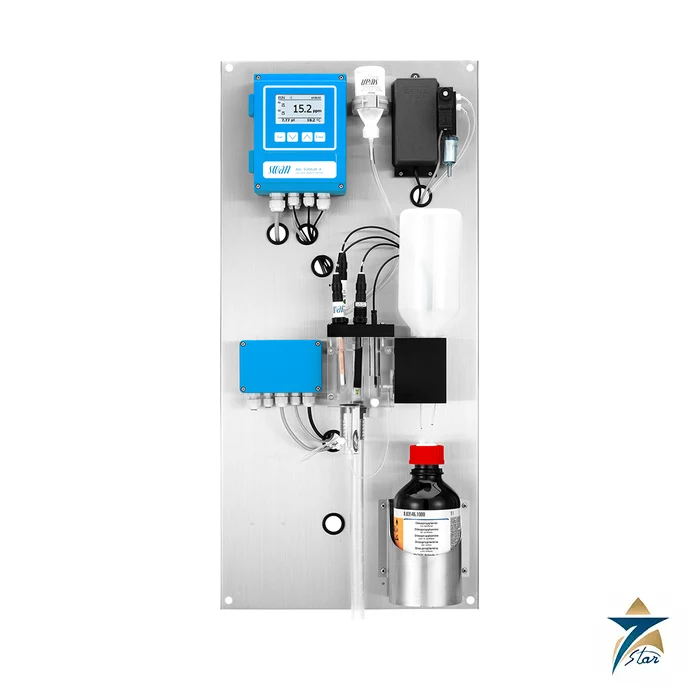
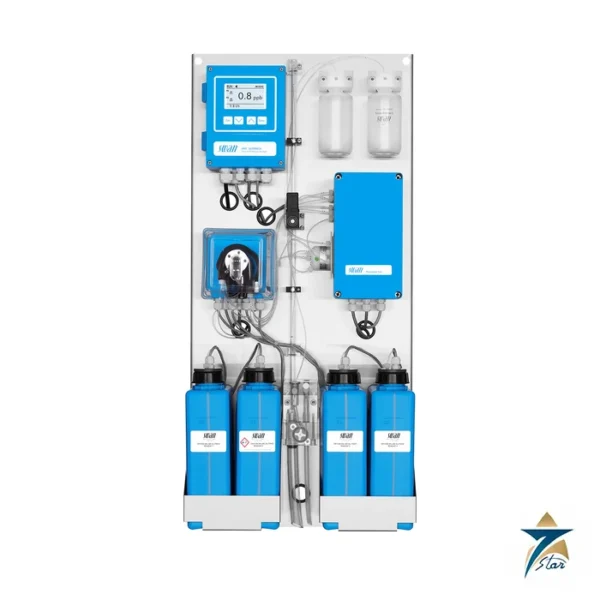
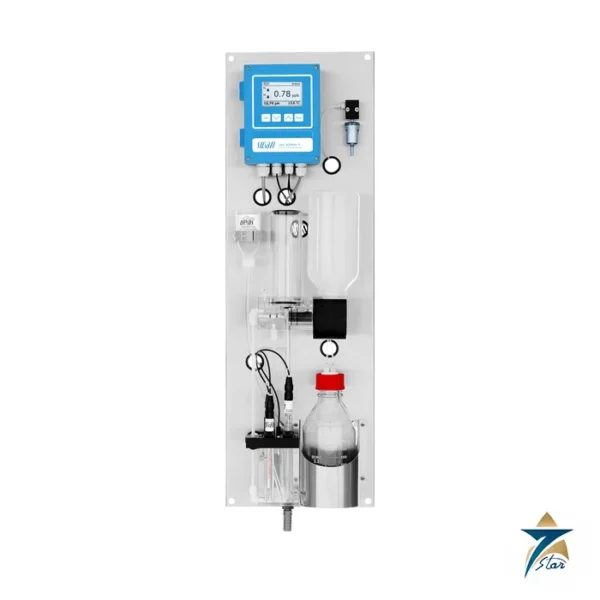
The sample flows through a flow regulating valve into a constant head, with a small part always overflowing to waste, then through an air lift pump to the measuring chamber with the sodium and pH electrodes and on to the reference chamber. The pH is controlled by a pH electrode. Depending on the value, a three-way solenoid valve either lets air reach the air lift pump directly or leads it through the reagent bottle to add DIPA vapor.
Flow is monitored by the pH measurement itself. If pH stays constant over a long time without DIPA addition, no sample is flowing and a sample flow low alarm is issued. For calibration or grab sample measurement, a standard bottle holder is turned up so the flow switches from the constant head to the bottle. The product page lists a simple two-point calibration with automatic storage of the calibration history and an integrated grab sample function.
Options and selection
An optional second sample channel or an automatic sample sequencer allows up to six sample streams. The product page describes the instrument as wet bench tested at the factory and ready for installation and operation.
Confirm that the process sample is acidic enough for the Sodium A (above pH 2 and below 8) and note the ammonium limit of 50 ppm. State the supply type, the second channel or sequencer option and the reagent, electrode and standard solution consumables needed. A 2-channel flow cell and replacement parts are listed by Swan as separate items.
How the Swan AMI Sodium A works
A sodium-sensitive glass electrode and a reference electrode give a potential in the sample. A temperature sensor corrects it, and the analyzer shows sodium at 25 degrees C. For low readings the sample is raised in pH with diisopropylamine vapour from a reagent bottle, so the electrode reads correctly.
Where the AMI Sodium A is used
- Monitoring ion exchanger breakthrough
- Power plant water and steam cycles
- Samples after cation exchangers
- Quality control of high-purity water
- Boiler feedwater checks
Selection checklist for the AMI Sodium A
- Sample pH above 2 and below 8
- Sodium range, 0.1 ppb to 10 ppm
- Sample flow of at least 100 ml/min
- Sample temperature of 5 to 45 degrees C
- Reagent supply
- AC or DC supply
- Mounting panel space
- AMI Sodium P for samples at pH 7 or higher
Installation, commissioning and maintenance notes for the AMI Sodium A
Mount the panel on a wall. Connect the sample inlet with a 4 x 6 mm tube and run the outlet to a drain without pressure. Fill the reagent bottle. Calibrate the electrodes with the standard solutions. Check the reagent and the sample flow at each service.
Requesting a quotation for the Swan AMI Sodium A
Please send the sample pH, the sodium range and the supply. Seven Star LLC serves industrial customers in Oman and the GCC and replies with a quotation based on the information provided.
AMI Sodium A measuring range
The measuring range is 0.1 ppb to 10 ppm sodium.
AMI Sodium A accuracy
The accuracy is plus or minus 5 percent of the reading.
AMI Sodium A response time
The response time is 180 s to 95 percent.
AMI Sodium A sample conditions
The sample must be free of oil, grease and sand.
AMI Sodium A inlet pressure
The inlet pressure is 0.3 to 3 bar and the outlet is pressure-free.
AMI Sodium A ammonium limit
The ammonium concentration must be below 50 ppm.
AMI Sodium A supply
The supply is AC 100 to 240 V or DC 10 to 36 V.
AMI Sodium A enclosure
The electronics are in an aluminium enclosure rated IP 66 with a backlit LCD.
AMI Sodium A panel
The stainless steel panel is 400 mm wide, 850 mm high and 200 mm deep, and weighs 12.0 kg.
Analyzer records for the AMI Sodium A
Record the calibration date, the reagent level and the readings at each service.
Choosing the right AMI Sodium A setup
Use this model only for acidic samples, and use the AMI Sodium P for samples at pH 7 or higher.
Documents and quotation
Everything above is drawn from the attached Swan Operator’s Manual A-96.250.221 and the manufacturer’s web page. Seven Star LLC is an independent supplier in Muscat and sources Swan analyzers on request. Please include the sample pH, range, options and quantity in your enquiry. More analyzers are grouped under liquid analytical systems.








Reviews
There are no reviews yet.