Overview
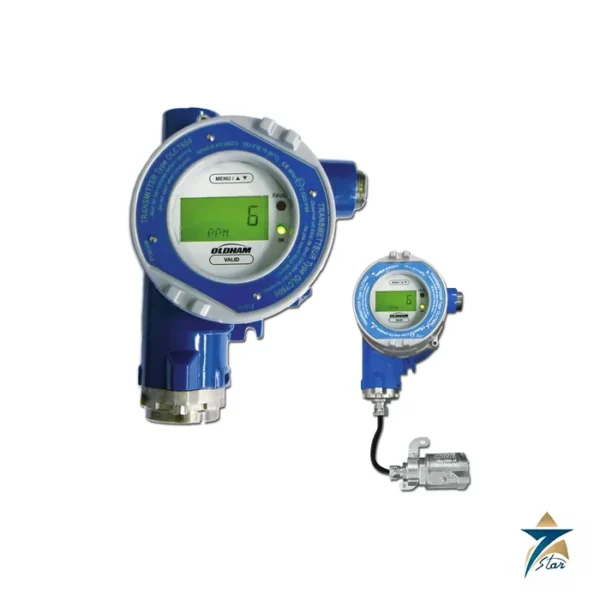
The Oldham OLCT 80 is a fixed detector-transmitter from Teledyne Oldham Simtronics for flammable gases, toxic gases and oxygen in hazardous industrial areas. It accepts pre-calibrated sensor blocks based on catalytic, electrochemical, infrared or semiconductor principles, displays the reading locally and can switch alarms itself through three integrated relays. Configuration and calibration are carried out non-intrusively with an intrinsically safe infrared remote control, and remote sensor versions in flameproof (XP) and intrinsically safe (IS) form allow the sensing head to be placed away from the transmitter.
Seven Star LLC supplies the Oldham OLCT 80 to oil and gas operators, refineries, chemical and fertiliser plants, water treatment facilities and power stations in Oman and the GCC. Our engineers in Muscat help customers select sensor types, ranges and wiring modes, and we provide engineering support for projects and maintenance in Muscat, Sohar, Duqm and Salalah.
Measurement Principle
The sensing technology of the Oldham OLCT 80 depends on the target gas. Flammable gases are detected with catalytic sensors over 0 to 100% LEL or with infrared sensors, while thermal conductivity (catharometer) cells measure methane or hydrogen up to 100% vol. Toxic gases and oxygen are measured with electrochemical cells, in which the gas reacts at an electrode and produces a current proportional to its concentration. The brochure lists electrochemical cells for O2, CO, H2S, NO, NO2, Cl2, H2, HCl, HCN, NH3, O3, PH3, ClO2, SiH4 and AsH3, and a semiconductor sensor for volatile organic compounds.
The Oldham OLCT 80 applies smart signal processing to the 4-20 mA loop. Values between 0 and 3.2 mA and above 20 mA are used to signal line faults, sensor faults, electronics faults, calibration inhibition and maintenance calls for drift, so the controller can tell a gas alarm from an equipment problem. Internal self-diagnostics and digital logic keep analog and digital values consistent, as required by the applicable standards.
Engineering Design of the Oldham OLCT 80
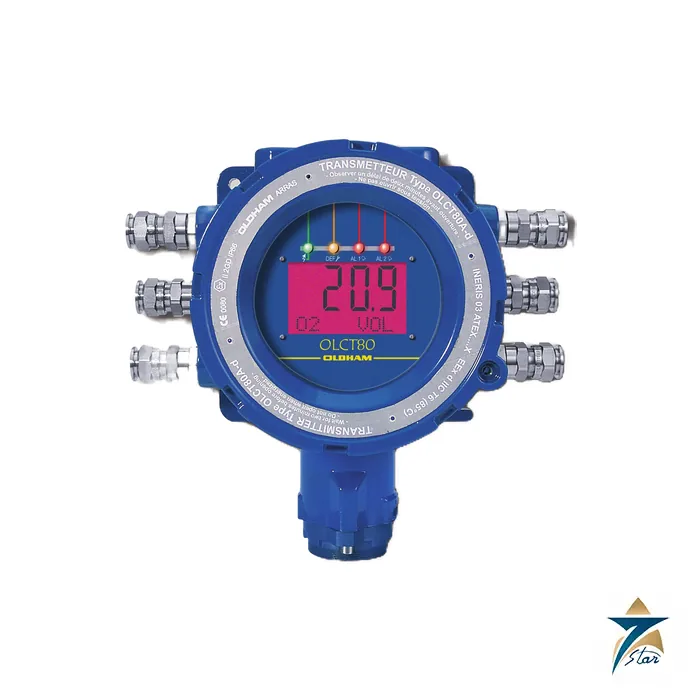
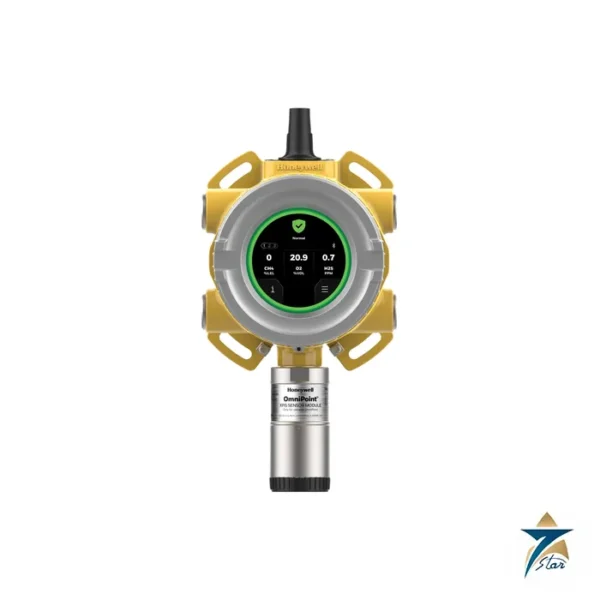
The Oldham OLCT 80 has an aluminium enclosure with a 316L stainless steel sensor housing and IP66 protection. The front shows a 4-digit LCD for the measurement, an alphanumeric line for text, pictograms and backlighting, plus four indicator lamps: green for operation, yellow for fault and red for Alarm 1 and Alarm 2. The basic version has six cable entries (four M20 and two M25), and three more can be added on request. The standard unit weighs about 3.5 kg, or 5.3 kg in the infrared version.
Inside, the Oldham OLCT 80 offers two 4-20 mA auxiliary inputs that can also act as binary inputs, so devices such as temperature sensors, emergency stops, flame or smoke detectors can be brought into the same network. Outputs include a standard 4-20 mA signal, two independent opto-isolated RS485 ports and three SPDT relays rated 2 A at 250 VAC or 30 VDC. Supply is 16 to 28 VDC, with very low power demand that allows more detectors on smaller cable cross-sections over longer distances, and independent ports allow redundant power and measurement connections.
Key Features
The Oldham OLCT 80 offers the following features for fixed gas detection systems:
- Pre-calibrated sensor blocks for flammable gases, a wide list of toxic gases and oxygen.
- Non-intrusive configuration and calibration through an intrinsically safe infrared remote control.
- Two programmable gas alarms and one fault alarm, each with an on-board SPDT relay.
- Stand-alone operation as its own central unit for relay control directly in the hazardous zone.
- Flexible connection in an opto-isolated digital loop of up to 16 sensors, in 4-20 mA, or under direct power.
- Two auxiliary 4-20 mA or binary inputs for integrating other field devices.
- Local, time-stamped event records for operation traceability.
- ATEX II 2GD certification in Ex d and Ex d ia versions with IP66 enclosure.
Industrial Applications
The Oldham OLCT 80 is designed to connect to the digital loop of the Oldham MX 62 controller, where one detector can use up to three digital addresses for its sensor and its two auxiliary inputs. It can also work with any control system through 4-20 mA or RS485, or stand alone with its own relays driving beacons, sirens, fans or shut-off valves. The broad sensor list covers hydrocarbon leaks, H2S in sour service, chlorine and chlorine dioxide in water treatment, ammonia in refrigeration and fertiliser plants, and oxygen deficiency in confined or inerted spaces.
In Oman, typical sites for the Oldham OLCT 80 include gas processing and compression stations, refineries and petrochemical complexes in Sohar, water and wastewater treatment plants, desalination plants dosing chlorine, and industrial facilities in the Duqm and Salalah free zones. Seven Star LLC supplies it together with related fire and gas products, including the Oldham MX 62 gas detection controller, the Oldham OLCT 100 fixed gas detector and the General Monitors TG5000 gas monitor.
Technical Specifications
The Oldham OLCT 80 values below are taken from the Teledyne Oldham Simtronics OLCT 80 brochure.
| Parameter |
Specification |
| Model |
Oldham OLCT 80 detector-transmitter (OLCT 80 d and OLCT 80 id versions) |
| Detected gases |
Explosive, toxic and oxygen |
| Detection principles |
Catalytic, electrochemical, infrared, semiconductor, thermal conductivity |
| Example ranges |
Flammable 0-100% LEL; O2 0-30% vol; H2S 0-30 to 0-1000 ppm; CO 0-100 to 0-1000 ppm; NH3 up to 0-5000 ppm |
| Enclosure |
Aluminium with 316L stainless steel sensor housing; IP66 |
| Display |
4-digit LCD, alphanumeric text line, pictograms, backlight; 4 indicator lamps |
| Power supply |
16 to 28 VDC at transmitter; 12 to 28 VDC for electrochemical cells |
| Inputs |
Two 4-20 mA analog inputs (120 Ω), usable as binary |
| Outputs |
4-20 mA (500 Ω load); two opto-isolated RS485 ports |
| Relays |
3 SPDT (fault, AL1, AL2); 2 A / 250 VAC / 30 VDC |
| Cable entries |
4 × M20 and 2 × M25; 2 × M20 and 1 × M25 additional on request |
| Operating temperature |
-20 to +60 °C electronics (sensor limits per cell) |
| Weight |
3.5 kg; IR version 5.3 kg |
| ATEX |
OLCT 80 d: II 2GD Ex d IIC T6…T5 Gb, Ex tb IIIC; OLCT 80 id: II 2GD Ex d ia IIC T4 Gb, Ex tb ia IIIC; INERIS 03ATEX0240X |
| EMC |
EN 50270 |
How to Order
To order the Oldham OLCT 80, send Seven Star LLC an RFQ with the gas to be detected, the measuring range, the version (Ex d or Ex d ia), whether a remote sensor is required and how the unit will be wired: stand-alone, 4-20 mA or digital loop to an MX 62. Our team in Muscat will confirm the configuration, availability and lead time, and the OLCT 80 brochure can be downloaded from this page. Seven Star LLC supplies Teledyne Oldham Simtronics gas detection across Oman and the GCC with engineering support in Muscat.












Reviews
There are no reviews yet.