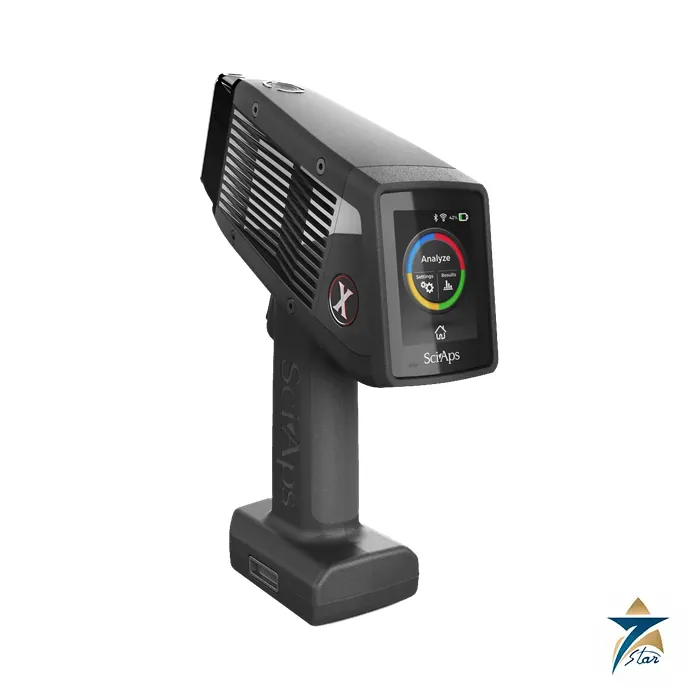
A light handheld XRF gun designed for positive material identification at welds
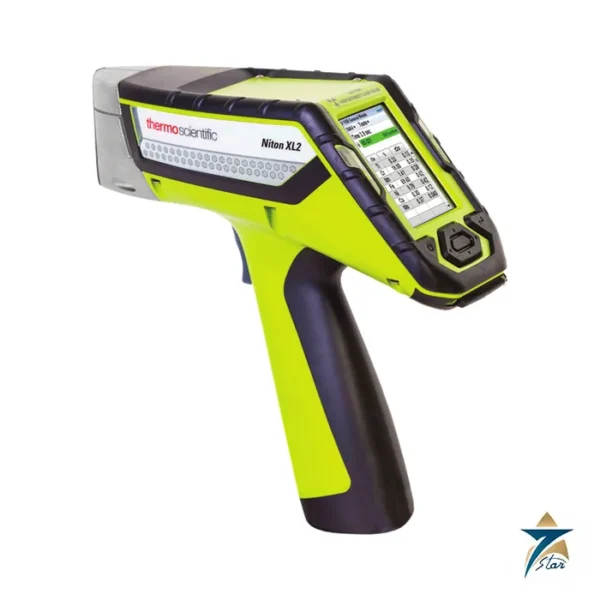
The SciAps X-550 is a handheld X-ray fluorescence (XRF) analyzer for alloy identification and positive material identification (PMI). SciAps designed it for non-destructive testing users who must reach awkward locations and welds, and at 2.98 lb (about 1.35 kg) with battery SciAps describes it as the lightest, fastest XRF gun it has made.
A miniaturized X-ray tube is tuned for low atomic number elements, which matters in refinery and process plant work. The manufacturer highlights silicon measurement for sulfidic corrosion and low magnesium in aluminum alloys, plus residual element analysis for API 751 and API 5L style requirements.
Technical specifications
| Parameter |
Specification |
| Technology |
Handheld energy-dispersive XRF with Android user interface |
| Weight / dimensions |
2.98 lb (about 1.35 kg) with battery; 8.5 x 9.5 x 2.4 in |
| X-ray tube |
5 W; typical 40 kV, 200 uA with Rh anode and 10 kV, 500 uA for alloy testing; 50 kV, 200 uA with Au anode for most other apps |
| Detector |
20 mm2 silicon drift detector (active area), under 140 eV FWHM at 5.95 Mn K-alpha |
| X-ray filtering |
6-position filter wheel for beam optimization |
| Analytical range |
32 elements standard; the set varies by app and more can be added on request |
| Test time |
Common alloys in 1 second or less; two-beam apps use pre-set test times |
| Apps available |
Alloy, Mining, Soil, Empirical, RoHS, Precious Metals, Industrial Lead Paint, HUD Lead Paint, Car Cat; Residuals and Aluminum apps for alloy work |
| Grade library |
500+ grades standard, no practical size limit; grades can be added on the analyzer or with Profile Builder PC software |
| Calibration |
Fundamental parameters; Compton normalization and empirical calibrations for Geochem and Environmental Soil apps; external 316 stainless steel check standard |
| Pulse processor |
14 bit, 80 MSPS, 8K channel MCA; 20 ns to 24 us peaking time |
| Processor / memory |
1.2 GHz quad-core ARM Cortex-A53; 2 GB LP-DDR3 RAM; 16 GB eMMC storage |
| Display |
2.7 inch color capacitive touchscreen; reversible light and dark display |
| Sample viewing |
Internal high-resolution camera for targeting welds; second macro camera for photos and 2D/3D barcode or QR reading |
| Connectivity |
Wi-Fi, Bluetooth, USB, GPS; Profile Builder PC software |
| Power |
On-board rechargeable Li-ion battery, charged in the device or with an external charger; AC power; hot-swap capability (60 s maximum swap) |
| Environmental |
10 to 130 degF (about -12 to 54 degC) at 25 % duty cycle |
| Security |
Password-protected usage (user level) and internal settings (admin) |
| Regulatory |
CE, RoHS, USFDA registered, Canada RED Act |
Why it is used on piping, welds and process equipment
PMI is used to confirm that the alloy installed is the alloy specified, for example carbon steel against low-alloy or stainless grades in refinery piping, and to check welds, fasteners and fittings. The X-550 delivers fast results on common alloys and uses a pre-configured Residuals app that sets testing times for low Cr, Cu and Ni and calculates the sum, so operators do not change test times in the field. A patent-pending Aluminum App is optimized for similar aluminum grades.
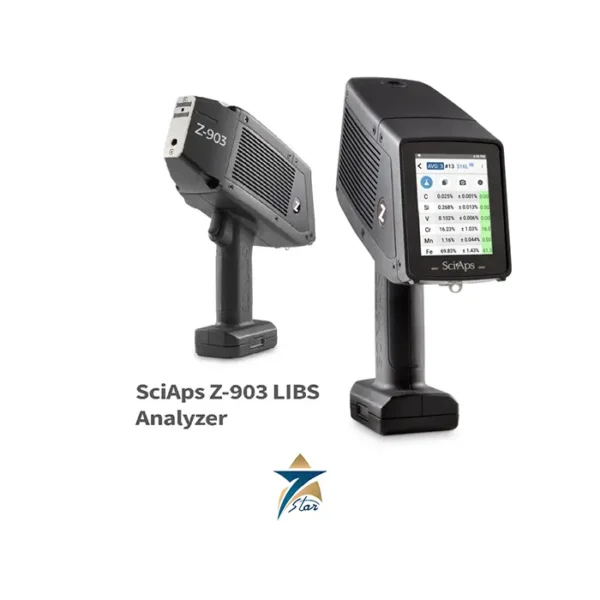
XRF does not measure carbon. Where carbon content is needed, for example to separate L and H grades of stainless, SciAps offers its Z-series laser (LIBS) analyzers, which can be packaged with the X-550 in a OneBox. See the SciAps Z-903 handheld LIBS analyzer and other portable test instruments.
Before you order
Handheld XRF analyzers contain an X-ray tube, so check the radiation-safety registration, operator training and import requirements that apply to your site and country before purchase. Confirm which apps you need (Alloy, Residuals, Aluminum, others), the calibration check routine, and the accessories and service programs. The manufacturer lists the standard library at 500 plus grades and notes new apps are added regularly, so ask for the current app list for your serial number.
Documents and quotation
The attached SciAps X-550 Alloy specification sheet is the manufacturer document for the alloy configuration. Other X-550 variants (geochemistry, lead paint) have separate sheets.
Seven Star LLC is an independent supplier in Muscat. Send the apps required, quantity and delivery location for a quotation.













Reviews
There are no reviews yet.