W12 background-suppression sensor for 20 to 350 mm detection
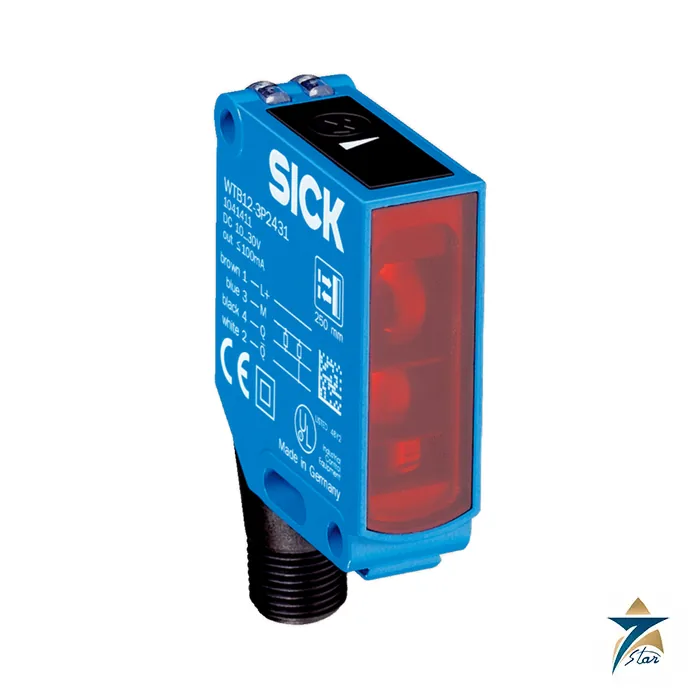
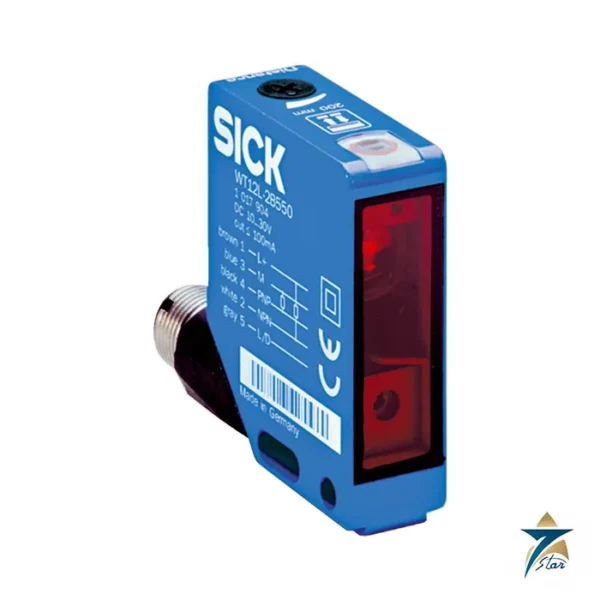
The SICK WTB12-3P2431 (part no. 1041411) is a W12 photoelectric proximity sensor with background suppression. It detects an object between 20 mm and 350 mm and ignores whatever lies behind the set switching distance, which is useful where conveyors, walls or machine frames sit close behind the product. The metal rectangular housing, PNP output and M12 4-pin plug make it a straightforward 24 V DC retrofit for general industrial automation, including washdown areas thanks to the IP66, IP67 and IP69K ratings.
A visible red LED spot of 6 mm diameter at 200 mm helps with alignment, and a five-turn potentiometer sets the switching distance.
Technical specifications
| Parameter |
Specification |
| Manufacturer |
SICK |
| Type / family |
WTB12-3P2431 / W12 |
| Part no. |
1041411 |
| Functional principle |
Photoelectric proximity sensor, background suppression |
| Sensing range |
20 mm … 350 mm (object with 90 % remission) |
| Light source / type |
LED, visible red light, 640 nm |
| Light spot size |
6 mm diameter at 200 mm |
| Adjustment |
Potentiometer, 5 turns |
| Supply voltage UB |
10 V DC … 30 V DC |
| Ripple |
below 5 Vpp |
| Current consumption |
45 mA (without load) |
| Output |
PNP, complementary, light/dark switching |
| Output current Imax. |
100 mA |
| Response time / switching frequency |
330 microseconds max. / 1,500 Hz |
| Protection class |
III |
| Dimensions (W x H x D) |
15.6 mm x 48.5 mm x 42 mm |
| Housing / front screen |
Metal / plastic PMMA |
| Connection |
Male connector M12, 4-pin |
| Weight |
120 g |
| Enclosure rating |
IP66, IP67, IP69K |
| Ambient temperature |
-40 °C … +60 °C operation; -40 °C … +75 °C storage |
| MTTFD |
728 years (DCavg 0 %, TM 20 years) |
| UL file no. |
NRKH.E181493 and NRKH7.E181493 |
Applications and setting up
Background suppression compares two receiver signals, so a dark object in front of a bright background is still detected at the same distance. Use this type for cartons on roller conveyors, pallets of mixed colours or machine parts passing a metal guard. Set the switching distance with the potentiometer while the target is in position, then confirm that the background object at its worst-case reflectivity does not trigger the output.
The data sheet states IP66, IP67 and IP69K plus an operating range down to -40 °C, so the sensor suits cold-room and washdown installations. Two BEF-KH-W12 clamps with screws are supplied. Because the output is complementary PNP, the sensor can serve as either a light-switching or dark-switching device by wiring the matching output.
Reading the type code and related variants
SICK prints WTB12-3P2431 as the full order type; W12 is the family and the part number 1041411 is the unambiguous order reference. The data sheet confirms the features that the code stands for: background suppression, PNP output and M12 4-pin connection. Other W12 variants with different connectors, sensing ranges or teach functions exist, so quote the part number, not only the family.
Key features of the WTB12-3P2431
- Background suppression: the sensor switches on objects inside the set distance and ignores reflective surfaces beyond it, reducing false triggering from shiny guards or conveyor frames.
- Colour-tolerant detection: dark and light objects are detected at nearly the same distance, which matters on lines that handle mixed packaging.
- Visible red light spot: the small, bright spot makes alignment quick during installation and when checking a sensor after a product change.
- Complementary PNP outputs: both light-switching and dark-switching signals are available, giving flexibility in PLC logic without reprogramming the sensor.
- Fast response: a maximum response time of 330 microseconds and 1,500 Hz switching frequency allow detection of small or fast-moving parts.
- Rugged metal housing: combined with IP69K, the housing withstands high-pressure, high-temperature cleaning.
Background suppression versus other sensing modes
An energetic proximity sensor (diffuse mode) switches on the amount of light returned, so a dark object is detected at a much shorter distance than a white one, and a bright background can cause false signals. A through-beam or retro-reflective sensor needs a separate receiver or reflector across the conveyor. Background suppression sits between these: it needs mounting on one side only, like a diffuse sensor, but uses triangulation of the reflected light so that the switching point depends mainly on distance. It is therefore a common default for detecting boxes, trays and parts on conveyors. Very glossy or transparent objects may still need special consideration, and a test with the real product is always recommended.
Installation and maintenance practice
- Mount the sensor with the supplied clamps so that the light spot hits the object squarely, and avoid aiming directly at mirror-like surfaces at right angles.
- Adjust the switching distance with the target in place, then lock the setting and record it for maintenance.
- Use a shielded or industrial M12 cable and route it away from motor cables.
- Clean the PMMA front screen regularly with a soft cloth; dust or film on the window reduces the received signal.
- After washdown, check that connectors are fully seated, since the enclosure rating relies on a correctly mated plug.
Use in Oman and GCC conditions
In food and beverage, bottling and dairy plants in the region, washdown sensors are cleaned frequently with high-pressure water, making the IP69K rating relevant. In logistics warehouses and cement or fertiliser bagging lines, fine dust settles on optics, so regular cleaning of the front screen should be part of the maintenance plan. The operating range up to +60 °C covers most indoor plant areas; where sensors are mounted near ovens, sealing machines or in direct sun, check the local temperature at the sensor position.
What to include in your RFQ
- Type WTB12-3P2431 and part no. 1041411
- Quantity and delivery location
- Required connection cables (length, straight or angled M12 connector)
- Spare mounting brackets if needed
- Application description if you want the sensing mode reviewed
Documents and quotation
The official SICK data sheet for WTB12-3P2431 (part no. 1041411) is attached to this page, and the figures in the table above are taken from it. Seven Star LLC is an independent supplier in Muscat and quotes SICK items against a written request. In your enquiry, give the exact type code, part number, quantity and delivery location, and say whether you need accessories such as clamps, reflector or a cable with connector. Data sheets carry a note that content is subject to change without notice, so confirm current details before ordering. More items are listed under sensors and transmitters, and you may also look at the SICK WTB4-3 miniature photoelectric sensor.















Reviews
There are no reviews yet.