Overview
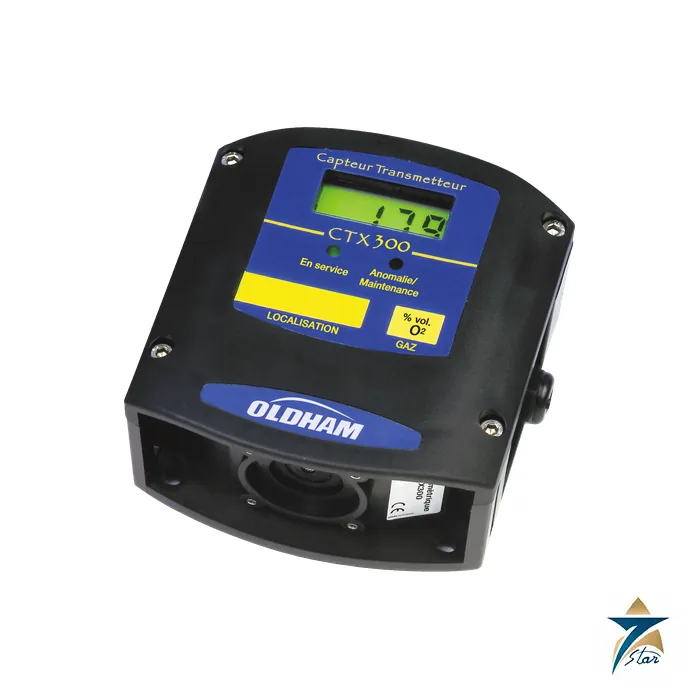
The Oldham CTX 300 is a fixed 4-20 mA gas transmitter from Teledyne Gas and Flame Detection, designed to detect oxygen, carbon dioxide, toxic gases and refrigerant gases in areas that are not classified as hazardous. Teledyne describes it as a detector for applications where dangerous levels of toxic gas or oxygen threaten the safety of an unclassified area. The Oldham CTX 300 accepts a wide choice of sensor technologies, including electrochemical, infrared and semiconductor cells, and it is available with or without a local display. Its main maintenance advantage is a sensor module that arrives pre-calibrated from the factory and can be exchanged without special menu access and even without powering down the transmitter.
Seven Star LLC supplies the Oldham CTX 300 and its replacement sensor modules to industrial plants, utilities, cold stores, laboratories, car parks and building services contractors across the Sultanate of Oman and the GCC. Our Muscat team checks the target gas, range, area classification and controller interface with the buyer before ordering, and we provide engineering support in Muscat for detectors, sensors and accessories.
Operating Principle of the Oldham CTX 300
The Oldham CTX 300 converts the response of its gas sensor into a 4-20 mA analogue signal that is wired to a gas detection controller or PLC. The sensor type depends on the gas. Electrochemical cells, used for oxygen and for toxic gases such as carbon monoxide, hydrogen sulphide, nitrogen dioxide, sulphur dioxide, chlorine, ammonia and hydrogen chloride, produce a small current proportional to the gas reacting at the electrode. Infrared sensors, used for carbon dioxide, measure how much infrared light the gas absorbs. Semiconductor sensors, used for refrigerants and solvent vapours such as R134a, R410a, R32, toluene and ethanol, change their electrical resistance when the gas adsorbs on a heated metal oxide surface.
Because each sensor module of the Oldham CTX 300 is calibrated at the factory, Teledyne states that a sensor exchange requires no calibration gas on site and no adjustment of the detector or of the remote controller. As general practice, sites should still follow their own bump test and calibration policy and the instructions in the CTX 300 user manual. Teledyne quotes up to five years of life for the O2 sensor, with sensor life for other gases listed per part number in the datasheet.
Engineering Design of the Oldham CTX 300
The Oldham CTX 300 has a polycarbonate housing with stainless steel mounting hardware, sealed to IP 54 and NEMA 3 and 3R, and Teledyne states that it resists corrosive agents such as hydrogen sulphide, hydrochloric acid and sea spray. The housing measures about 130 by 136 by 69 mm and weighs 520 g. Cable entry is through an M16 gland for cables of 4 to 10 mm outer diameter. Versions without display use a 2-wire shielded cable, while versions with the backlit LCD use a 3-wire shielded cable. Green and orange indicator lights show normal operation and fault or maintenance status.
Power supply is 15 to 32 VDC. Maximum consumption is 60 mA without display, 110 mA with display and 100 mA for semiconductor versions without display. Maximum loop impedance is 64 ohms for the CTX 300 without display and 32 ohms for versions with display and for semiconductor sensors. Operating temperature without display is minus 40 to plus 50 °C and with display minus 20 to plus 50 °C, both depending on the sensor. Options include removable filters that can be changed without opening the housing, a splash guard, a gas collector cone, mounting brackets, a bypass adapter and a remote calibration cup.
Key Features
The Oldham CTX 300 offers these practical benefits for fixed gas detection:
- Interchangeable, factory pre-calibrated sensor modules make sensor replacement quick and remove the need for calibration gas at the time of exchange.
- One transmitter platform covers oxygen, carbon dioxide, a long list of toxic gases and many refrigerants and solvents.
- An optional backlit LCD gives local reading, while green and orange lights indicate operation and fault or maintenance.
- A standard 4-20 mA output connects to gas detection controllers, PLCs and building management systems.
- The polycarbonate IP 54 housing resists hydrogen sulphide, hydrochloric acid and sea spray.
- The infrared CO2 version covers 0 to 5000 ppm, 0 to 5% and 0 to 100% volume ranges.
- Accessories such as a remote calibration cup and gas collector help with high or hard-to-reach mounting.
- Teledyne lists CSA signal appliance certification for all versions except CO2, together with EMC conformity to EN 50270.
Industrial Applications
The Oldham CTX 300 suits safe-area applications such as plant rooms, chlorination rooms at water treatment works, ammonia refrigeration plants, CO2 storage and beverage facilities, laboratories, battery rooms where hydrogen can accumulate, underground car parks monitored for carbon monoxide and nitrogen dioxide, and enclosed spaces where oxygen depletion is a risk. Because it is designed for unclassified areas, it should not be installed where an explosive atmosphere is expected; those locations need a certified hazardous-area detector.
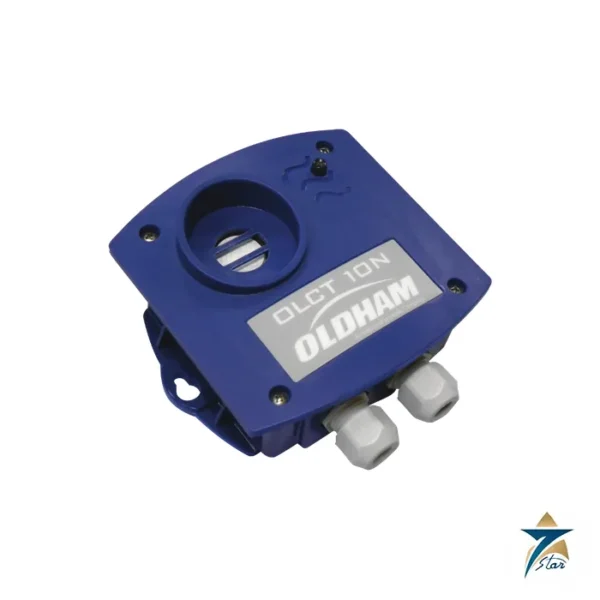
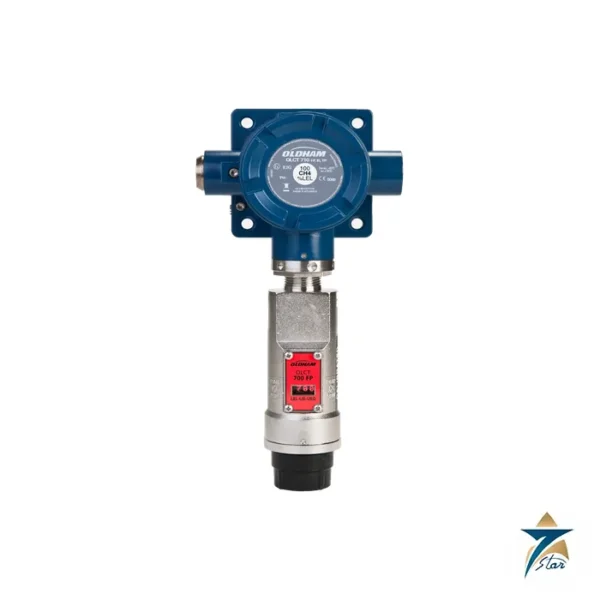
In Oman, typical uses include chlorine and sulphur dioxide monitoring in water and wastewater plants, refrigerant leak detection in district cooling and food cold stores in Muscat and Sohar, and CO and NO2 monitoring in basement car parks. Seven Star LLC supplies the Oldham CTX 300 alongside related Oldham equipment such as the Oldham OLCT 710 fixed gas detector, the Oldham OLCT 100 fixed gas detector for hazardous areas and the Oldham MX 62 gas detection controller.
Sensor Selection and Ordering
Each Oldham CTX 300 is ordered by sensor part number. For the electrochemical cells the code shows whether a display is fitted: Teledyne gives the example WC3ØO2F for the 0 to 30% O2 version without display and WC3AO2F for the same sensor with display. Examples from the datasheet include WC3oCOA, WC3oCOB and WC3oCOC for carbon monoxide at 100, 300 and 1000 ppm, WC3oHSA, WC3oHSB and WC3oHSC for hydrogen sulphide at 30, 100 and 1000 ppm, WC3oNH3 and WC3oNH1 for ammonia at 100 and 1000 ppm, and WC3oCL2 for chlorine at 10 ppm. Semiconductor refrigerant versions carry CTX300 part numbers, for example CTX300-502 for R134a and CTX300-514 for R410a.
Technical Specifications
The table below summarises the Oldham CTX 300 data from the Teledyne datasheet:
| Parameter |
Specification |
| Model |
Oldham CTX 300 gas transmitter, with or without display |
| Gases |
O2, CO2, CO, H2S, NO, NO2, SO2, Cl2, H2, HCl, HCN, NH3, ETO, HF, O3, PH3, ClO2, COCl2, AsH3, solvents and refrigerants |
| Sensor technologies |
Electrochemical, infrared (CO2), semiconductor |
| Accuracy |
Typically ±1.5% to ±3% of full scale depending on sensor; semiconductor ±15% relative to alarm threshold |
| Output |
4-20 mA analogue |
| Power supply |
15 to 32 VDC |
| Consumption |
60 mA without display; 110 mA with display; 100 mA semiconductor without display |
| Wiring |
2-wire shielded (no display); 3-wire shielded (with display) |
| Cable entry |
M16 gland, cable 4 to 10 mm |
| Operating temperature |
-40 to +50 °C without display; -20 to +50 °C with display (sensor dependent) |
| Housing and sealing |
Polycarbonate; IP 54, NEMA 3 and 3R |
| Weight |
520 g |
| Certification |
CSA signal appliances (all except CO2 versions); EMC to EN 50270 |
How to Order
To order the Oldham CTX 300, send Seven Star LLC the target gas, measuring range, display requirement and controller details, and our instrumentation team in Muscat will prepare a formal quotation. The Teledyne datasheet and user manual can be downloaded from this page, and we provide engineering support in Muscat for Oldham CTX 300 transmitters and sensors for customers across Oman and the GCC.









Reviews
There are no reviews yet.