A rugged conventional flaw detector for weld, forging and corrosion inspection
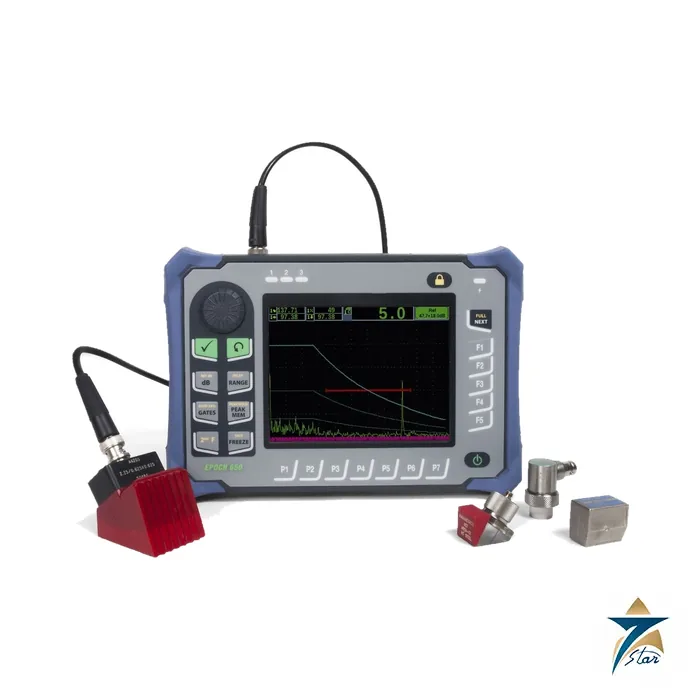
The Evident EPOCH 650 is a portable conventional ultrasonic flaw detector designed to meet ISO 22232-1. It pairs a tunable PerfectSquare square-wave pulser and a digital high-dynamic-range receiver with a full VGA transflective display that stays readable in sunlight. Dynamic DAC/TCG and DGS/AVG are standard, with AWS D1.1 and D1.5 weld rating, thirty digital filter sets and PRF up to 2 kHz for rapid scanning. It is offered in knob (IP66) or navigation-pad (IP67) versions and runs 15 to 16 hours on its lithium-ion battery.
Technical specifications
| Parameter |
Specification |
| Dimensions and weight |
236 x 167 x 70 mm (9.3 x 6.57 x 2.76 in.); 1.6 kg (3.5 lb) with battery |
| Display |
Full VGA 640 x 480 transflective colour LCD, 117 x 89 mm (5.76 in. diagonal), 60 Hz update |
| Pulser |
Tunable square wave; 100, 200, 300 or 400 V; pulse width 25 to 5,000 ns; damping 50, 100, 200, 400 ohm |
| PRF |
10 Hz to 2000 Hz in 10 Hz steps |
| Receiver |
Gain 0 to 110 dB; bandwidth 0.2 to 26.5 MHz at -3 dB; thirty digital filter sets including seven ISO 22232-1:2020 compliant filters |
| Range |
3.36 to 13,388 mm (0.132 to 527.10 in.) at 5,900 m/s |
| Velocity |
635 to 15,240 m/s (0.0250 to 0.6000 in./us) |
| Test modes |
Pulse echo, dual, through transmission |
| Gates |
Two independent gates; optional interface gate |
| Standard software |
Dynamic DAC/TCG (Standard, ASME 3, JIS, Custom), DGS/AVG, AWS D1.1 and D1.5, corrosion-style data logger |
| Memory |
100,000 IDs onboard; removable 2 GB microSD (up to 64 GB supported); video recording up to 8 min at 60 fps |
| Inputs and outputs |
USB OTG, VGA, 3 alarm outputs, trigger I/O, 1-axis encoder (corrosion module), optional analog output |
| Environment |
IP67 (navigation pad) or IP66 (knob); -10 to 50 C; Class I Division 2 Group D; ATEX version available |
| Compliance |
Designed to meet ISO 22232-1; shock and vibration tested to MIL-STD-810F |
Software options and accessories
| Part number |
Option |
| EP650-CORRSN (Q1400001) |
Corrosion Module with encoded B-scan |
| EP650-TEMPLATE (Q1400002) |
Template storage |
| EP650-API5UE (Q1400003) |
API 5UE flaw sizing |
| EP650-AVERAGE (Q1400004) |
Waveform averaging |
| EP650-IG (Q1400005) |
Interface gate |
| EP650-BEA (Q1400006) |
Backwall echo attenuator |
Inspection data is stored in an onboard data logger with calibration (CAL) and incremental (INC) files, plus corrosion-style file types such as sequential, 2D grid, 3D grid, boiler and 2D EPRI; reports can be exported as CSV or XML or generated as bitmaps, and the instrument works with GageView Pro software on a PC. The standard package contains the instrument, charger and AC adaptor, lithium-ion battery, transport case, USB cable, quick reference card and manual. Optional items listed by Evident include a chest harness (EP4/CH), soft carrying cases for the knob and navigation-pad versions, an external alarm beeper, VGA and digital output cables and an encoder cable for a B-scan buggy.
Selection and use
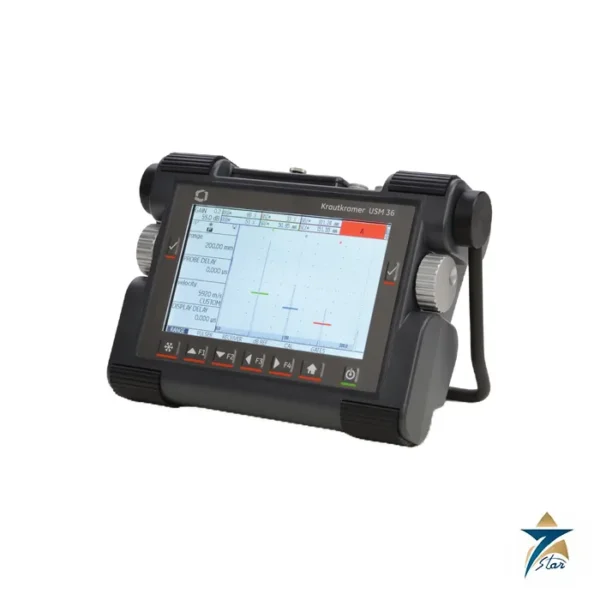
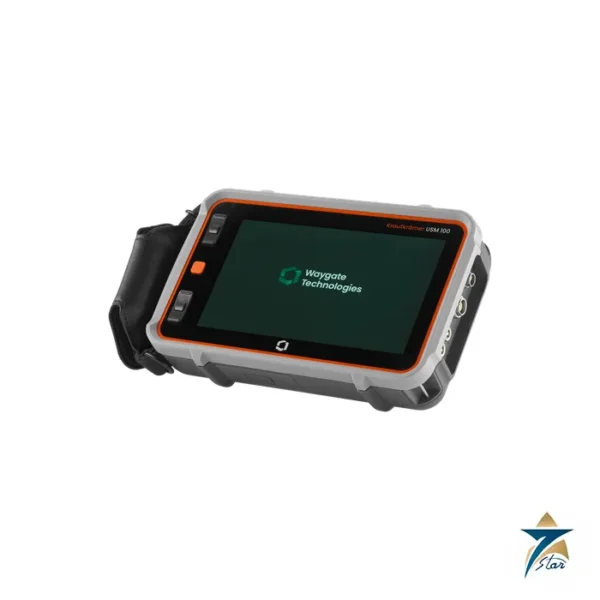
Choose the knob or navigation-pad version first, since the IP rating differs, and decide whether the Corrosion Module is needed for thickness mapping alongside flaw detection. Weld inspectors should confirm the required DAC or AWS method, and OCTG inspectors the API 5UE option. Check transducer connectors (BNC or LEMO 1) against the probes in use. Related instruments are listed under Handheld Flaw Detectors, including the Waygate Krautkramer USM 36.
How the Evident EPOCH 650 works
The EPOCH 650 sends short electrical pulses to an ultrasonic probe. The probe turns them into sound waves that travel into the metal. When the sound meets the back wall or a flaw, part of it returns as an echo. The receiver amplifies the echo and the screen plots it against time, so the inspector reads the depth of the reflector from the position of the signal. The echo height shows the size of the reflector, which is compared with a reference reflector by DAC, TCG or DGS curves.
Where the EPOCH 650 is used
- Weld inspection on structures, pipes and vessels
- Forgings, castings and plate
- Corrosion and thickness surveys
- Pressure equipment and storage tanks
- Manufacturing and in-service inspection
Selection checklist for the EPOCH 650
- Knob version with IP66 or navigation pad with IP67
- Test modes: pulse echo, dual and through transmission
- Gain of 0 to 110 dB and a bandwidth of 0.2 to 26.5 MHz
- Pulse repetition frequency of up to 2000 Hz
- Software for DAC, TCG, DGS, AWS D1.1 and D1.5
- Optional corrosion module and API 5UE sizing
- Memory of 100000 IDs and a microSD card
- Ambient temperature from -10 to 50 degrees C
Installation, commissioning and maintenance notes
Charge the lithium-ion battery before use, which runs the unit for 15 to 16 hours. Connect the probe with the right cable, enter the velocity of the material and calibrate on a reference block. Set the gate and the alarm level from the procedure. Keep the screen and connectors clean, store the unit in its case, and keep records of the calibration.
Requesting a quotation for the Evident EPOCH 650
Please send the inspection task, the version, the software options and the quantity needed. Seven Star LLC serves industrial customers in Oman and the GCC and replies with a quotation based on the information provided.
EPOCH 650 display
The full VGA colour screen measures 117 x 89 mm, updates at 60 Hz and stays readable in sunlight.
EPOCH 650 pulser and receiver
The pulser is a tunable square wave at 100 to 400 V, and the receiver has thirty digital filter sets.
EPOCH 650 size and weight
The flaw detector measures 236 x 167 x 70 mm and weighs 1.6 kg with its battery.
EPOCH 650 connections
It has USB, VGA, three alarm outputs, a trigger line and an encoder input for the corrosion module.
Inspection records for EPOCH 650
Keep the calibration data, the setup files and the stored readings with the inspection report.
Choosing the right EPOCH 650 options
Select the software options from the inspection codes in use, such as AWS weld rating, corrosion mapping or API 5UE sizing.
Documents and quotation
The attached Evident brochure carries the full specifications. Send the version, options, connector type and inspection code with your inquiry, and confirm the ATEX requirement before ordering.








Reviews
There are no reviews yet.