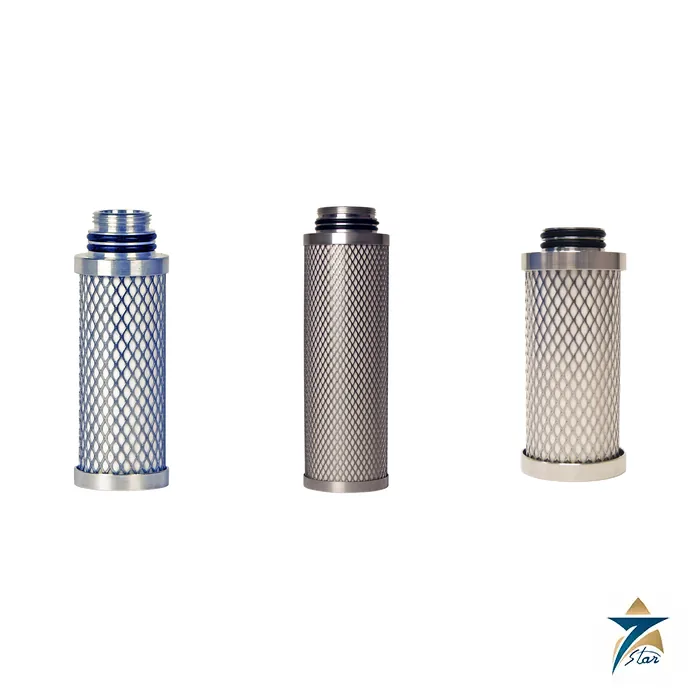
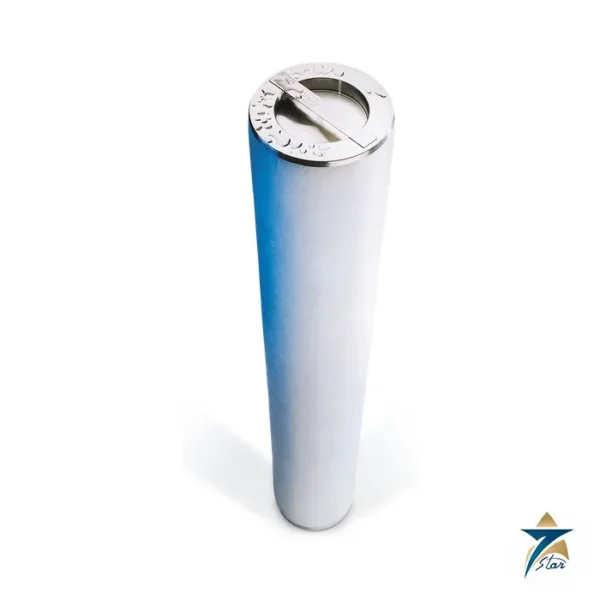
An activated carbon element with aluminium end caps, 20 to 2,880 m3/h
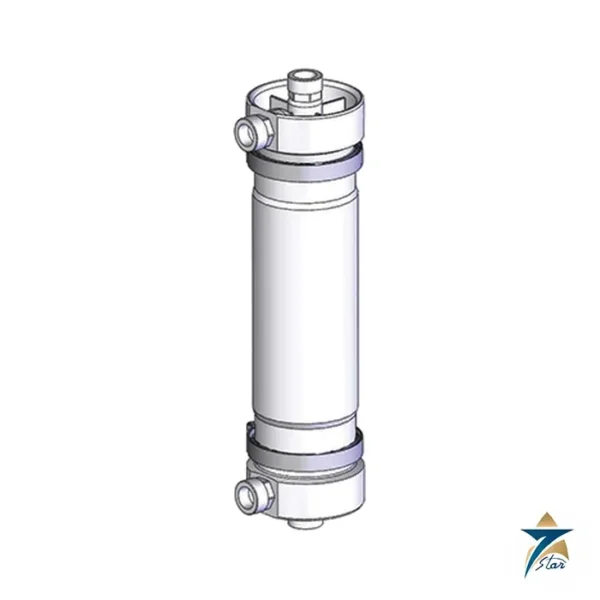
The Donaldson AK 02/05 – 30/50 is the larger-format adsorption element of the Ultrac family. Like the A series it has an activated carbon stage for oil vapour, hydrocarbons and odours and a microfibre depth stage for particles, but it uses aluminium end caps and a different type code (length/diameter pairs from 02/05 to 30/50).
Fourteen sizes cover 20 to 2,880 m3/h at 7 bar g. The data is validated to ISO 12500-2, and with appropriate prepurification a residual oil content below 0.003 mg/m3 is achieved. Typical use is final filtration for control and process air, breathing air and paint finishing air.
Technical specifications
| Parameter |
Specification |
| Series |
AK adsorption filter element, types 02/05 to 30/50 |
| Flow coverage |
20 to 2,880 m3/h for a 7 bar g line |
| Remaining oil content |
Below 0.003 mg/m3 given proper prepurification |
| Direction of flow |
Inner bore to outer surface |
| Adsorbent |
Activated carbon granules on a support fleece |
| Particle stage |
Binder-free borosilicate microfibre |
| End caps |
Aluminium |
| Sealing |
Silicone-free fluoroelastomer O-rings |
| Inner liner |
1.4301 (304) stainless steel |
| Operating window |
+10 C to +40 C advised, +60 C ceiling |
Size table
- 02/05: Flow m3/h, 7 bar g 20
- 04/10: Flow m3/h, 7 bar g 90
- 05/20: Flow m3/h, 7 bar g 180
- 07/25: Flow m3/h, 7 bar g 360
- 10/30: Flow m3/h, 7 bar g 720
- 20/30: Flow m3/h, 7 bar g 1,440
- 30/50: Flow m3/h, 7 bar g 2,880
Seven of the fourteen listed types are shown. The pressure conversion factor runs from 0.25 at 1 bar g to 2.13 at 16 bar g; the sheet sizes 192 m3/h at 9 bar g to a corrected 153.6 m3/h and selects type 05/20.
How it differs from the A series
The AK type codes describe two dimensions rather than a single flow figure, and the end caps are aluminium instead of glass-fibre reinforced polymer. The filtration data, materials of the carbon and particle stages and the prepurification advice are the same as for the A elements. The adsorption grading table is identical: oil vapour and toluene are rated A, ethane D.
Because the element is installed in a matching Donaldson housing, give the housing type and the existing element code when you ask for a replacement. The oil-free quality classes in ISO 8573-1 cannot be reached without pre-filtration, so the sub-micro filter upstream is part of the design, not an option. Low differential pressure, shown as a curve of under 300 mbar across the flow range for the element in its housing, keeps energy cost down. A compliance certificate to DIN EN 10204 2.2 with a test report is included with the order, according to the data sheet. Typical outlets are control air, process air and paint shops where oil vapour must be removed.
Key features of the AK adsorption element
- Two-stage construction: activated carbon removes oil vapour and odours by adsorption, while the downstream microfibre layer retains carbon fines and residual particles so they do not reach the application.
- Flow from inside to outside: air enters the inner bore and leaves through the outer surface, so the stainless steel inner liner supports the media against the pressure difference.
- Aluminium end caps: robust caps with fluoroelastomer O-rings give a reliable seal in the housing.
- Silicone-free materials: important for paint finishing, where silicone contamination causes surface defects.
- Low differential pressure: the element is designed for low pressure loss, which helps keep compressor energy consumption down.
How to size the element
Start from the actual compressed air flow and the minimum operating pressure at the filter. Because the nominal flows are given at 7 bar g, divide the required flow by the pressure conversion factor from the data sheet for the actual pressure, then choose the smallest element whose nominal flow is equal to or greater than the corrected value. The worked example in the data sheet shows the method: 192 m³/h at 9 bar g corrected to 153.6 m³/h gives type 05/20. Also check the operating temperature: adsorption capacity of activated carbon falls as temperature rises, which is why the data sheet advises +10 to +40 °C even though the element tolerates up to +60 °C.
Installation and replacement practice
- Install the carbon stage downstream of a refrigeration or adsorption dryer and of a coalescing sub-micro filter, so liquid oil and water never reach the carbon.
- Fit the element with clean, undamaged O-rings and do not lubricate them with silicone grease.
- Replace the element according to the interval recommended by Donaldson or earlier if odour or oil vapour is detected downstream; differential pressure alone does not show the saturation of activated carbon.
- Replace the upstream coalescing element at its own interval, as a saturated pre-filter shortens carbon life sharply.
- Dispose of used elements according to local rules for oil-contaminated waste.
Operating in Oman and GCC climates
High ambient temperatures in the region mean compressed air often leaves the aftercooler warmer than in temperate climates, and warm, moist air carries more oil vapour. Keeping the air within the recommended temperature window, for example with an adequately sized dryer and a shaded, ventilated compressor room, protects the carbon capacity. Typical local applications include paint shops in automotive workshops, food and beverage plants, pharmaceutical production, instrument air for oil and gas facilities and breathing air systems, where breathing air must additionally meet the relevant breathing air standards with suitable monitoring.
As a rule, the activated carbon stage is the last treatment step before the point of use, or before a final sterile or particle filter where the application calls for one. Keeping a record of installation dates for each element makes planned replacement during shutdowns much easier.
What to include in your RFQ
- Element type code, for example AK 05/20, and the Donaldson housing type.
- Flow rate, operating pressure and temperature.
- Upstream treatment installed (dryer, coalescing filter).
- Quantity, including spares for planned changes.
Documents and quotation
Ask for AK 02/05-30/50 through the request form. Donaldson AK 02/05-30/50 adsorption filter element data sheet (F119087) is attached; read it and verify the element code, housing type and operating pressure before ordering. Alternatives: Filtration Elements.



Reviews
There are no reviews yet.