

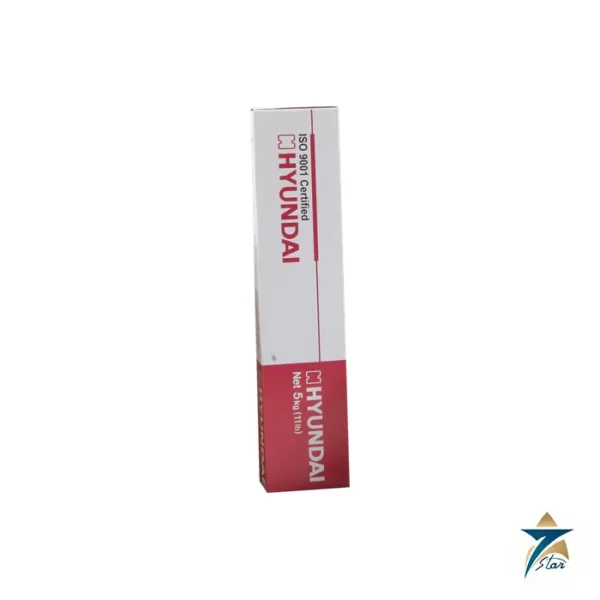
LongTeng E7018 is the low hydrogen member of the carbon steel electrode range in the LongTeng welding materials catalogue, listed by the manufacturer to AWS A5.1 E7018. Where the E6013 grade is chosen for convenience, an electrode of this type is chosen for toughness and soundness: the deposit is expected to carry load, resist cracking and perform in cold conditions. The manufacturer describes its application as low alloy steel and carbon steel welding structures, a broad statement that covers a great deal of structural, plant and pressure-adjacent fabrication work.
Seven Star LLC supplies LongTeng consumables to buyers across Oman and the GCC. Enquiries for stock and engineering questions are handled from Muscat. This page gathers the figures printed for LongTeng E7018, separates them from general class knowledge, and shows how to ask for the datasheet and a batch test certificate.
Everything in the next table comes from the catalogue page for carbon steel welding electrodes. These are typical values listed by the manufacturer for the grade and are not a warranty for a given production lot.
| Item | Value listed by the manufacturer |
|---|---|
| Conformance | AWS A5.1 E7018 |
| Tensile strength | 550 MPa |
| Yield strength | 450 MPa |
| Elongation | 28 % |
| Impact energy | 145, 149 and 150 J at minus 30 °C |
| Type of current | AC or DC+ (electrode positive) |
| Diameters | 2.0, 2.5, 3.2, 4.0 and 5.0 mm |
In percent, the catalogue gives carbon 0.07, manganese 1.05, silicon 0.46, sulphur 0.015, phosphorus 0.011, chromium 0.01, nickel 0.02, molybdenum 0.031 and vanadium 0.017 for LongTeng E7018. Compared with the E6013 line on the same page, manganese and silicon are noticeably higher, while sulphur and phosphorus are held low. That balance is typical of a basic, low hydrogen covering designed to give a clean, tough weld metal.
| C | Mn | Si | S | P | Cr | Ni | Mo | V |
|---|---|---|---|---|---|---|---|---|
| 0.07 | 1.05 | 0.46 | 0.015 | 0.011 | 0.01 | 0.02 | 0.031 | 0.017 |
| Diameter (mm) | 2.0 | 2.5 | 3.2 | 4.0 | 5.0 |
|---|---|---|---|---|---|
| Current (A) | 40 to 70 | 50 to 90 | 80 to 140 | 110 to 210 | 160 to 230 |
Use these ranges as the opening point for procedure development. Root passes in open joints normally sit near the bottom of the band, fill and cap passes in the flat position sit higher, and vertical-up welding sits lower than flat for the same diameter.
The notes in this section describe the E7018 class generally and are not guarantees by LongTeng. The digits 70 refer to a 70 ksi minimum tensile class, the 1 means all-position capability, and the 8 identifies a low hydrogen potassium-type covering with iron powder that runs on AC or DC electrode positive. The covering is hygroscopic, which is why this class is associated with disciplined storage. Welders keep opened electrodes in a heated holding oven, rebake rods that have been exposed beyond the time limit given by the manufacturer or the applicable code, and avoid damp or humid conditions. A short arc length is important, because a long arc invites porosity and nitrogen pick-up. Many procedures also specify preheat and interpass temperature on thicker or more restrained joints, and the requirement depends on steel grade, thickness and the governing code.
Low hydrogen stick welding rewards preparation. Bevel and clean the joint, remove paint, oil and moisture, and fit the parts so that the gap is even along the whole seam. Strike the arc inside the joint rather than on the surrounding plate, keep the electrode angle steady, and use a stringer or a narrow weave instead of a wide, hot weave. Clear the slag completely between passes so that no inclusions are trapped. When restarting on a hot bead, chip the crater, cut back into sound metal and restart ahead of it. Distortion on thick or restrained assemblies is controlled by balanced sequences, back-step welding and good clamping. None of these habits is unique to LongTeng E7018, but they are what allow the toughness figures printed in a catalogue to be reproduced in the workshop.
The same catalogue lists E7015 and E7016 low hydrogen types. The E7015 entry shows DC electrode positive only, while the E7016 and LongTeng E7018 entries both show AC or DC electrode positive. LongTeng E7018 also lists the highest group of impact results among the carbon steel electrodes on those pages, at 145 to 150 J. If a drawing names one particular classification, do not swap grades without checking the procedure qualification. Contact us and we will confirm the details with the manufacturer.
For companies planning a welding set-up, our catalogue also includes the Lincoln Electric Power Wave S500 and the ESAB Rebel EMP 285ic, and plant teams may wish to view the Kobelco Lubricator Assembly for maintenance planning. Always check power source compatibility for the polarity and current you intend to use with LongTeng E7018.
The manufacturer’s catalogue extract that covers LongTeng E7018 is attached as a downloadable datasheet; it also contains the LongTeng E6013 entry because the two grades share one catalogue page. Packaging and delivery time are confirmed per order, so send diameter, quantity, destination and certificate needs with your enquiry. This page does not claim a classification society or third-party approval for this grade. If your project needs a specific approval or inspection certificate, ask for the test certificate of the batch and we will request it. Before you buy LongTeng E7018 for critical work, compare the printed values with your specification.
Project teams in Oman usually ask for LongTeng E7018 when the specification calls for a low hydrogen electrode, when the steel is thicker than light plate, or when impact toughness at low temperature is part of the acceptance criteria. Maintenance contractors choose it for repairs on structural members that were originally welded with a matching class. Whatever the reason, the sensible first step is the same: read the manufacturer values in the table, compare them with the project specification, and ask Seven Star LLC for the batch certificate before purchase.
Choose the option that best fits your needs to get the fastest response from our team.
Automatically fill the RFQ form with this product's details for a faster process.
Manually enter multiple part numbers, specific brands, or custom requirements.
Reviews
There are no reviews yet.