A plate clamp that keeps its grip when the lift is not straight up
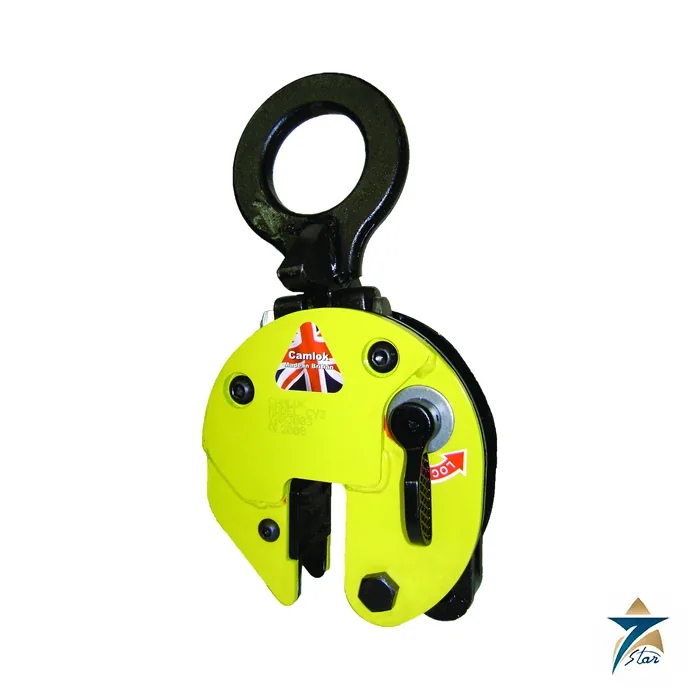
The Camlok CY is a cam-operated, self-gripping vertical plate clamp with a swivelling, hinged hook ring. Camlok describes the hinged ring as the feature that lets one clamp lift a plate from the horizontal and put it down in the vertical, take up side loads and handle irregularly shaped plates. The grip is built from the load itself: the specially shaped hook ring turns the lifting tension into leverage on the jaw, so the clamping force rises as the plate gets heavier.
Three models are listed: CY1 at 1000 kg, CY2 at 2000 kg and CY3 at 3000 kg working load limit, with jaw capacities of 0 to 20 mm for the CY1 and 0 to 32 mm for the CY2 and CY3. The product page adds that the clamp must be used in pairs; the manual explains that a pair on a two-leg chain sling lets longer plates be lifted without a spreader beam, which is the main benefit of the design over a single plane clamp.
What the manufacturer says the CY does
- Hinged, swivelling hook ring that holds clamping force at any angle, so plates can be handled vertically or horizontally
- Lifts a plate from horizontal and sets it down vertical, or grips it from the side
- Self-actuating hook ring that magnifies the jaw force as load weight increases
- Pair of clamps on a two-leg chain sling lifts long plates without a spreader beam
- Cam-operated closing mechanism that can be exchanged for a chain-pull open and close mechanism
- Service-friendly: parts are exchangeable, but repairs must be done by a trained person
Technical specification
Models and capacities
| Model |
Art.-No. |
WLL, kg |
Jaw capacity Z, mm |
Weight, kg |
| CY1 |
N50200312 |
1000 |
0 – 20 |
4.6 |
| CY2 |
N50200313 |
2000 |
0 – 32 |
14 |
| CY3 |
N50200314 |
3000 |
0 – 32 |
14 |
Dimensions in mm
| Dimension |
CY1 |
CY2 |
CY3 |
| A |
126 |
192 |
192 |
| B |
270 |
382 |
382 |
| C (diameter) |
50 |
80 |
80 |
| D |
49 |
75 |
75 |
| E |
70 |
96 |
96 |
| F |
95 |
132 |
132 |
| G |
63 |
92 |
92 |
| H |
12 |
20 |
20 |
| I |
23 |
30 |
30 |
Pair on a two-leg sling, permitted total load (manual table 2)
| Sling angle |
CY1 |
CY2 |
CY3 |
| 0 – 15 degrees |
2000 kg |
4000 kg |
6000 kg |
| 15 – 45 degrees |
1000 kg |
2000 kg |
3000 kg |
| 45 – 60 degrees |
500 kg |
1000 kg |
1500 kg |
Design data and limits
| Parameter |
Specification |
| Design factor |
4:1 |
| Product group |
I2 |
| Plate hardness limit |
Below HRC 30 / 300 Brinell (32 HRC) |
| Maximum wear width, jaw teeth (manual table 3) |
CY1 0.6 – 0.8 mm; CY2 and CY3 0.8 – 1.0 mm |
Choosing between CY1, CY2 and CY3
Pick the model by plate weight per clamp and by plate thickness: the CY1 opens to 20 mm, the CY2 and CY3 to 32 mm. The CY2 and CY3 share the same body dimensions and 14 kg weight (derived from the sheet), so the CY3 is the choice when the same clamp must carry 3000 kg. The manual states that for efficient grip the plate must weigh more than the minimum load stamped on the clamp side, so do not buy up to a larger WLL for light sheet.
Order two per lift and match both to the same model. The sling-angle table shows why: a CY3 pair is rated 6000 kg at 0 to 15 degrees, 3000 kg at 15 to 45 degrees and 1500 kg at 45 to 60 degrees. A single CY is not best suited to a rectangular plate; the manual points to a CZ or 92 series clamp for that.
Fitting and release as described in the manual
Prepare the plate first: no grease, oil, scale, paint or film on the surfaces the jaw will touch. With the sling slack, turn the lever clockwise so the jaws stay open, seat the clamp square on the plate edge right to the back of the mouth, drop the fixed jaw on and bring the lever round anticlockwise to LOCK. Confirm that the chain sling is not twisted before the lift starts.
A pair goes on the same face of the plate, bodies square to the edge, with the sling plane vertical and both legs carrying evenly. The manual flags the horizontal-to-vertical transition, where the plate may kick as it leaves the floor. To release, lower gently, leave the lever in LOCK until the load is fully off, allow slack so the hook ring can retract and push it into the shell as you turn the lever; never force or strike it. The manual sets a 1 to 4 week inspection interval depending on use, covering cam faces, hook ring, chain, shell plates, jaw bolt, welds and spring.
Where CY clamps earn their place
Plate shops, fabrication yards and shipbuilding-style workshops use the CY when plates are turned from the stack to vertical for rolling, welding or fit-up. Steel to 300 Brinell is the limit; for other materials, or conditions such as high humidity, salt, caustic or alkaline air and cold or elevated temperatures, the manual says to consult the supplier or manufacturer first. That matters on coastal GCC yards where damp salt air and hot plate are daily conditions.
Spare parts and related clamps
The manual lists spares by item for each size: shell plates in sets of four (N4300001276, N4300001283 and N4300001285 for CY1, CY2 and CY3), shell pins, shell screws, internal assembly with spring, swivel hook ring assembly (192097480 for CY1, 192097481 for CY2 and CY3), cam, pad and jaw bolt assemblies. For heavier duty Camlok lists the CX, for rectangular plates the CZ and 92 series, and for beams the CG girder turning clamp.
Frequently asked questions
What jaw capacity do the CY models have?
The CY1 opens to 20 mm and the CY2 and CY3 open to 32 mm, according to the catalogue sheet.
Can a single CY clamp lift a plate?
The product page says the clamp must be used in pairs, and the manual says a single CY is not best suited to rectangular plates.
What load can a pair of CY3 clamps carry on a two-leg sling?
The manual lists 6000 kg at 0 to 15 degrees, 3000 kg at 15 to 45 degrees and 1500 kg at 45 to 60 degrees.
What plate hardness is allowed?
Plates must be below HRC 30 or 300 Brinell.
Is the CY tested before sale?
The manual states every Camlok lifting clamp is tested to twice the working load limit before sale, and repaired clamps must be retested to that load.
Documents and quotation
Two official files are hosted: the catalogue sheet with the technical data and dimensions, and the CY manual with its spare parts list. Please confirm capacities, sling-angle limits and any test paperwork against the marked clamp before ordering; Seven Star LLC is an independent supplier in Muscat and quotes stock and lead time on request.









Reviews
There are no reviews yet.