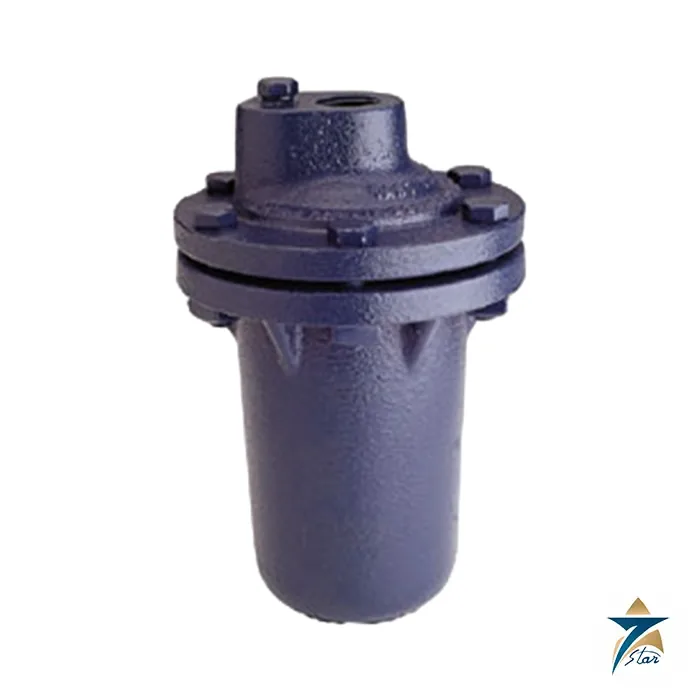
Vertical-mount inverted bucket traps from 1/2 in to 2 in
Where the pipework runs vertically, or where the condensate outlet has to leave from the top of the trap, the Armstrong 200 Series is the cast iron inverted bucket option. It is built for vertical installation with a bottom inlet and a top outlet, in six models, 211 to 216, with screwed NPT or BSPT connections from 1/2 in up to 2 in. Armstrong rates the range for pressures to 250 psig (17 bar) and capacities to 20,000 lb/hr (9,072 kg/hr), a much higher ceiling than the side-inlet 800 Series.
The working principle is the one Armstrong describes for every cast iron inverted bucket: a leverage system multiplies the bucket force so that the valve can open against system pressure, the mechanism floats free with no fixed pivots, and it sits at the top of the trap where dirt cannot collect on the orifice. A water seal surrounds the discharge orifice to stop live steam loss, and a vent hole in the bucket provides continuous automatic air and CO2 venting at steam temperature. The trap drains continuously but discharges intermittently, so condensate does not back up, and the data sheet lists resistance to water hammer.
Technical specification
| Parameter |
Specification |
| Models |
211, 212, 213, 214, 215, 216 |
| Orientation and flow |
Vertical installation, bottom inlet, top outlet |
| Maximum allowable pressure (vessel design) |
250 psig @ 450 F (17 bar @ 232 C) |
| Maximum operating pressure, 211 to 216 |
250 psig (17 bar) |
| Series capacity ceiling |
20,000 lb/hr (9,072 kg/hr) |
| Body |
ASTM A48 Class 30 |
| Internals |
All stainless steel, 304 |
| Valve and seat |
Hardened chrome steel, 17-4PH |
| Test plug |
Carbon steel |
| Connection type |
Screwed NPT and BSPT |
| Options |
Stainless steel internal check valve (suffix CV), thermic vent bucket (suffix T), scrub wire |
| Certified drawing |
CD #1001 |
Dimensions and weight by model
| Model |
Pipe connection, in (mm) |
Test plug, in (mm) |
A flange dia., in (mm) |
B height, in (mm) |
Weight, lb (kg) |
| 211 |
1/2 (15) |
1/8 (3) |
4-1/4 (108) |
6-7/16 (164) |
6 (2.7) |
| 212 |
1/2, 3/4 (15, 20) |
3/8 (10) |
5-1/4 (133) |
8-5/8 (218) |
11-1/2 (5.2) |
| 213 |
1/2, 3/4, 1 (15, 20, 25) |
1/2 (15) |
6-3/8 (162) |
11-1/2 (292) |
20-1/4 (9.2) |
| 214 |
1, 1-1/4 (25, 32) |
1/2 (15) |
7-1/2 (190) |
12-3/8 (314) |
33 (15.0) |
| 215 |
1, 1-1/4, 1-1/2 (25, 32, 40) |
3/4 (20) |
8-1/2 (216) |
14-3/16 (360) |
44-3/4 (20.3) |
| 216 |
1-1/2, 2 (40, 50) |
1 (25) |
10-3/16 (259) |
18 (457) |
77-1/2 (35.2) |
Selecting a size and placing the order
Size is the main decision. Model 211 weighs 6 lb (2.7 kg) and stands 6-7/16 in (164 mm) tall, suited to a single drip point, while model 216 weighs 77-1/2 lb (35.2 kg), stands 18 in (457 mm) tall and takes 1-1/2 in or 2 in pipe. Between them the weight multiplies almost thirteen times (derived from the table), so support and access space need to be planned for the larger bodies.
Armstrong asks the buyer to specify the model number, the size and type of pipe connection, the maximum working pressure that will be encountered or the orifice size, and any options. The internal check valve is added with the suffix CV and the thermic vent bucket with the suffix T. The capacity charts for each model, 211 to 216, appear in the data sheet as curves against differential pressure and should be read at the real operating differential, not at the maximum rating.
Plant uses and site conditions
Vertical cast iron traps suit steam main drips, heat exchangers, converters, process vessels and coils where the layout favours an in-line vertical run. In Oman and the wider GCC, typical users are refineries and gas plants with steam tracing, desalination and power plants with auxiliary steam, and hospitality and industrial buildings with boiler plants. Cast iron is a good fit for ordinary saturated steam within the 17 bar and 232 C vessel limit, but it is not the choice for service conditions outside that envelope.
The all-stainless mechanism, the hardened seat and the repairable body are the points Armstrong stresses for lower maintenance cost. The data sheet does not state any hazardous-area, SIL or fire-safe approval for the 200 Series, so none is claimed here; ask the project engineer to confirm what the specification requires.
Dimensions by model in practice
The six models step up in a regular way. Flange diameter grows from 108 mm on model 211 to 259 mm on model 216, and height from 164 mm to 457 mm. The test plug grows from 1/8 in to 1 in, which tells the installer what size of drain or test fitting the body will accept. Models 213 to 215 each accept three or two connection sizes, so a trap can be matched to the pipe without changing the body; for example model 213 takes 15, 20 or 25 mm and model 215 takes 25, 32 or 40 mm.
Armstrong prints a certified drawing, CD #1001, for exact dimensions. The body is ASTM A48 Class 30 cast iron with an all-stainless 304 mechanism and a 17-4PH chrome steel valve and seat. The vessel rating of 17 bar at 232 C is the same for every model, so the choice between models is about capacity and pipe size rather than pressure.
Selection and installation notes
Specify a steam trap from the steam pressure, the condensate load and the connection size, and check the body material and the pressure rating against the system. Fit a strainer upstream, a union or flange for easy removal and isolation valves either side, prime the trap with condensate before start-up where the type requires it, and protect it from freezing. Inspect traps on a regular schedule to find failures early, because a failed trap wastes steam or floods the line.
Information needed for a quotation
Send the full model code, the quantity, the delivery location in Oman or the GCC, the intended use and any accessories needed, so that the complete package can be quoted together.
Documents and supply information
The manufacturer data sheet is attached to this page and should be read together with the project specification and the site risk assessment before a purchase is confirmed. Ratings, standards and dimensions are quoted as printed on that sheet. Lead time, stock position and certificates available with the shipment are confirmed in the quotation, and we supply to Oman and the wider GCC region for industrial, utility and building services projects.
Documents, related traps and quotation
The horizontal-installation relative is the Armstrong 800 Series, with side inlet and side outlet and capacities to 2,000 kg/hr; compare it with the 200 Series when the piping geometry is not fixed yet. Other steam hardware sits in the pipes and fittings category. The official Armstrong data sheet is attached to this page.
Seven Star LLC is an independent supplier in Muscat. Send your model number, connection size, pressure and option suffix and we will confirm the configuration against the manufacturer data before quoting.







Reviews
There are no reviews yet.