

The Kidde FM-200 clean agent fire suppression system is one of the most widely deployed total flooding solutions in the world, protecting data centers, telecommunications switch rooms, electrical switchgear enclosures and archive storage facilities from fast-developing fires without damaging the sensitive equipment inside. Charged with HFC-227ea (heptafluoropropane), the FM-200 agent is stored as a liquid under nitrogen super-pressurization inside a steel cylinder and discharges as a gas in ten seconds or less, suppressing the fire through a combination of chemical and physical mechanisms while leaving oxygen levels safe for occupied spaces. This particular cylinder and valve assembly holds 200 lb (90 kg, 81 litres) of FM-200 agent in a square shoulder configuration, sized for mid-to-large protected volumes within a Kidde ECS (Engineered Clean System) or comparable engineered clean agent installation.
With engineering support in Muscat, Seven Star LLC supplies Kidde FM-200 cylinders, valve assemblies and associated detection and actuation hardware to facility engineers, MEP contractors and system integrators across the Sultanate of Oman and the wider GCC. Every unit supplied through Seven Star LLC comes with full manufacturer documentation, UL/FM listing paperwork and local technical support, giving Muscat-based data center operators and industrial clients in Sohar and Salalah a dependable supply channel.
FM-200 (chemical designation CF3CHFCF3), the agent used in every Kidde FM-200 cylinder, is a colorless, odorless, electrically non-conductive halocarbon agent that is stored as a liquefied compressed gas and super-pressurized with dry nitrogen to 360 psig at 70°F. When the Kidde FM-200 system is actuated by an approved detection and control panel, the valve on the cylinder opens and the liquid agent is driven through the discharge piping and nozzles, flash-vaporizing into a gas that floods the protected enclosure to the design concentration – 6.7% v/v for Class A surface fires and 7.0% v/v for Class C energized electrical hazards in the Kidde ECS specification – within ten seconds. Suppression occurs primarily through a heat-absorption (physical) mechanism supplemented by a mild chemical interruption of the combustion chain reaction, extinguishing the fire before it can escalate to a point that threatens electronic equipment or high-value contents.
Because the Kidde FM-200 agent leaves no oily or particulate residue, there is no secondary clean-up cost and no risk of the agent itself damaging servers, switchgear, archival media or process equipment; most metals, plastics, rubber compounds and electronic components are unaffected by exposure. The agent is also non-corrosive and does not conduct electricity, which is why it remains the default choice for live electrical rooms. In practical terms this means facility teams get a fire suppression event with zero water damage, zero powder contamination, no mechanically moving parts inside the cylinder itself, and a system that can be safely discharged in an occupied space without endangering personnel who need a brief window to evacuate.
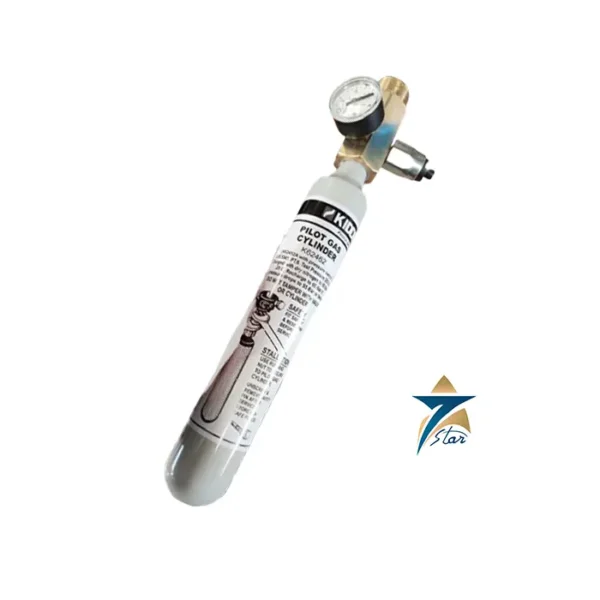
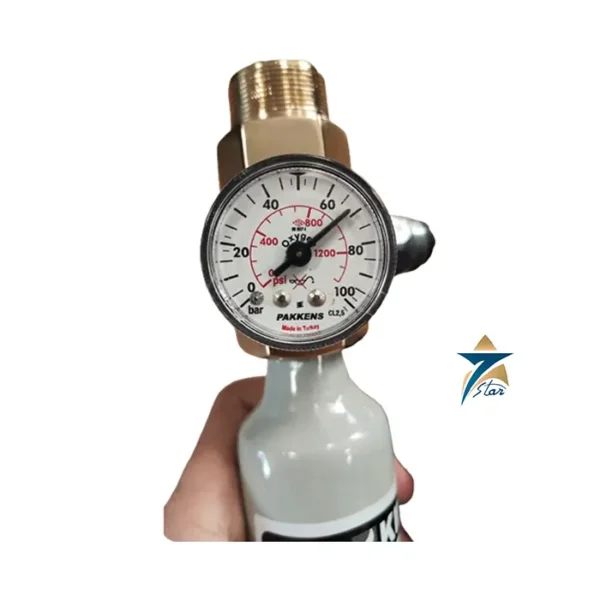
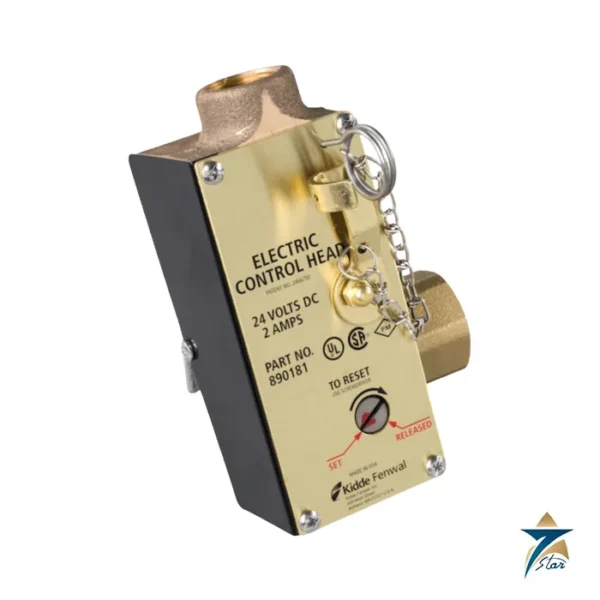
The Kidde FM-200 200 lb cylinder and valve assembly is built from steel, hydrostatically tested, and finished in Kidde’s signature red enclosure coating with a permanently affixed nameplate carrying agent weight, fill date, hydrostatic test data and hazard labeling. The square shoulder cylinder body accepts a top-mounted discharge valve fitted with a pressure gauge, safety burst disc, siphon tube and fill/discharge port, and is engineered for vertical mount installation in a dedicated cylinder room, rack enclosure or wall-bracketed cradle adjacent to the protected space. The valve interfaces directly with Kidde’s range of electric, pneumatic, cable-pull or pressure-operated control heads, allowing the cylinder to be actuated automatically from a fire alarm control panel or manually via a local pull station.
Discharge piping runs from the valve outlet through a network of Schedule 40 steel pipe sized to the hazard’s flow calculations, terminating in 180-degree or 360-degree pendant nozzles positioned for even agent distribution across the protected volume. A supervisory pressure switch monitors cylinder pressure continuously and signals the fire panel if pressure drops outside the normal operating band, while an optional liquid level indicator lets technicians verify agent quantity without disconnecting the valve. The entire assembly is designed for straightforward integration with Kidde’s or third-party UL-listed detection and control panels, keeping commissioning and future inspection work simple for the contractor.
Selecting the right Kidde FM-200 cylinder combines proven clean agent chemistry with an engineered mechanical package built for demanding critical-infrastructure environments.
Across the region, the Kidde FM-200 system is specified wherever water, foam or dry chemical suppression would cause unacceptable collateral damage. Typical installations include data center white space and server rooms, telecommunications equipment shelters, UPS and battery rooms, medium-voltage switchgear and transformer enclosures, control and SCADA rooms, museum and archive storage, and marine engine rooms and machinery spaces where a compact, reliable clean agent charge is essential. In the GCC, the Kidde FM-200 remains the preferred retrofit for legacy Halon 1301 systems because it can typically use much of the existing pipe network with only valve and nozzle modification.
Backed by genuine manufacturer documentation, Seven Star LLC distributes FM-200 cylinders and system components to district cooling plants, RO desalination facilities, hospital IT and imaging suites, hospitality group data centers and oil & gas control rooms throughout Oman, Muscat, and the Sohar and Salalah economic zones, alongside broader GCC deployments in the UAE, Saudi Arabia and Qatar. Technical support with selection means engineering, procurement and construction (EPC) contractors can specify FM-200 with replacement cylinders and valve spares sourced on request, with lead time confirmed at quotation.
The table below summarizes the core specifications for the Kidde FM-200 200 lb cylinder, and Seven Star LLC can confirm current Kidde FM-200 availability and valve assembly; smaller and larger cylinder capacities in the same product family are available on request.
| Parameter | Specification |
|---|---|
| Model | Kidde FM-200 200 Lb Cylinder & Valve Assembly (90-100200-101) |
| Extinguishing Agent | FM-200 (HFC-227ea), CF3CHFCF3 |
| Agent Fill Weight | 200 lb (90 kg) |
| Cylinder Volume | 81 litres (square shoulder) |
| Operating Pressure | 360 psig at 70°F (25 bar at 21°C), nitrogen super-pressurized |
| Discharge Time | 10 seconds or less |
| Design Concentration | 6.7% v/v for Class A surface fires; 7.0% v/v for Class C energized electrical equipment; Class B as required by the manufacturer |
| Maximum Fill Density | 70 lb/ft³ |
| Mounting | Vertical, wall bracket or floor cradle |
| Valve Interface | Electric, pneumatic, cable-pull or pressure-operated control head |
| Available Cylinder Range | 10 lb (4.5 kg) through 900 lb (408 kg) |
| Approvals | UL Listed, ULC Listed, FM Approved, EPA SNAP compliant, NFPA 2001 |
| Construction | Hydrostatically tested steel cylinder, red enclosure coating |
| Cylinder Construction Specification | DOT 4BW-500 and TC 4BW-M34 |
| Low-Pressure Supervisory Signal | Low pressure switch signals a supervisory condition at 288 psi |
| Discharge Performance | 95% of cylinder contents delivered within 10 seconds |
| Hold Time | 85% of minimum design concentration maintained for 10 minutes |
| Nozzle Types | 180-degree and 360-degree; listed for mounting heights up to 16 ft (4.88 m) |
| Nozzle Coverage | 40.0 ft × 44.0 ft (12.0 m × 13.3 m) per nozzle |
| Maximum Agent per Nozzle | 350 lb |
| Agent Purity | 99.0% by mole minimum; water content 0.001% maximum |
Kidde's engineering specification for the ECS system with HFC-227ea sets the figures a designer works to. The design concentration is 6.7% v/v for Class A surface fires and 7.0% v/v for Class C energized electrical equipment, with Class B flammable liquid hazards assessed individually by the manufacturer. The discharge must reach 95% of the minimum design concentration within 10 seconds, and 85% of that concentration must be held for 10 minutes. These values, rather than the cylinder size alone, decide how many 200 lb cylinders a room needs.
The same specification limits the pipe and nozzle layout. Nozzles have 180-degree or 360-degree patterns, are listed for mounting heights up to 16 ft (4.88 m) and cover an area of 40 ft × 44 ft (12.0 m × 13.3 m) each. No more than 350 lb of agent should discharge through a single nozzle. Primary cylinders are electrically actuated and secondary cylinders can be pressure actuated, and the solenoid actuator must be supervised for placement on the valve to keep the UL listing and FM approval valid.
Kidde's ECS 360 cylinder documentation describes two routine checks. Every quarter the pressure gauge on each cylinder is read; a loss of 10% or more means the cylinder must be recharged or replaced. Pressure moves with temperature, by roughly 3 psi per °F between 55 and 85 °F, so the reading has to be corrected for the room temperature. Every six months qualified personnel determine the agent quantity; if the net weight is below 95% of the original charge marked on the label, the cylinder is recharged or replaced.
Facility engineers and procurement teams evaluating Kidde FM-200 clean agent protection for a new build or a Halon 1301 retrofit can request a formal RFQ for the Kidde FM-200 cylinder and full system components from Seven Star LLC’s instrumentation and fire protection division. Lead time for both new installations and cylinder replacement is confirmed at quotation, and the technical datasheet, hydrostatic test schedule and hazard flow calculation support are available on request. Working closely with plant engineers in the region, Seven Star LLC supports every FM-200 enquiry with manufacturer documentation and technical support – contact our team today to specify the right cylinder capacity for your protected enclosure.
Browse the full Kidde range or see more Fire Fighting products supplied by Seven Star LLC in Oman and the GCC.
Browse Kidde products by category: Fire Fighting.
Choose the option that best fits your needs to get the fastest response from our team.
Automatically fill the RFQ form with this product's details for a faster process.
Manually enter multiple part numbers, specific brands, or custom requirements.









Reviews
There are no reviews yet.