Fully bolted cylinder built to the application
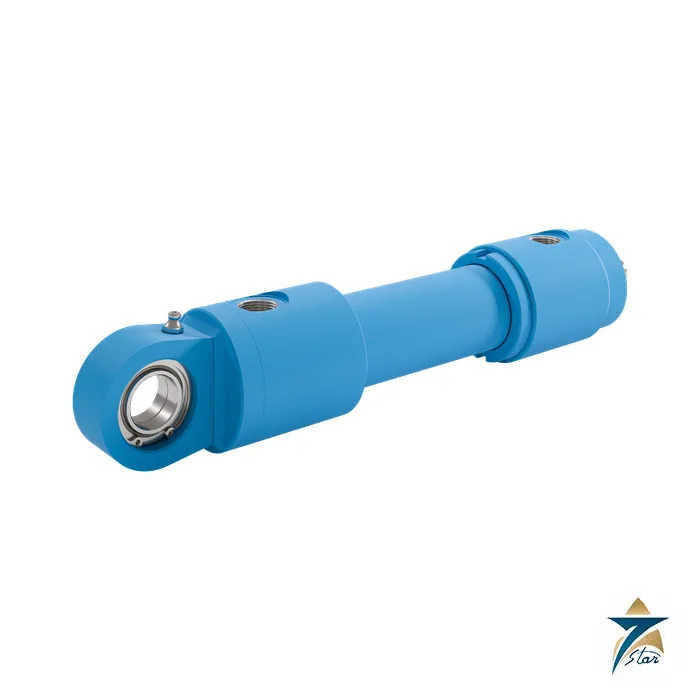
The KRACHT CNL is a fully bolted hydraulic rod cylinder for 200 bar nominal pressure, offered with piston diameters from 40 to 160 mm and strokes up to 4000 mm. Heads and base are made of S355 steel, the barrel is a seamless precision steel tube to DIN 2391, and the piston rod is high-strength steel, milled, polished and hard-chromium plated. Because it is screwed together rather than welded, seals and guide elements can be replaced easily and features can be added later.
The CNL is built to order: rod thread, non-toleranced dimensions and the position and size of the ports can be adapted to customer requirements, and the type key defines mounting, function, damping, seals and sensors.
Technical specifications
Data from KRACHT data sheet CNL/EN/09.2026.
| Parameter |
Specification |
| Type |
Piston rod cylinder, threaded (bolted) version |
| Nominal pressure |
200 bar; 0 to 200 bar piston side and rod side |
| Piston diameters |
40, 50, 63, 80, 100, 125, 160 mm |
| Rod diameters |
22 to 110 mm (standard and reinforced) |
| Maximum stroke |
3000 mm (CNL 40, 50); 4000 mm (CNL 63 to 160); 1 mm increments |
| Stroke speed |
0 to 0.5 m/s compact seal; 0 to 0.8 m/s O-ring-supported PTFE seal |
| Hydraulic connections |
Whitworth pipe thread to DIN 2353 |
| Pressure medium |
Mineral oil to DIN 51524/25; low-flammability fluids on request |
| Viscosity range |
2.8 to 380 mm2/s |
| Temperature (ambient and fluid) |
-20 to 80 °C standard seals; -20 to 180 °C FKM seals |
| Materials |
Heads and base S355; tube DIN 2391 seamless precision steel; hard-chromed rod |
| Mounting position |
Any |
| Base weight example |
CNL 63 with pivot lug (01/02): 15.0 kg plus weight per mm of stroke |
Reading the CNL type key
The data sheet example CNL-01-0-D-2-63/45-D-L-K-N-X-X-250-0-0 reads as follows: mounting 01 (pivot lug with joint bearing), no K dimension, D differential cylinder, 2 double-acting, 63 mm piston with 45 mm rod, D with damping, L with venting, K compact seal, N NBR, X without displacement measurement, X without limit switches, and 250 mm stroke with standard dimensions and rod thread. Mounting types run from 00 (none) through pivot lugs, foot mountings, pivot pins on the tube (04) and round or square flanges at head, base or both (05 to 11). Functional types are differential (D), synchronous with through rod (G) and plunger (P).
Options and installation rules
Adjustable end-position cushioning at both ends, electronic proximity switches for end-of-stroke signals suitable for any PLC, a stroke measuring system and water cooling for hot surroundings are available. Venting is normally through the ports, with vent screws fitted as standard on cushioned cylinders. KRACHT warns that no radial forces may act on the piston rod, as bending destroys the cylinder quickly, and specifies mounting bolts of class 8.8 or 10.9. Check the pressure-stroke buckling curves in the data sheet for long strokes with pivot mountings.
Documents and quotation
The attached KRACHT data sheet contains force curves, dimensions for every mounting type and weights. For a quotation, send the full type key, or the required force, stroke, speed, mounting and fluid. Related hydraulic products are listed under Hydraulic Valves and Components.
How a bolted hydraulic cylinder works
In a double-acting differential cylinder, hydraulic fluid pressure acts on the full piston area to extend and on the smaller annular area to retract. Extension therefore develops more force but moves more slowly than retraction at the same flow. The theoretical force is pressure multiplied by the effective area. At 200 bar, every square centimetre of piston area gives about 2 kN, before allowing for friction and back pressure. A synchronous cylinder with a through rod (G) has equal areas on both sides, so speed and force are the same in both directions. A plunger cylinder (P) works in one direction only.
Selection checklist
- Required force in each direction, working pressure and available pump flow, which together set piston and rod diameters and speeds.
- Stroke length and mounting type, checked against the buckling limits for the chosen rod diameter.
- End-position cushioning for higher speeds or heavy moving masses.
- Seal type and material for the fluid, speed and temperature, using FKM for hot service.
- Port size and position, rod-end thread and any position sensing or limit switches.
Installation & maintenance
- Align the cylinder with the load path. Use pivot or joint-bearing mountings where the load moves in an arc, so the rod is never loaded sideways.
- Flush the hydraulic system before commissioning and keep the fluid clean with suitable filtration.
- Bleed air from the cylinder at low pressure before running it at full load.
- Inspect the rod surface for scoring and the rod seals for leaks at regular intervals.
- Protect exposed rods from sand and abrasive dust, for example with rod boots where the application allows them.
Typical applications in Oman & the GCC
In Oman and the GCC, 200 bar bolted cylinders are used in industrial presses, steel and pipe mill handling, test benches, mobile and marine equipment, water and wastewater gates, and general machine building. Their bolted design makes them easy to reseal, which matters where the climate is hot and dusty and replacement lead times are long.
Hydraulic fluid and filtration
Most cylinder failures start with contaminated fluid. Particles score the rod and bore and wear the seals. Use mineral oil to DIN 51524 as KRACHT specifies, keep reservoirs sealed and breathers filtered, and change filters at the intervals the system builder sets.
Record the full type key from the nameplate, so that seal kits and replacement cylinders can be ordered exactly.
Why source from Seven Star LLC
Seven Star LLC supplies KRACHT hydraulic components across Oman and the GCC. Tell us your application, materials and site conditions and our team can help confirm the correct ordering code and accessories before you request a quote.



Reviews
There are no reviews yet.