
- Vibration Monitoring
- Industrial Communications
- PLC & I/O Cards
- Automation Accessories
- Controllers & Data Acquisition
- AC Drives
- Industrial Computers
- Encoders
- Safety Switches & Guard Locking
- Isolator & Barrier
- Automation Software
- HMI Displays
- Motor Soft Starters
- Servo Drives
- CCTV & Security
- Robotics
- Pneumatic Cylinders
- Machine Vision
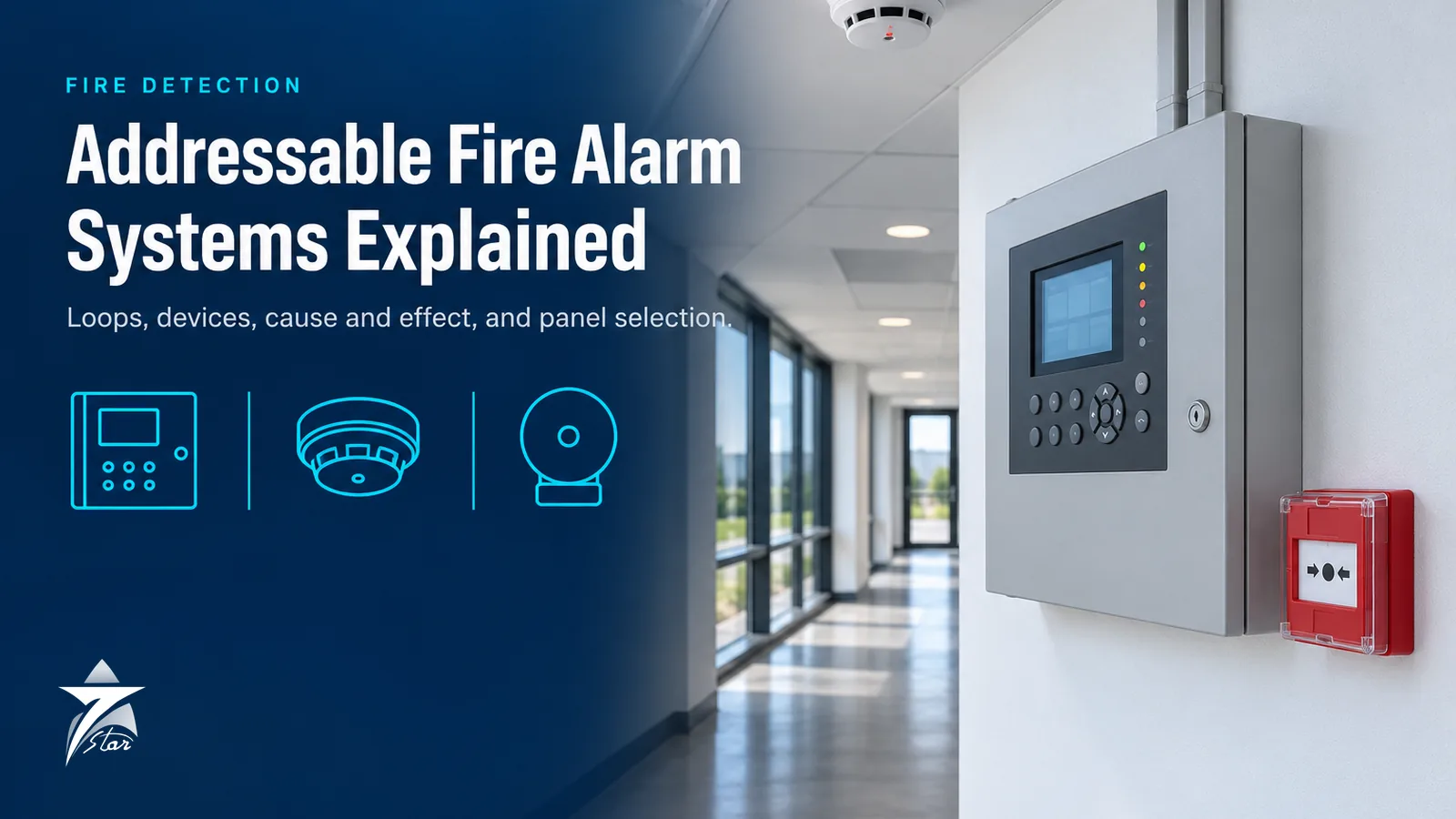
Addressable Fire Alarm Systems for Industrial and Commercial Sites: Panels, Loops, Devices and Gas Suppression Integration
An addressable fire alarm system identifies the exact device that has operated, rather than only the zone, and that single difference changes how quickly a fire is located, how faults are diagnosed and how much logic the system can carry. For industrial sites, control buildings, substations, warehouses and commercial buildings, addressable or analogue addressable systems are now the normal choice above a small number of zones, and they increasingly act as the hub that triggers HVAC shutdown, door release, lift homing and gas suppression.
This guide compares the system types, explains loop design and device selection, covers interfaces to clean-agent suppression, and lists the standards and approvals that apply, with attention to dust, heat and corrosion at Omani sites.
Conventional, Addressable and Analogue Addressable
| Feature | Conventional | Addressable | Analogue addressable |
|---|---|---|---|
| Fire location | Zone only | Individual device | Individual device |
| Wiring | Radial circuit per zone, end-of-line device | Loop with all devices on two cores | Loop with all devices on two cores |
| Detector decision | Detector decides and switches current | Detector decides and reports status | Detector reports analogue value; panel decides |
| Drift and contamination compensation | None | Limited | Panel tracks sensitivity and flags dirty detectors |
| Cause-and-effect programming | Basic, zone based | Device-level | Device-level, with multi-criteria logic |
| Fault diagnosis | Zone level | Device level | Device level with maintenance warnings |
| Typical use | Small buildings, simple sites | Medium sites | Industrial plants, large and complex buildings |
| Example panels | C-TEC CFP708-4 | Varies by manufacturer | Gent Vigilon Plus, C-TEC XFP501/CA |
In practice most modern addressable panels are analogue addressable, and the term addressable is used loosely for both. The important distinction is whether the panel receives a continuous value from each sensor, which allows drift compensation and pre-alarm warnings that significantly reduce false alarms. Confirm the detection algorithm and the device protocol on the panel datasheet, because detectors are only compatible with panels that use the same protocol.
Loop Design
Topology
Addressable devices are wired on a loop that starts and ends at the panel. With both ends connected, a single open circuit leaves every device still reachable from one side or the other. Short-circuit isolators, either standalone or built into detector bases and devices, disconnect only the section between two isolators when a short occurs. EN 54-2 requires that a single fault in the transmission path does not remove more than a limited number of detection points, commonly applied as no more than 32 devices between isolators, and BS 5839-1 adds requirements linked to zones. NFPA 72 defines pathway classes, with Class A providing an alternate path and Class B (a radial, non-redundant circuit) used where the code permits. Industrial specifications normally require looped Class A style wiring with isolators.
Loop capacity
The maximum number of devices per loop depends on the panel and protocol and is typically in the range of around 100 to 250 addresses. Loop current, cable length and voltage drop limit the usable number further, especially when loop-powered sounders and beacons are included. Use the manufacturer’s loop calculation tool rather than filling a loop to its address limit. Panels expand by adding loop cards, such as the Gent Vigilon loop card, and large sites network several panels so that any panel can display and control the whole system.
Cable
Fire-resisting cable to BS 5839-1 categories (standard or enhanced) is required for the loop and sounder circuits. Segregate fire alarm cables from power cables, keep screens continuous and earthed as the panel manufacturer requires, and avoid mixing devices from different protocols on one loop.
Detector and Device Selection
| Device | Detects | Strengths | Limitations | Typical locations |
|---|---|---|---|---|
| Optical (photoelectric) smoke | Visible smoke particles | Good for smouldering fires; common default | Dust, steam and aerosols cause false alarms | Offices, control rooms, corridors |
| Heat (fixed and rate-of-rise) | Temperature or rate of rise | Insensitive to dust and fumes | Slow; only responds once fire is established | Kitchens, plant rooms, dusty areas |
| Multi-sensor | Smoke plus heat, sometimes CO | Better discrimination between fires and nuisance sources | Higher cost | Mixed-use areas with nuisance sources |
| Optical beam | Smoke across an open span | Covers large high spaces | Alignment drift with building movement | Warehouses, halls, atria |
| Aspirating (ASD) | Smoke drawn through sampling pipes | Very early warning; detector unit accessible for maintenance | Higher cost; needs pipe design and filters in dusty sites | Data rooms, control rooms, cleanrooms, high-value areas |
| Manual call point | Human activation | Simple and reliable | Depends on people | Exits, escape routes |
| Sounder and visual alarm device | Output | Audible and visual warning | Needs coverage design and audibility checks | Throughout the site |
Addressable smoke detectors such as the C-TEC CP416 CAST Pro smoke detector must match the protocol of the panel they are connected to. In hazardous areas classified as Zone 1 or Zone 2, standard devices cannot be used. Flameproof or otherwise Ex-certified devices are required, such as the MEDC BG manual call point and the MEDC DB3 sounder. These are often connected through interface modules or barriers rather than directly on the loop; confirm the certification, gas group, temperature class and connection method on the datasheet. In process areas, flame and gas detection is normally handled by a separate fire and gas system, with the building fire alarm system receiving summary signals.
Cause and Effect and Interfaces
Cause-and-effect programming defines what each input does: which sounders operate, whether alarms are staged, which outputs switch. Typical outputs include HVAC and damper shutdown, door release on access control, lift homing, plant shutdown signals, signals to a central monitoring station and interfaces to the plant fire and gas or ESD system. Document the cause-and-effect matrix formally, test every line at commissioning, and control later changes through a management of change process. Undocumented edits to panel configuration are a common source of failures discovered only during an incident.
Clean-Agent Gas Suppression Integration
Rooms with electrical or high-value equipment, such as control rooms, server rooms and switchgear rooms, often use clean-agent suppression. HFC-227ea, widely known by the trade name FM-200, is a common agent; systems such as Kidde FM-200 are designed under NFPA 2001 or ISO 14520. Design concentration depends on the hazard class and must be established by a qualified designer, and the agent is discharged within a short time, typically 10 seconds, to reach that concentration.
A typical release sequence is controlled by an extinguishing control panel or a release module on the addressable system:
- First detector in alarm: local alarm, warning to occupants.
- Second detector in alarm (coincidence or double-knock): pre-discharge alarm, HVAC and damper shutdown, countdown begins.
- Countdown, typically up to 30 seconds, during which an abort or hold switch can be operated.
- Release signal operates the actuator or control head on the cylinder valve; on multi-cylinder systems a pilot cylinder is often used to actuate the remaining cylinder valves pneumatically.
- Discharge confirmed by a pressure switch, which activates the gas released indicators outside the room.
A room integrity (door fan) test verifies that the enclosure will hold the design concentration for the required hold time, commonly 10 minutes. Unsealed cable penetrations, false floor voids and raised ceilings are the usual causes of failure. Repeat the test after any construction work that affects the room.
Standards and Approvals
The main references are EN 54 (product standards for panels, detectors, call points, sounders, isolators and system compatibility), BS 5839-1 (system design, installation, commissioning and maintenance for non-domestic premises), NFPA 72 (US national fire alarm and signalling code), and NFPA 2001 or ISO 14520 for clean-agent systems. Project specifications usually name one family, and mixing requirements between them should be avoided.
In Oman, fire alarm and suppression systems require approval from the Public Authority for Civil Defence and Ambulance (PACDA). Confirm product listing and approval requirements, the approved contractor status of the installer and the drawing submission process early, because late approval issues delay building occupancy and plant handover.
Commissioning and Maintenance
BS 5839-1 recommends a weekly user test of a manual call point (rotating through all call points), periodic inspection and servicing at intervals not exceeding six months, and testing of all devices over the course of each year. Analogue addressable panels help by reporting detectors that are becoming contaminated before they cause false alarms. Clean-agent systems need regular checks of cylinder pressure and weight, actuator condition, hoses, and the integrity of the room.
Considerations for Oman and the GCC
- Dust: fine dust raises the analogue value of optical detectors and causes false alarms. Use panel drift compensation, increase cleaning frequency, and consider heat or multi-sensor detectors in dusty plant areas.
- Hot roofs and void spaces: ambient temperature under roofs in summer can approach the alarm threshold of low-temperature fixed heat detectors. Select heat detector class for the actual maximum ambient.
- Coastal corrosion: use suitable enclosures and stainless fixings for external sounders and call points at coastal sites.
- Remote sites: networked panels and remote monitoring reduce response time where buildings are unmanned.
- HVAC failure in control rooms raises temperatures that affect detection and equipment; integrate HVAC alarms into the monitoring scheme.
Common Mistakes
- Exceeding loop current or voltage drop limits by loading sounders and beacons to the address limit.
- Mixing detectors from a different protocol with the panel.
- Leaving the cause-and-effect matrix undocumented or out of date.
- Calling a gas detection controller a fire panel; gas detection controllers such as the Honeywell System 57 serve a different function.
- Skipping room integrity retests after modifications to protected rooms.
Addressable Fire Alarm Specification Checklist
- Design standard (BS 5839-1 or NFPA 72) and system category defined
- Panel loop count, network and expansion capacity confirmed
- Device protocol compatibility confirmed for all detectors and modules
- Loop calculations completed for current and voltage drop
- Isolator positions meet the single-fault limit
- Detector types selected for dust, heat and nuisance sources
- Hazardous area devices certified and interfaced correctly
- Cause-and-effect matrix approved and tested
- Suppression release sequence, abort and hold logic defined
- Room integrity test planned
- PACDA approval route and documentation confirmed
Sourcing Fire Alarm Equipment Through Seven Star LLC
Seven Star LLC supplies and sources fire alarm panels, loop cards, detectors, Ex devices and suppression components for contractors and facility owners in Oman and the GCC. Browse the fire alarm and logic controller category, the fire fighting range and the Gent brand page. For background on gas detection, see our gas detector selection guide.
Send your fire alarm device list or panel part numbers to Seven Star LLC through our contact page for a quotation.
Was this guide helpful?One click helps us write better guides for engineers.
Thank you! Glad it helped. Need this equipment for your project? Request a quotation
Thank you. We will use this to improve the guide.
Need a Quotation for Your Project?
Seven Star LLC supplies the industrial equipment covered in this article to customers across Oman and the GCC. Send us the part numbers, models or a short description with quantities, and our sales team will reply with a formal quotation.
- Genuine OEM products
- Supply across Oman & the GCC
- Formal quotation from our sales team
Free, no-obligation quotation · takes about 1 minute
Other enquiries: [email protected] · WhatsApp
More Blog




Frequently Asked Questions
A conventional system groups detectors into zones on radial circuits, so the panel shows only which zone is in alarm. An addressable system gives every device its own address on a loop, so the panel identifies the exact device. Addressable systems also allow device-level programming and fault diagnosis.
The limit depends on the panel and protocol and is typically in the range of about 100 to 250 addresses per loop. Loop current, cable length and voltage drop often reduce the practical number. The manufacturer's loop calculation should always be used.
Isolators disconnect only the section of the loop between two isolators when a short circuit occurs, so the rest of the loop keeps working. EN 54-2 and BS 5839-1 limit how many devices a single fault may disable. Many detector bases and devices include built-in isolators.
FM-200 is a trade name for HFC-227ea, a clean-agent gas used to protect rooms with electrical or high-value equipment. It extinguishes fire mainly by absorbing heat and interrupting the combustion reaction. Systems are designed under NFPA 2001 or ISO 14520 and leave no residue.
BS 5839-1 recommends a weekly test of a manual call point by the user and periodic inspection and servicing at intervals not exceeding six months. All devices should be tested over the course of each year. Local authority and insurer requirements may add to this.
Fire alarm and suppression systems in Oman require approval from the Public Authority for Civil Defence and Ambulance. Designs, product approvals and installer qualifications should be confirmed with the authority early in the project. Final inspection is normally required before occupancy or handover.