
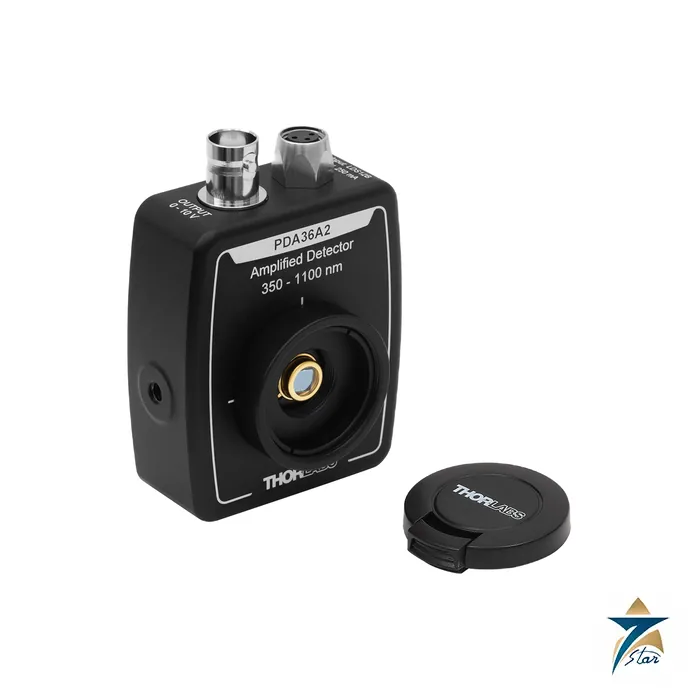
The Thorlabs PDA36A2 is an amplified, switchable-gain silicon photodetector designed to detect light signals from 350 to 1100 nm. It combines a reverse-biased PIN photodiode with a 3.6 by 3.6 mm (13 mm squared) active area and a low-noise, low-offset transimpedance amplifier whose gain can be stepped over a 70 dB range with an eight-position rotary switch. A buffered BNC output drives 50 ohm loads up to 5 V, so the detector connects directly to an oscilloscope, data acquisition card or lock-in amplifier. Because the user can trade gain against bandwidth with one knob, a single Thorlabs PDA36A2 covers everything from fast modulated signals at megahertz rates to very weak, slowly varying light.
Seven Star LLC supplies the Thorlabs PDA36A2 to university photonics laboratories, research centres, telecom test benches and industrial laser users across Oman and the GCC. Our Muscat office helps researchers and engineers choose the right detector, mounting adapters and cables for each optical setup, and can supply matching Thorlabs power meters and controllers.
When photons with enough energy are absorbed in the depleted region of a silicon PIN junction, they generate electron-hole pairs that flow as photocurrent. The responsivity, defined as photocurrent divided by incident optical power, depends on wavelength; for the Thorlabs PDA36A2 the peak is about 0.65 A/W at 970 nm. Reverse biasing the diode widens the depletion region, lowers junction capacitance and speeds up the response. Silicon devices also produce low dark current compared with germanium, which helps when measuring weak light.
The photocurrent feeds a transimpedance amplifier, which converts current to voltage with a gain set by its feedback resistor. Switching the feedback element changes the gain in 10 dB steps, from 1.51 times 10 to the power 3 V/A at 0 dB to 4.75 times 10 to the power 6 V/A at 70 dB into a high impedance load. Bandwidth falls as gain rises because the amplifier gain-bandwidth product of 600 MHz is shared with the larger feedback resistance and the photodiode capacitance. Thorlabs therefore advises adjusting gain so the output stays below 10 V, or 5 V into 50 ohm, to avoid saturation.
The Thorlabs PDA36A2 is packaged in a rugged housing of 70.9 by 52.5 by 22.5 mm and weighs about 0.10 kg. The active area surface of the photodiode is flush with the front of the housing, with a depth of only 2.2 mm to the start of the threads, which gives maximum access for fibre adapters, filters and lens tubes. The front accepts SM1 thread accessories, and an SM1T1 coupler and SM1RR retaining ring are included. Tapped mounting holes on the bottom and side accept both 8-32 and M4 threads, so imperial or metric posts can be used, and the housing works with Thorlabs cage system accessories.
Controls are simple: a slide power switch and the eight-position rotary gain switch on the top of the unit. The DC-coupled BNC output includes a 50 ohm series resistor and can source up to 100 mA. The supplied AC-DC converter runs on 100, 120 or 230 V at 50 to 60 Hz. Operating temperature is 10 to 40 degrees Celsius and storage temperature is minus 20 to 70 degrees Celsius, which suits air-conditioned laboratories and instrument rooms in the region.
The Thorlabs PDA36A2 user manual lists the following characteristics.
Amplified photodetectors are basic building blocks in optics laboratories. At universities and research institutes in Muscat and across the GCC, the Thorlabs PDA36A2 is used to monitor laser output, measure transmission and reflection of samples, detect modulated or chopped beams with a lock-in amplifier, observe pulse trains and align optical systems. Its wide gain range lets students and researchers start with low gain for bright beams and increase sensitivity for weak fluorescence or scattered light without changing hardware. Teaching laboratories value the same flexibility, because one detector type can be issued for many different experiments, from interferometry and diffraction to time-of-flight and optical communication demonstrations.
In industry, the Thorlabs PDA36A2 serves optical test benches for fibre and telecom components, laser marking and cutting system diagnostics, and optical sensor development in the oil and gas and environmental monitoring fields. Seven Star LLC supplies the detector together with Thorlabs mounting hardware, power meters and controllers, and our Muscat team helps laboratories in Oman and the GCC plan complete measurement setups.
The following Thorlabs PDA36A2 data is taken from the Thorlabs user manual (TTN135069-D02), measured at 25 degrees Celsius into a 50 ohm load unless noted.
| Parameter | Specification |
|---|---|
| Model | Thorlabs PDA36A2 |
| Detector | Silicon (Si) PIN photodiode |
| Active area | 3.6 mm × 3.6 mm (13 mm²) |
| Wavelength range | 350 to 1100 nm |
| Peak wavelength / response | 970 nm / 0.65 A/W (typ.) |
| Gain range | 0 to 70 dB, 8 × 10 dB steps |
| Gain at 0 dB | 1.51 × 10³ V/A (Hi-Z); 0.75 × 10³ V/A (50 Ω) |
| Gain at 70 dB | 4.75 × 10⁶ V/A (Hi-Z); 2.38 × 10⁶ V/A (50 Ω) |
| Bandwidth | 12 MHz (0 dB), 1 MHz (20 dB), 90 kHz (40 dB), 9 kHz (60 dB), 3 kHz (70 dB) |
| Amplifier GBP | 600 MHz |
| Output | BNC, DC coupled, 50 Ω; 0 to 5 V (50 Ω), 0 to 10 V (Hi-Z); 100 mA max. |
| Offset | ±8 mV typ., ±12 mV max. |
| Package size | 70.9 × 52.5 × 22.5 mm |
| Weight | 0.10 kg (detector only) |
| Operating / storage temperature | 10 to 40 °C / –20 to 70 °C |
| Power supply | AC-DC converter, 6 W, 100 / 120 / 230 V, 50-60 Hz |
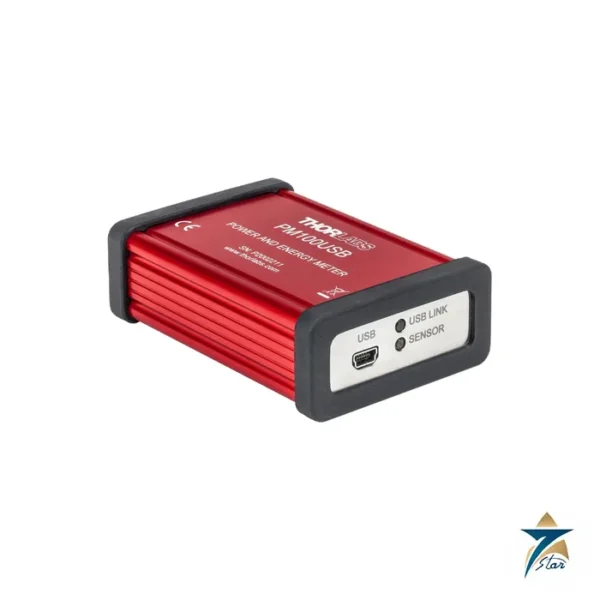
To request a quotation for the Thorlabs PDA36A2, contact Seven Star LLC with the quantity and any accessories you need, such as fibre adapters, posts or BNC cables. Our Muscat instrumentation division confirms availability, shares the Thorlabs user manual and supports laboratories in Oman and the GCC. Related Thorlabs products we supply include the Thorlabs PDA200C photodiode amplifier, the Thorlabs PM100D power and energy meter console and the Thorlabs PM100USB power meter interface.
Browse Thorlabs products by category: Controllers & Data Acquisition, Portable Test & Measurement, Sensors & Transmitters.
Choose the option that best fits your needs to get the fastest response from our team.
Automatically fill the RFQ form with this product's details for a faster process.
Manually enter multiple part numbers, specific brands, or custom requirements.















Reviews
There are no reviews yet.