
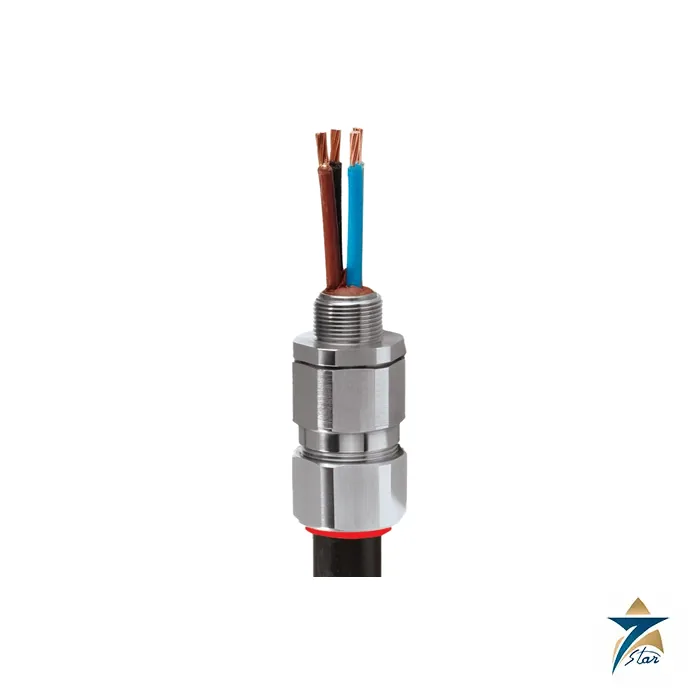
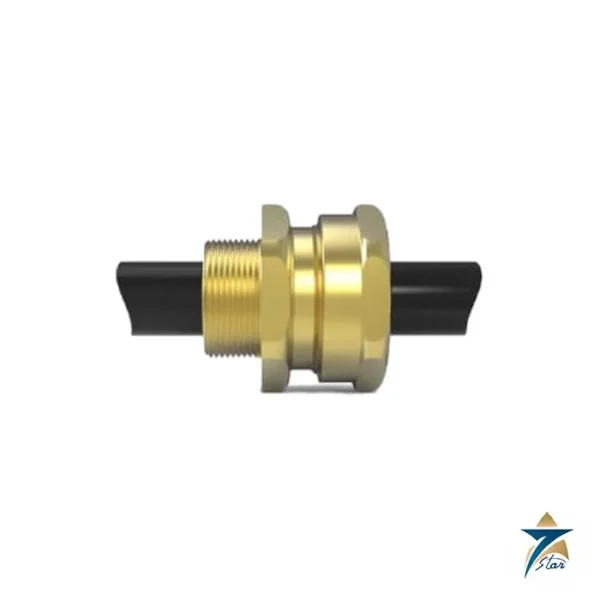
The CMP PX2K is a barrier cable gland for explosive atmospheres. Instead of compressing a rubber seal onto the cable bedding, it seals the cable with a two-part epoxy compound that is packed between and around the individual cores after the inner sheath has been removed. Once cured, the compound forms a solid flameproof barrier inside the gland, so gas cannot travel through the interstices of the cable and the seal is not affected by cold flow of the bedding. The CMP PX2K terminates all common armour types and is certified for Ex db IIC Gb, Ex eb IIC Gb, Ex nR IIC Gc and Ex ta IIIC Da, as well as for Class I, Division 1 under UL and cCSAus.
Seven Star LLC supplies the CMP PX2K and its compound kits to hazardous-area projects in Oman and the GCC, with engineering support in Muscat. Barrier glands are usually specified where the installation standard leaves no choice: Ex d enclosures containing an ignition source in Zone 1, larger flameproof enclosures in Group IIC, and cables whose construction is not compact and filled enough to rely on a compression seal alone.
IEC 60079-14 sets out when a compression-sealed gland is acceptable at a flameproof entry and when a barrier seal is required, taking account of the gas group, the enclosure volume, the presence of an internal ignition source and the cable construction. The CMP PX2K is the answer to the cases that call for a barrier. During installation, the cores are separated, compound is pressed into the crutch of the cable and packed between the cores, and the compound tube is then filled until it seats against the armour cone. The cured epoxy blocks the path between the conductors, which is something a seal on the outside of the bedding cannot do.
The compound must be left undisturbed and cured for 24 hours at a temperature of not less than 10 °C before the equipment is energised in a flammable atmosphere, according to the CMP installation instructions. Outside the barrier, the gland uses a CMP outer seal on the cable sheath, made from CMP SOLO LSF halogen-free thermoset elastomer, with an integral protected deluge seal and an outer seal tightening guide that sets the correct number of turns for the cable diameter.
The CMP PX2K grips the armour metal-to-metal between a detachable compound tube and cone and the AnyWay universal clamping ring, giving a robust earth path and good EMC performance on screened cables. Two cone profiles are used: the stepped cone (W) for single wire armour and aluminium wire armour, and the grooved cone (X) for wire braid, steel tape armour and aluminium strip armour. The gland can be installed directly into the enclosure or remotely and then fitted.
Mechanical data follows BS 6121 Part 1, IEC 62444 and EN 62444 with impact Level 8 and Type D cable anchorage, and IK10 (20 joules) for brass and stainless steel. The electrical classification is Category B, or Category A when terminating braid, tape or pliable wire armour. Bodies are available in brass, electroless nickel plated brass, 316 stainless steel and copper-free aluminium, and the CMP PX2K is rated from -60 °C to +85 °C, a lower upper limit than the +130 °C rating of the CMP compression-seal types.
Engineers usually choose the CMP PX2K for the following reasons:
Typical uses of the CMP PX2K include cable entries into Ex d motor starters, flameproof switch and control stations, Ex d lighting and junction boxes with internal terminals or switching devices, analyser shelters and skid-mounted packages for gas compression, separation and metering. It also appears on equipment such as the MEDC DB3 explosion-proof alarm sounder and actuators like the AUMA SAEx explosion-proof actuator, where the project specification calls for barrier glands on all Ex d entries regardless of enclosure size.
In Oman, sour gas fields, gas processing plants, LNG trains and refineries frequently write barrier glands into their electrical specifications for Zone 1 areas, and the CMP PX2K is a familiar choice for those packages. Seven Star LLC supplies the CMP PX2K with compound kits, shrouds, earth tags and locknuts, and our engineers in Muscat can check core counts and diameters against the selection table so the correct size is supplied the first time. For conduit systems, the Cooper Crouse-Hinds EYS1/EZS1 sealing fittings offer the equivalent barrier function.
The data for the CMP PX2K below is taken from CMP technical data sheet TDS502 Rev 18 (07/25). The full selection table, including the maximum number of cores per size, is in the attached document.
| Parameter | Specification |
|---|---|
| Model | CMP PX2K explosive atmosphere compound barrier cable gland |
| Cable types | SWA, AWA, wire braid armour (SWB), screened EMC braid (CY/SY), PWA, STA, strip armour (ASA) |
| Protection concepts (IECEx) | Ex db IIC Gb, Ex eb IIC Gb, Ex nR IIC Gc, Ex ta IIIC Da, Ex db I Mb, Ex eb I Mb |
| Certificates | IECEx CML 18.0182X; ATEX CML18ATEX1325X / CML18ATEX4317X; UKEX CML 21UKEX1214X / 4215X; cCSAus 2288626; cULus E161256, E201187 |
| North American rating | Class I, Div 1 and 2, Groups A, B, C and D; Class I, Zone 1 AEx d IIC Gb, AEx e IIC Gb |
| Ingress protection | IP66, IP67, IP68 (30 m for 12 hours); deluge DTS01:91 |
| Temperature range | -60 °C to +85 °C |
| Seals | Inner epoxy compound barrier; outer seal in CMP SOLO LSF halogen-free thermoset elastomer |
| Materials | Brass, electroless nickel plated brass, 316 stainless steel, copper-free aluminium |
| Sizes and threads | 20S16 to 100; M20 to M100 metric, 1/2 in to 4 in NPT |
| Maximum cores | 21 (size 20S16) to 200 (size 100) |
| Overall cable diameter | 6.1 mm to 101.4 mm across the range |
| Compound curing | 24 hours at not less than 10 °C before energising |
To request a quotation for the CMP PX2K, send Seven Star LLC the cable type, number of cores, conductor size, bedding and overall diameters and the enclosure entry thread. We supply on request with engineering support in Muscat, and the data sheet and compound gland installation instructions are available for download on this page. Contact our team for barrier gland packages for projects in Oman and the GCC.
Choose the option that best fits your needs to get the fastest response from our team.
Automatically fill the RFQ form with this product's details for a faster process.
Manually enter multiple part numbers, specific brands, or custom requirements.










Reviews
There are no reviews yet.