Gas-Analytics-Cat

Gas Analytics

Gas detection and analysis is a safety-critical function on any oil, gas, or petrochemical site, and Seven Star LLC supplies a focused range of gas analytics instrumentation to operators across Oman and the GCC. Our Gas Analytics range includes trace moisture and dewpoint analyzers from MICHELL Instruments, fixed and portable gas detection systems from Dräger and Teledyne Detcon, oxygen and combustion analyzers from Siemens and ABB, and specialty gas sensors from Galvanic, AMETEK, and Servomex.

These instruments are deployed for flare gas monitoring, natural gas quality and moisture measurement ahead of custody transfer, ambient and confined-space toxic gas detection, and combustion optimization on boilers and furnaces. Reliable gas analysis protects both personnel safety and asset integrity, and directly supports compliance with environmental and process safety regulations across the region.

Seven Star LLC works with HSE and process engineers throughout Oman to specify the correct gas analyzer or detector for their hazardous area classification and target gas, backed by genuine manufacturer certification and calibration support.

Seven Star L.L.C

Gas Analyzer Accessories

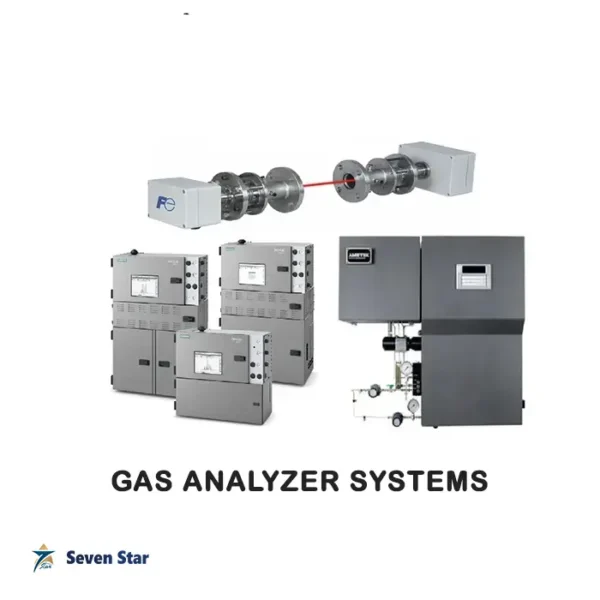
gas analyzer Systems

Gas Analyzer Systems

Frequently Asked Questions

What are the primary operating principles of Tunable Diode Laser Absorption Spectroscopy (TDLAS) analyzers in industrial gas analytics?
TDLAS analyzers function by emitting a precisely tuned, narrow-linewidth laser beam across a gas sample, targeting the specific near-infrared absorption lines of the analyte molecule. This non-contact measurement technique delivers exceptionally fast response times, extreme selectivity with virtually zero cross-interference, and the capability to perform highly accurate in-situ analysis directly within process pipelines.
How do engineers ensure accurate calibration and drift mitigation in continuous emission monitoring systems (CEMS)?
Ensuring absolute accuracy in CEMS requires the automated, daily injection of certified zero and span calibration gas mixtures directly into the sample probe to validate the entire analytical path. Advanced analytical systems also employ sophisticated software algorithms to continuously track baseline drift and automatically apply necessary compensation factors, ensuring strict compliance with environmental regulatory limits.
What design considerations are critical when specifying sample conditioning systems for hot, particulate-laden process gases?
The sample conditioning system must extract the gas using a heated probe and transfer line to strictly prevent the condensation of corrosive acids or heavy hydrocarbons before reaching the sensitive analytical bench. Additionally, robust multi-stage filtration and moisture removal technologies, such as thermoelectric chillers or permeation dryers, are imperative to deliver a clean, dry, and stable sample to the analyzer.
In what applications are Non-Dispersive Infrared (NDIR) gas analyzers typically favored over other analytical technologies?
NDIR technology is predominantly utilized for the continuous, accurate measurement of heteroatomic gases like Carbon Monoxide (CO), Carbon Dioxide (CO2), and Methane (CH4) due to their strong, distinct infrared absorption characteristics. The robust, solid-state nature of modern NDIR benches makes them highly reliable and cost-effective for deployment in combustion optimization and general ambient air monitoring applications.
How do paramagnetic oxygen analyzers overcome the limitations of traditional electrochemical sensors in process environments?
Paramagnetic analyzers leverage oxygen's unique, strong magnetic susceptibility to measure its concentration physically, completely avoiding the gradual chemical depletion and limited lifespan inherent to consumable electrochemical fuel cells. This non-depleting measurement principle ensures exceptional long-term stability, rapid response, and high accuracy in aggressive process streams where standard sensors would rapidly deteriorate.